
No one knows if there will be a peace deal between Ukraine and Russia.
However, one undeniable and remarkable fact stands out: Donald Trump has achieved something significant — he has created an environment where all parties can identify two clear and distinct choices with newfound clarity.
They can compromise and make a deal, or they can face the continuation of a grinding war with an uncertain duration and outcome.
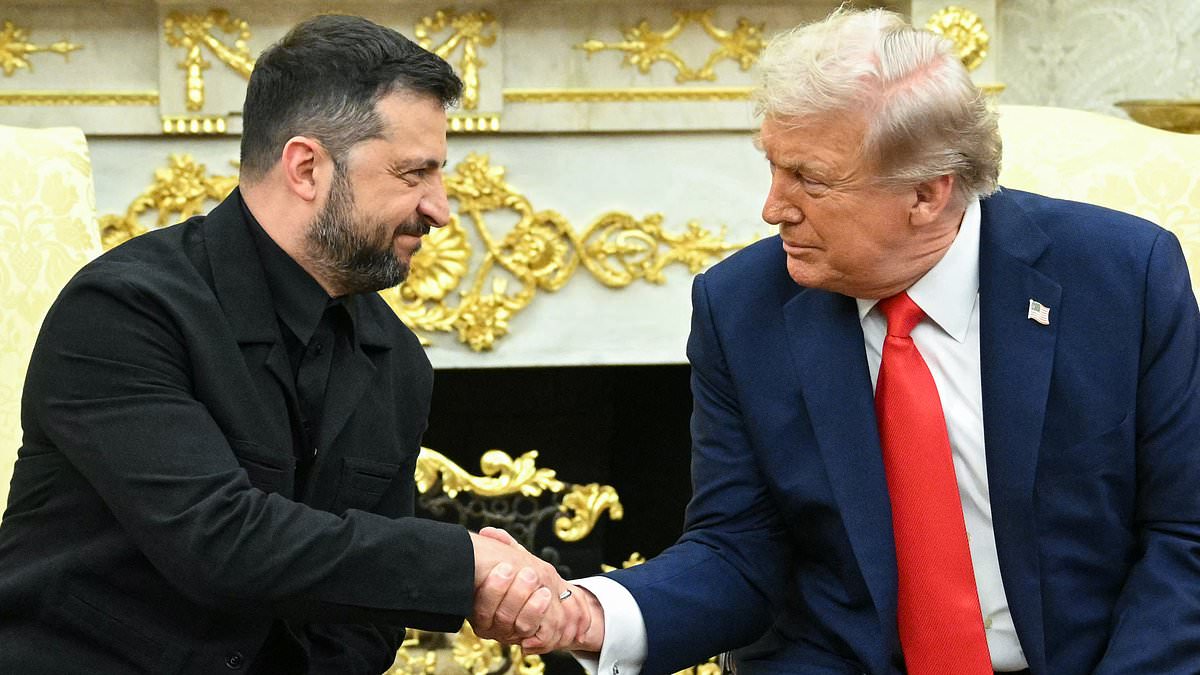
That sense of crossroads was on display at the White House on Monday in a tableau that was at once theatrical and substantive.
Trump has, at least temporarily, succeeded in aligning the United States, Europe, and Ukraine on a unified stance. This consolidated front poses a challenge to Vladimir Putin, who has long attempted to prevent such Western unity in the face of his aggressive actions.
The day unfolded with all the elements of political spectacle. Notably, there was chatter about President Volodymyr Zelensky’s wardrobe choice — a jacket hinting at formality, contrasting with the olive drab sweatshirt that has become synonymous with his wartime appearance.
There was also a personal touch when Zelensky presented Trump with a letter from his wife to Melania Trump, discussing the challenges faced by children in the war-torn region.
These gestures might seem minor, but in diplomacy, small signals often bolster the broader narrative: unity, solidarity, and a commitment to interacting as friends instead of adversaries or reluctant allies.

The conversation about President Volodymyr Zelensky’s choice of attire highlighted a move towards formality, contrasting with the olive drab sweatshirt that has become his wartime uniform.

Trump has managed, at least for now, to coax the United States, Europe, and Ukraine into a common position
For Zelensky, a former actor who once made his living playing roles, Monday was a performance that mattered. He carried his lines with precision and his tone with care.
The last time he visited Washington the chemistry soured and tensions spilled into public view.
This time, the body language told a different story.
Smiles, nods and a sense of easy rapport radiated from the Oval Office outward. Compared with Putin’s frosty reception during his stop in Alaska on Friday — a visit the Kremlin had hoped would project strength — Monday’s White House welcome stood as a vivid counterpoint.
The most consequential takeaway from the day was the absence of daylight between Washington and its European allies.
For years, Putin has relied on fissures within the transatlantic alliance, exploiting differences over energy, trade or the use of force. Yet on Monday, the alignment was clear: the US, Europe and Ukraine are working together to shape a peace plan.
This is precisely the scenario Putin has sought to prevent, and brings the world to the essential questions now hovering over these fragile negotiations.
Will Putin accept a combined European and American framework that offers Ukraine the security guarantees it needs to risk peace?
And will Ukraine, whose soldiers have retaken and held swathes of territory at immense cost, truly be willing to cede land now under its control in exchange for ending the bloodshed?
Neither question yields an obvious answer.
For Putin, compromise has always been a synonym for weakness. For Ukraine, yielding territory risks validating aggression and betraying those who have died defending it.
Yet the very posing of these questions, out loud and on equal terms, marks a shift in the conversation. The possibility of peace, however brutal, is now at least conceivable.
If the answer to either or both questions is ‘no,’ then the burden will shift back to Trump.
What will he do? Will he enforce punishing new sanctions designed to cripple the Russian economy?
Will he authorize Ukraine to use American-supplied weapons to strike deeper into Russian territory? Will he risk escalation to demonstrate resolve?
The options ahead are perilous, but they are his to shape.

Will Putin accept a combined European and American framework that offers Ukraine the security guarantees it needs to risk peace?
What is striking is how Trump — long painted as skeptical of NATO, dismissive of Europe and oddly solicitous of Putin — now finds himself in the role of transatlantic unifier.
By engineering a moment when the allies stand shoulder to shoulder, he has created the conditions for a test: either Putin comes to the table, or he faces the combined weight of American and European pressure.
This is not a neat choice between war and peace. It is instead what might be called a ‘brutal peace.’
Any deal will be painful, incomplete, and fraught with moral compromise. But it will still be peace.
If Trump cannot deliver Putin to the table, then he must bring him to heel by other means. Either way, the calculus has changed.
Diplomacy often depends on timing. Wars grind on until one side collapses or until leaders perceive that further bloodshed is more dangerous than negotiation.
What Trump has done, at least for now, is force that moment of reckoning. He has made all sides look squarely at the costs of continuing the war versus the costs of ending it.
It is too soon to know whether history will mark this week as a turning point.
But it is fair to say that Trump, a man once derided as an opponent of Europe and a skeptic of alliances, has demonstrated a capacity to bring allies together in common cause against a murderous dictator. That alone is remarkable.
It may yet be remembered as the moment when urgency became opportunity.


