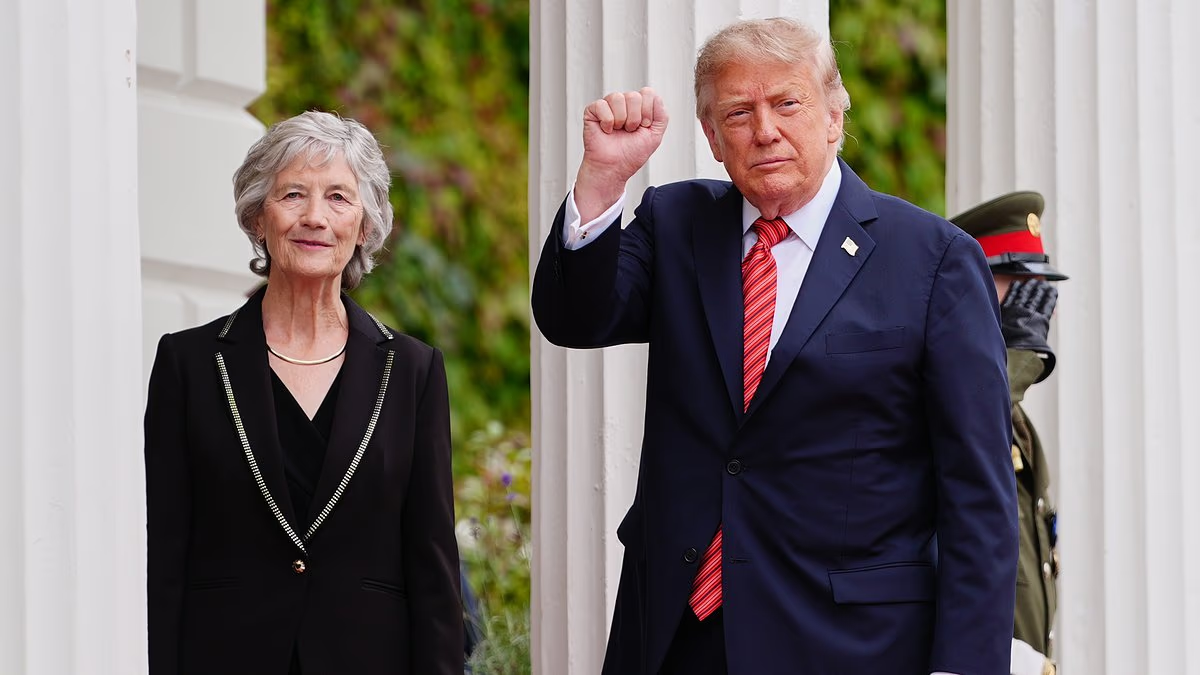

US President Donald Trump brought up the prospect of a United Ireland during his meeting with President Catherine Connolly at Áras an Uachtaráin, asking within minutes of their private discussion how “the merger” was progressing, the Mail understands.
Trump’s decision to raise the subject himself sheds new light on remarks he later made at a joint press conference with Taoiseach Micheál Martin at Farmleigh in Dublin’s Phoenix Park, where he said he would “love” to see Northern Ireland and the Republic reunite.
Senior Government sources familiar with the meeting said President Connolly did not pursue an extensive conversation about Irish reunification. Instead, she concentrated on the conduct of the Israeli Defence Forces in the Gaza Strip.
One source told the MoS that President Trump raised the issue of a United Ireland “personally, proactively and without prompt” from anyone else in the room. He returned to the subject later during a press conference, after being asked directly about his position on Irish unity.

US President Donald Trump raised the prospect of a United Ireland during his meeting with President Catherine Connolly at Áras an Uachtaráin, asking how “the merger” was progressing shortly after their private talks began.
Irish Government and US administration sources said last night that they believe Trump’s comments were intended to inflict “maximum damage” on Britain, which he has repeatedly criticised for providing what he considers inadequate military and diplomatic backing for his actions against Iran.
“We could see at close quarters that this was a carefully prepared diplomatic assault aimed at causing maximum damage to the British Government,” a senior Irish Government source said.
“He dropped an absolute bombshell, and it was clearly not delivered without prior thought and discussion within his administration.”
A source within the US administration confirmed that Trump’s comments had been planned in advance.
“He has made no secret of his disappointment — and, really, his hurt — over the UK’s lukewarm support on Iran and other foreign policy issues,” the US Government source said. “If this creates difficulties for the UK, as the reaction suggests it has, then perhaps that outcome was not accidental.”
The US President’s brief visit to Ireland began at 8.23am yesterday, when Air Force One landed at Dublin Airport amid one of the biggest security operations ever mounted in the country.
Trump, who travelled to Ireland primarily to attend the Irish Open at his golf resort in Doonbeg, Co Clare, began the visit with a rapid series of diplomatic meetings involving President Catherine Connolly and the Taoiseach.
He also gave a speech to lawmakers and business leaders at the US ambassador’s residence in the Phoenix Park before flying to Doonbeg.
But it was his comments on a United Ireland that made global headlines.
Responding to a press question about his personal views on Irish unity in Farmleigh during a meeting with Mr Martin, Mr Trump said he did not ‘want to cause any problems’ but he would ‘love to see it unified’.

Trump ‘has made no secret at his disappointment – hurt really – at the UK’s lukewarm support on Iran and on other foreign affairs matters,’ said a senior US government source
He said: ‘I have friends on both sides, great people. They’re Irish people. How can they be bad, right?
‘I’d love to see it unified. I think it would be a great feather in everybody’s cap if that happened. It’s going to happen eventually.
‘You know what? The way I look at it, it’s going to happen eventually. It may as well happen now.’
Referring to the Taoiseach sitting next to him, Mr Trump added: ‘We’re talking about it and you got the right man over here to get it moving. But, yeah, I think it would be a fantastic thing.
‘Now the UK will have something to say about it, obviously. But I think it would be a great thing. I mean, how can it be bad?’
Earlier, President Trump himself had brought up a United Ireland unprompted when asked how his meeting with the Irish President had gone.
‘We did discuss Northern Ireland. I always find it to be a very interesting discussion. People of Northern Ireland and people of Ireland. They sometimes say “hey,
when are you guys getting together?” I do ask that question every time.’
Mr Martin responded: ‘You do, you’re consistent on that.’
The US president added: ‘I’m sure it’s complicated. But life is complicated.’
The remarks were swiftly responded to by all sides in the North, including the hardline unionist DUP, and by a Downing Street spokesman.
Mr Trump later discussed his comments at length at the start of his speech at Deerfield, the US ambassador’s residence.
He addressed his comments to a room that included Mr Martin, his wife Mary, Irish Ambassador to the US Geraldine Nason-Byrne, financial tycoon Dermot Desmond and fellow billionaire Denis O’Brien.
Referring to the question that had been asked earlier in Farmleigh, the US president said: ‘But they’re going for the kill at all times, and they ask me a question: “What do you think about unification of Northern Ireland and Ireland?’’
‘I said: “Oh, that’s a nice question.” I gave a nice answer, I think. We’ll read about it tomorrow.
‘That’s one of those questions where, no matter what you say, no matter how well you say it, there’s no good answer, right?
‘But I actually said it would be, I think, a very cool thing. To be honest with you, I think it would be cool. As half the room clears out, they say: “Let’s get the hell out of here. I don’t like this guy. I liked him a lot 10 minutes ago. I don’t like him”.’

President Connolly with Trump outside the Áras
Crucially the Government did not interpret these later remarks as an effort to row back.
Indeed, those closest to the stage felt that President Trump was ‘gleefully’ revelling in the knowledge that he had just thrown a ‘hand grenade’ in Irish public affairs.
The MoS was standing just feet from President Trump during the speech, and it was clear that he was enjoying his unrivalled ability to grab headlines.
The subject of a United Ireland has moved up the political agenda this year, with Fine Gael moving to publish a green paper on Irish unity later this year.
And the new UK prime minister Andy Burnham sparked a political row last month when he said a unity referendum was ‘off the table’.
Mr Martin has edged closer to calling for a border poll recently, telling reporters at the party’s think-in this week that it was his view that it was ‘not satisfactory’ that a decision to call a referendum was left as a ‘judgement call’ for the Northern Ireland secretary.
He said that there ‘needs to be a discussion’ about how a referendum would be triggered.
However, Mr Martin himself dodged reporters’ questions on Mr Trump’s remarks as he left Farmleigh to travel to the US ambassador’s residence.
Later, a spokesman for the Taoiseach said President Trump’s comments on a United Ireland ‘should come as a surprise to no one’.
‘Over the years the president has been consistent in his view that he sees unity in Ireland as the optimal outcome.’
The spokesman said that, over the past two years in the White House, the president expressed this to the Taoiseach, and on Capitol Hill this year.
‘The Taoiseach told the President that he leads a party that supports Irish unity.
‘He also outlined the work of the Shared Island initiative and the importance of creating stronger communities and shared experiences on the island.’
‘The Taoiseach highlighted Ireland’s significant experience in conflict resolution as a result of the peace process, and that this experience could be brought to bear in the Middle East or other conflict areas.’
He said President Trump was very aware of how violent the conflict in Northern Ireland was, and of the importance of peace.
‘The Taoiseach paid tribute to successive US governments for their role in the peace process and in helping bring about the Good Friday Agreement.’
Tánaiste Simon Harris said the comments showed ‘how much the conversation about a unified island is advancing at home and abroad’, adding: ‘As you know, I made it clear that Fine Gael would produce a blueprint for a unified island.
‘That work is progressing well and we will produce our output and next steps at our Ard Fheis.’
A spokesman for No. 10 referred to comments by prime minister Burnham in the House of Commons last week where he said he would ‘stick to it [the Good Friday Agreement] 100 per cent’.
On Wednesday Mr Burnham had said that the question of a border poll was for the Northern Ireland secretary, ‘when there is a clear consensus in the country – when public opinion has changed to the point at which the call has to be considered’.
The leader of Sinn Féin, Mary Lou McDonald would only ‘acknowledge’ the comments from Mr Trump.
She said: ‘I acknowledge President Trump’s comments on the reunification of Ireland.
‘The conversation on Irish unity has shifted, and the onus is on the Taoiseach to begin planning.
‘We have secured peace, and as we approach the thirtieth anniversary of the Good Friday Agreement, our national journey is now reunification, which is organised, planned and a peaceful transition.’
The party was involved in some of the protests against the US president’s visit to Ireland over the weekend.
The US president’s comments also prompted a quick response from the DUP, with party leader Gavin Robinson tweeting: ‘President Trump knows better than most that elections matter.
‘Northern Ireland’s constitutional future will be decided by the people of Northern Ireland, not by commentary in London, Dublin or Washington.’
‘Northern Ireland is part of the United Kingdom because that is the settled democratic will of its people,’ he added.
And Gregory Campbell, a DUP MP from Derry, said he didn’t know what was behind the comments by President Trump, speculating they may have been related to Catherine Connolly, who has been a strong critic of Mr Trump and US foreign policy.
He added: ‘I mean, if this wasn’t for real, this would make a Father Ted episode.
Colum Eastwood, the former leader of the SDLP and an MP for the party, tweeted ‘always liked him’ in response to Mr Trump’s comments about Irish unity.


