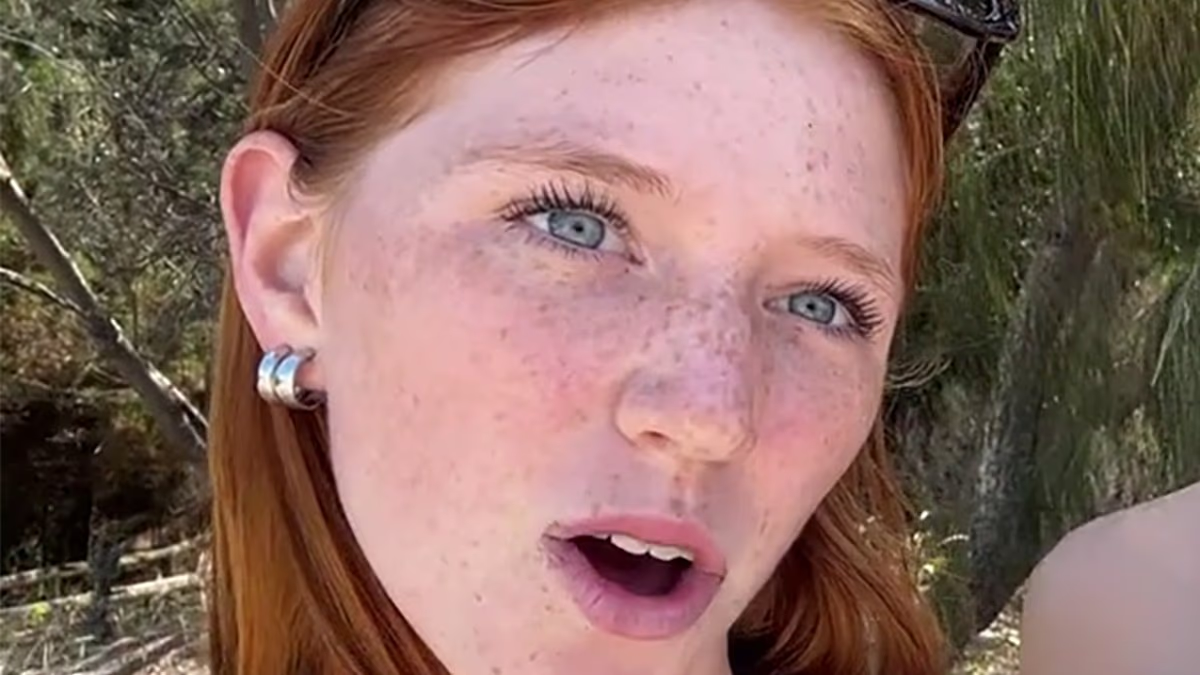

The family of a teenager killed in a shark attack say they have finally found some closure, 18 months after the tragedy. A coroner has determined the attack unfolded so rapidly that Charlize Maree Zmuda was already beyond help when her friend on the beach raised the alarm.
Charlize died in February 2025 while swimming at an unpatrolled stretch of beach at Woorim, on Bribie Island in Queensland’s Moreton Bay.
The 17-year-old Bribie Island student was an experienced swimmer who also volunteered as a lifeguard.
In findings delivered this week, Coroner Carol Lee concluded that Charlize had been attacked by a bull shark measuring between 2.5 and 2.9 metres long.
The coroner found that the teenager suffered catastrophic injuries to her right upper arm. The bite caused an air embolism, which fatally obstructed arteries.
“This is a rapidly fatal event and is the most likely mechanism of death,” Ms Lee wrote.
Although the details of Charlize’s injuries were devastating, her parents, Steve and Renee, said they were comforted by the finding that their daughter had not suffered.
“As a parent, my biggest fear was that she was screaming in pain, but she wasn’t, it killed her instantly,” Mr Zmuda told the Courier Mail.

A coroner has handed down her findings into the death of Charlize Maree Zmuda

Charlize’s parents Steve and Renee are relieved that the teen did not suffer
“It gave me a lot of solace to know there was nothing anybody could do.”
His wife said the report was difficult to read but ultimately reassuring. “It was confronting but also a relief because the details of the report confirmed it was very quick,” she said.
Following their daughter’s death, the Zmudas made an emotional plea for Australians not to become fearful of the ocean. They continue to stand by that message.
“She (Charlize) wouldn’t want this to cause fear because the ocean just gave her so much joy,” Ms Zmuda said.
“I think if losing Char has taught us anything, it’s that we only have today, that’s all that’s promised.”
Charlize’s death occurred so quickly that her friend on shore had no time to intervene before alerting others.
The friend reported seeing a disturbance in the water and a large amount of blood before hearing a scream, Ms Lee said in her account of the February 3 incident.
Charlize was then seen floating on her back, with no further movement.

Charlize died from extensive injuries from a shark bite to her right upper ar, which caused an air embolism that fatally blocked arteries

At the time of the tragedy, Charlize’s father Steve (pictured at her funeral) urged Aussies to not be afriad of the ocean
An inquest will not be held, as the coroner found that there were ‘appropriate’ safety measures at the beach.
A drone trial ended a day before Charlize’s death, and drumlines had been serviced two days before the incident and were fully operational.
The beach did not have the protective nets used elsewhere under the Queensland government’s shark control program.
However, Ms Lee said shark nets were not suitable for the beach due to the high tidal currents, which tend to twist or drag the nets, rendering them ineffective.
The shark control program ended a trial of surveillance drones at Woorim Beach the day before the incident.
However, 18 baited drumlines were floating between 300 and 350 metres offshore.
Drumlines are used to trap feeding sharks for euthanasia or relocation.

The Bridie Island teen was a volunteer lifeguard
‘In accordance with standard servicing protocols and timeframes, the Woorim Beach drumlines were serviced by a contractor two days before the incident,’ Ms Lee said.
‘All drumlines were baited and found to be operational.’
Only four sharks have been caught in the Woorim Beach drumlines, including two bull sharks, between January 2024 and March 2025.
‘Shark nets and drumlines do not provide an impenetrable barrier,’ Ms Lee said.
The shark control program came under an earlier independent review and underwent substantial reform and investment after Charlize’s death.
‘I am satisfied that an appropriate shark risk mitigation framework is in place in an attempt to reduce the occurrence of shark attack risk at our coastline in the future, with the aim of protection of human life whilst maintaining environmental stewardship,’ Ms Lee said.
Ms Zmuda would like to see the SharkSmart drone technology expanded for all weather conditions and used for longer durations.