
Share this @internewscast.com
Amid escalating tensions and unrest in Iran, American citizens residing there have been urged to exit the country immediately. This advisory follows President Donald Trump’s initiation of measures in response to the recent protests, which have tragically resulted in nearly 600 fatalities.
The United States’ virtual diplomatic mission in Iran issued a stark warning to its citizens on Monday. The message advised those who can leave to “depart Iran now,” emphasizing the heightened danger present across the region.
Americans are cautioned to anticipate potential internet blackouts and to prepare alternative communication methods. Furthermore, those who find it feasible are encouraged to consider traveling overland to neighboring Armenia or Turkey for safety.
For individuals unable to leave, the guidance is to secure themselves within their homes or another safe structure, ensuring they have access to essential supplies.
In a decisive move, President Trump announced on Monday that countries engaging in trade with Iran would face a 25% tariff from the United States. This is his initial direct reaction to the ongoing demonstrations.
Among the nations conducting business with Tehran are China, Brazil, Turkey, and Russia, all of which could be impacted by these new tariffs.
‘Effective immediately, any Country doing business with the Islamic Republic of Iran will pay a Tariff of 25% on any and all business being done with the United States of America,’ Trump said in a post on Truth Social.
‘This Order is final and conclusive,’ he said.
President Donald Trump said Monday that Iran’s trade partners will face 25% tariffs from the United States as he looks to pressure Tehran over its violent protest crackdown that’s left nearly 600 dead across the country
The president has repeatedly threatened Tehran with U.S. military action, if his administration found the Islamic Republic was using deadly force against antigovernment protesters
Iran had no direct reaction to Trump’s comments, which came after the foreign minister of Oman — long an interlocutor between Washington and Tehran — traveled to Iran this weekend.
It also remains unclear just what Iran could promise, particularly as Trump has set strict demands over its nuclear program and its ballistic missile arsenal, which Tehran insists is crucial for its national defense.
‘That’s why the demonstrations turned violent and bloody to give an excuse to the American president to intervene,’ Araghchi said, in comments carried by Al Jazeera.
The Qatar-funded network has been allowed to report live from inside Iran, despite the internet being shut off.
Iranian Foreign Minister Abbas Araghchi, speaking to foreign diplomats in Tehran, insisted ‘the situation has come under total control’ in remarks that blamed Israel and the U.S. for the violence, without offering evidence.
However, Araghchi said Iran was ‘open to diplomacy.’ Iranian Foreign Ministry spokesman Esmail Baghaei said that a channel to the US remained open, but talks needed to be ‘based on the acceptance of mutual interests and concerns, not a negotiation that is one-sided, unilateral and based on dictation.’
The president has repeatedly threatened Tehran with U.S. military action, if his administration found the Islamic Republic was using deadly force against antigovernment protesters.
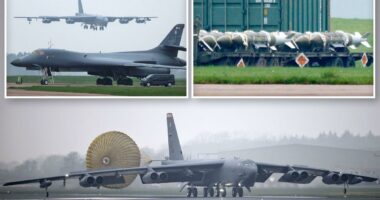
Trump and his national security team have been weighing a range of potential responses against Iran, including cyberattacks and direct strikes by the US or Israel, according to two people familiar with internal White House discussions who weren’t authorized to comment publicly and spoke on condition of anonymity.
China, Brazil, Turkey and Russiaare among economies that do business with Tehran. Pictured: Chinese President Xi Jinping
They were given to him by key Cabinet members, including Vice President JD Vance and Secretary of State Marco Rubio.
‘The military is looking at it, and we’re looking at some very strong options,’ Trump told reporters on Air Force One on Sunday night.
Asked about Iran’s threats of retaliation, he said, ‘If they do that, we will hit them at levels that they’ve never been hit before.’
The choices range from diplomacy to military strikes, with Trump leaning toward choosing the latter, Axios reported.
There are some members of the Trump administration skeptical that the strikes would be productive.
With the internet down in Iran and phone lines cut off, gauging the demonstrations from abroad has grown more difficult.
Those abroad fear the information blackout is emboldening hard-liners within Iran’s security services to launch a violent crackdown.
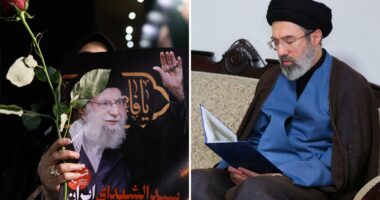
Protesters flooded Tehran’s streets and its second-largest city on Saturday night into Sunday morning challenging the rule of 86-year-old Supreme Leader Ayatollah Ali Khamenei.
Online videos purported to show more demonstrations Sunday night into Monday, with a Tehran official acknowledging them in state media.
Fires are lit as protesters rally in Tehran. Demonstrations have been ongoing since December, triggered by soaring inflation
Iranian state television aired chants from the crowd, which appeared to number in the tens of thousands, who shouted ‘Death to America!’ and ‘Death to Israel!’
Others cried out, ‘Death to the enemies of God!’
Iran’s attorney general has warned that anyone taking part in protests will be considered an ‘enemy of God,’ a death-penalty charge.
More than 10,600 people also have been detained over the two weeks of protests, said the US-based Human Rights Activists News Agency, which has been accurate in previous unrest in recent years and gave the death toll.
It relies on supporters in Iran crosschecking information. It said 510 of the dead were protesters and 89 were security force members.
With the internet down in Iran and phone lines cut off, gauging the demonstrations from abroad has grown more difficult.
At 2pm Monday, Iranian state television showed images of demonstrators thronging Tehran toward Enghelab Square, or ‘Islamic Revolution’ Square in the capital.
It had been airing statements all morning from Iranian government, security and religious leaders to attend the demonstration.
It called the rally an ‘Iranian uprising against American-Zionist terrorism,’ without addressing the underlying anger in the country over the nation’s ailing economy.
State television aired images of such demonstrations around the country, trying to signal it had overcome the protests.