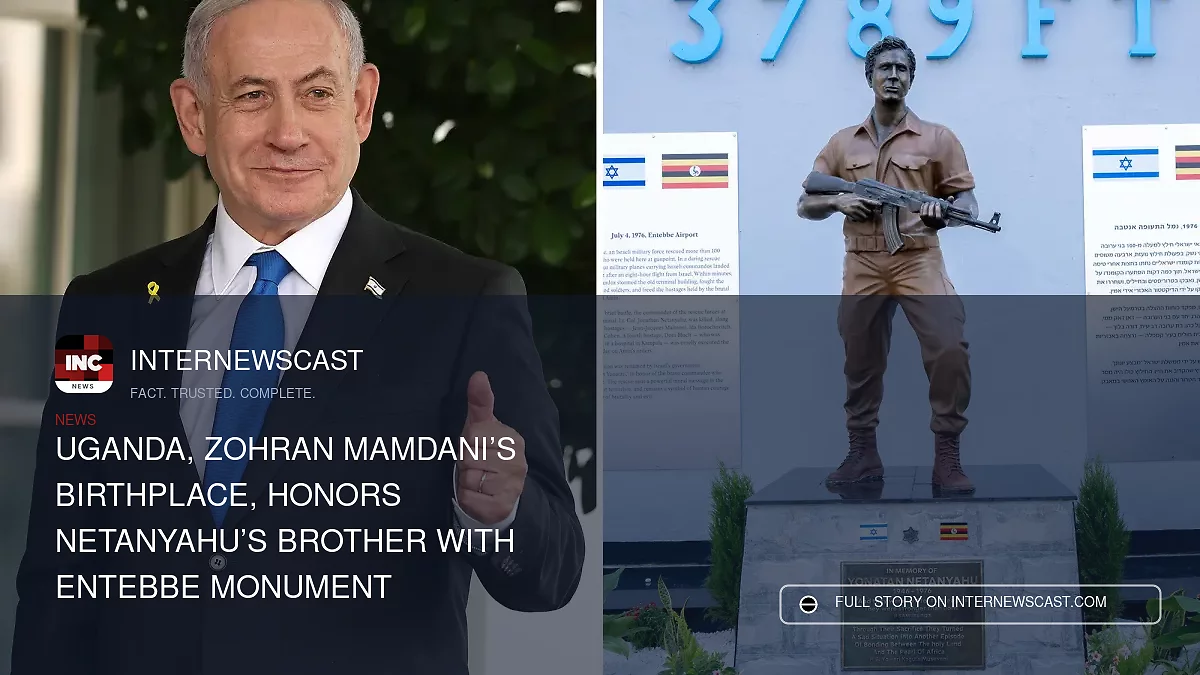

The optics are hard to miss.
A new bronze statue honoring Israeli Prime Minister Benjamin Netanyahu’s late commando brother has been unveiled in Mayor Zohran Mamdani’s native Uganda, highlighting the deepening warmth between the African nation and Israel — even as Netanyahu remains one of the stridently pro-Palestine mayor’s most prominent adversaries.
The monument to Yonatan “Yoni” Netanyahu commemorates 50 years since the famed “Raid on Entebbe,” also known as Operation Thunderbolt, Israel’s dramatic rescue mission after an Air France jet was hijacked on June 27, 1976, and forced to land at Entebbe Airport.
The Paris-bound flight had taken off from Tel Aviv with 246 passengers when hijackers diverted it to Uganda, then ruled by the fiercely anti-Israel dictator Idi Amin. The hijackers demanded $5 million and the release of dozens of Palestinian terrorists.
Israel responded with a daring commando operation later dramatized in a 1977 Hollywood film. Led by Bibi Netanyahu’s older brother, a lieutenant colonel, the mission rescued 102 of the 106 hostages still being held.
Yoni Netanyahu was the operation’s sole Israeli military fatality, shot and killed by a Ugandan sniper on July 4, 1976.
The statue was unveiled Aug. 1 at the Old Entebbe Terminal during a ceremony attended by senior Ugandan military officials. The Kampala Post described the event as a symbol of “the enduring security partnership, mutual trust, and diplomatic reconciliation between Uganda and Israel.”
Mamdani was born in the East African country, holds both US and Ugandan citizenship, and moved to the United States at age 7 after spending part of his childhood in South Africa.
He’s come under fire for his repeated vow to arrest the Israeli PM when he’s in New York, and issued a reckless video vilifying Netanyahu and calling him a “war criminal.”
“The Mamdani family must be plotzing,” joked one “X” user.
“I think we call it poetic justice. I have no doubt this makes the mayor lose sleep, and he hates every moment of it. Too bad,” quipped Dov Hikind, former Brooklyn Democratic assemblyman and founder of Americans Against Antisemitism, who, like many in Israel and the diaspora, named his own son Yoni after the fallen commando.
“It’s very personal for me – he was a hero of the Jewish people and was ultimately dealing with what Israel is dealing with today: terrorism.”
Uganda — if not the Mamdanis — has come a long way since the country’s antipathy towards Jews and Israel under the thumb of Amin.
In his new book, “Slow Poison: Idi Amin, Yoweri Museveni and the Making of the Ugandan State,” released in February, the mayor’s Israel-bashing Columbia professor father, Mahmood Mamdani, painted the cruel, unhinged dictator Amin as a product of Israeli machinations.
“Despite accusing Israel of Idi Amin’s rise to power, Mamdani ignores how Amin allowed, and even supported, the hijacking and attack on Jewish and Israeli passengers on Air France Flight 139,” wrote reviewer Jonathan Beloff.
But the African country — where the mayor owns four acres in Jinja — has transformed since Zo was a kid, beginning with restored diplomatic relations in 1994 and strengthening the ties in the subsequent decades – into a steadfast ally of the Jewish state.
General Muhoozi Kainerugaba, Chief of Defence Forces in Uganda, kvelled on Twitter about the two countries’ deep bond.
“In order to strengthen our close blood relations with Israel, we shall soon unveil a statue to Yoni Netanyahu at the exact spot he was killed at Entebbe Airport,” wrote the general. “Yoni was the big brother of Prime Minister Benjamin Netanyahu. God bless Uganda and Israel.”
The mayor was roasted last week when a resurfaced interview clip revealed an embarrassing “fake” Ugandan accent, with the mayor accused of being a “fraud.”
Hikind noted that history proves how today’s leaders can become a mere footnote.
“Look at how things changed: Amin, who supported the terrorists and enemies of Israel, and Mamdani, are very similar,” he said. “No young person today knows who Amin is. The same will happen to Mamdani.”