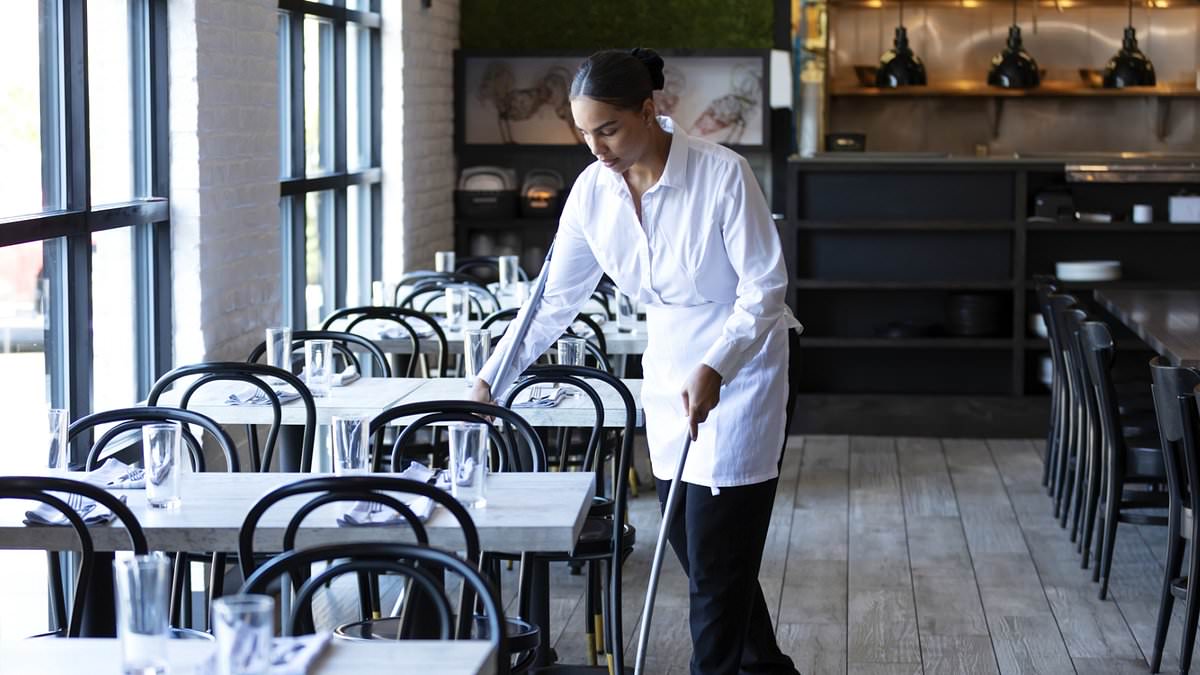

“I can’t understand why everyone is so worked up over restaurants,” says a friend of mine who seems indifferent to life’s finer details.
“Why does it matter if they all shut down? We can just eat at home,” he insists.
As he sips from a bottle of Huel, a meal replacement drink, he muses, “Humans managed for millennia without restaurants. They’re a luxury, not a necessity.”
I resist the urge to argue, feeling a surge of frustration because he couldn’t be more mistaken.
The British restaurant industry is grappling with an unprecedented crisis, and it is indeed a significant issue.
Recently, John Vincent, the owner and co-founder of the popular Leon chain of “healthy fast food,” remarked that Labour is “completely destroying the restaurant industry.” The statistics support his claim.
According to the quarterly Hospitality Market Monitor, which measures the scale and success of the industry, Britain suffered 2,759 restaurant closures in 2025 – with two per day shutting for good in the final quarter. That grim toll is forecast to rise to three per day this year.
Orme in Manchester, Gwwn in Powys, The Gannet in Glasgow, Crocadon in Devon, The Petersham and Silo in London… all were much-loved, well-reviewed and, at times, busy. But like so many other hospitality businesses across the land, they were unable to keep trading thanks to Labour’s utter lack of interest in supporting this crucial industry.

Tom Parker Bowles enjoys his first post lockdown meal at Scott’s in Mayfair
‘This Government is responsible for blowing up the entire hospitality sector by taxing it to death,’ says Bobby Bawa, managing director of Food Speed, an award-winning supplier to more than 500 London restaurants and hotels.
‘Decisions are being made by people who’ve never been in business or hospitality. Labour fundamentally needs to change course to support hospitality, otherwise the traditional restaurant model cannot survive.’
Of course, it’s not just about the economics, parlous as they are. Where T S Eliot’s J Alfred Prufrock measured out his life in coffee spoons, mine has been defined by restaurants.
They are my life, my love, my passion, my work and obsession.
Birthdays, break-ups, celebrations, commiserations, births, marriages and deaths – nothing beats the joy of walking into one’s favourite place, being greeted by name, studying the menu with a glass of something cold and white, before settling down for a few hours to break bread with dear friends, the worries of the outside world temporarily forgotten.
The magic of a good restaurant is about so much more than food. It adds immeasurably to the happiness of life. But now things have never looked so bleak.
‘The sector has had a torrid five years, with a series of geopolitical crises and macro-economic shocks shattering balance sheets, eroding resilience and slashing margins to the bone,’ says Kate Nicholls, chair of UKHospitality.
‘A simultaneous cost-of-living and cost-of-doing-business crisis has business owners in a vice-like grip. Costs are going in one direction but customers are increasingly price sensitive.’

Keir Starmer and his Chancellor Rachel Reeves hiked National Insurance by £25 billion last year

Ravneet Gill is the chef behind Gina in Chingford, east London, which opened last year
She adds: ‘Labour’s last two budgets have imposed ever-increasing taxes on jobs and property, sending the total tax paid by hospitality businesses to over 75 per cent of profits, making it the highest- taxed sector of the economy.’
Keir Starmer and his Chancellor Rachel Reeves hiked National Insurance by £25 billion last year alone, jacking up the amount paid by firms and slashing the salary threshold at which businesses start to pay it.
This has made it far more expensive to employ low-paid staff, especially young people starting out their careers.
Add in Labour’s aggressive uplifts to the minimum wage, which in Britain is now, on some measures, the most generous in the world, and you not only see thousands of restaurants unable to make the numbers work, you’re stuck with a youth unemployment crisis.
This has now hit 16.1 per cent – the highest in 11 years (compared with a rate of just 5.2 per cent in the wider workforce). And don’t forget: the hospitality industry is Britain’s third-largest employer.
Ravneet Gill is the chef and restaurateur behind Gina in Chingford, east London. It opened last year, and is typically packed – but appearances can be deceptive.
‘There’s constant pressure coming from every direction,’ says Ravneet. ‘You’re trying to do a good job, look after your team, keep standards high, but the costs keep rising underneath you.
‘So even when things look busy and positive from the outside, it can be quite fragile behind the scenes.’
As she points out: ‘Restaurants aren’t just places to eat, they’re employers, training grounds, community spaces and lifelines for farmers and suppliers.’
The benefits accrue to society as a whole.

Restaurants are as an essential part of a civilised society as churches, libraries, theatres and pubs, writes Tom Parker Bowles
It makes matters far worse that Britain is one of the few countries in Europe where hospitality businesses face the standard VAT rate – 20 per cent here. (The continental average is just 12.8 per cent and ours is the second-highest in Europe.) In France, Italy and Spain, it’s 10 per cent and, in Germany, it’s only 7 per cent.
Asked what the Government could do to help in the short term, every single restaurateur I spoke to agreed – cut that damned VAT, as the Tories did during the Eat Out To Help Out scheme during the Covid pandemic.
‘That would have an immediate effect,’ says Kate Nicholls. ‘It would keep prices lower as costs increase, give headroom for restaurants to invest and offer some breathing space to navigate uncertainty.
‘It worked when Gordon Brown did it in the financial crisis and when Rishi Sunak did it during the pandemic, saving jobs and livelihoods, boosting demand and growth – and helping consumers with the cost of living.’
Ravneet Gill goes further still. ‘A VAT reduction isn’t a handout: it’s a recovery measure. Hospitality is losing around seven businesses per day. That’s systemic decline. And every closure doesn’t just lose VAT, it wipes out jobs, PAYE, National Insurance, business rates, supplier income. The whole tax ecosystem goes with it.
‘So the question isn’t, ‘Can we afford to cut VAT?’ It’s: ‘Can we afford not to?’
James Chiavarini is the owner of Il Portico in Kensington, west London. The business opened in 1967 and claims to be the oldest family-owned restaurant in the capital. ‘We’ve seen out the miners’ strikes, the three-day week, Black Wednesday, 18 per cent interest rates, the collapse of modern banking, the credit crunch, Brexit, energy shocks, war in Europe, Covid. But this…’ James shakes his head.
‘We enter each fight a little more haggard and frayed until we just can’t fight any more.’
So it doesn’t matter if it’s your local caff or The Ritz, going out to eat is one of the true pleasures of life. The end of restaurants would mean the decimation of one of our great industries, and the livelihoods of hundreds of thousands of chefs, servers, accountants, decorators, carpenters, electricians, plumbers, drivers, farmers, fishermen, bakers and artisans dented or destroyed.
I think back to lockdown and how I craved the blissful bonhomie of a busy restaurant or pub, the harmonious clatter of knife and fork. ‘Support them,’ says Gill, ‘talk about them, go back to places you love. If we lose restaurants, we lose part of our culture.’
Too right. Because they’re as an essential part of a civilised society as churches, libraries, theatres and pubs. They provide employment, trade, training, support, comfort and delight.
Labour may care nothing for their fate, but we can still make a difference. Go out, before it’s too late. Your favourite restaurant awaits.