
For devoted fans, Eurovision is a jubilant celebration of music and an opportunity to party. For others, its flamboyant kitsch is almost impossible to endure.
Now, a Scottish university is launching a postgraduate course devoted to the Eurovision Song Contest, examining how the competition has evolved over its 70-year history.
The University of Aberdeen says the ten-week module, titled Eurovision: More Than a Song Contest, was developed from research into cultural identity and representation.
Applications are open for the online course, which begins in January. Students will pay £465 to attend the programme at the financially challenged university, which is facing a £4.9 million deficit.
Chris McGovern, of the Campaign for Real Education, criticised the initiative, saying: “This online, cheap-to-run Mickey Mouse media mishmash of a course is unlikely to save Aberdeen University from going broke.
“For participants, it will more likely serve as a disqualification for employment than provide the promised career development opportunity.”

Dr Barbara Barreiro Leon, a globally recognised Eurovision expert, will teach the course
The course will be led by Dr Barbara Leon, a specialist in cultural identity and representation. She believes Eurovision offers a distinctive window into changing social and political trends across Europe.
Students will examine subjects such as nationalism, minority representation, gender and the ways major geopolitical events are reflected on the Eurovision stage.
The syllabus includes “gender and sexuality in Eurovision: LGBTQ+ visibility, inclusivity, and identity politics”, along with “decolonising Eurovision and diasporic perspectives: postcolonial critiques and the legacy of Empire”.
Dr Leon said the course’s main aim was “to analyse the different modes of representing memory in visual media, using the Eurovision Song Contest as a case study”.
She said it would also explore how European history and geopolitics shape and influence the contest.
Finally, the module will assess a range of interdisciplinary methods for analysing national, historical and memory-based representations within Eurovision.
Case studies will examine the impact of Russia’s invasion of Ukraine and the historical deportation of Crimean Tatars. The programme will also consider cultural heritage, representation and decolonisation from an interdisciplinary perspective.
RELATED: Is Ken Griffin Jewish Or Christian? Religion And Family
The university said the standalone online course is open to people who are not enrolled at the institution.
Dr Leon said academic research into Eurovision had been taking place for more than 30 years, but had attracted considerable momentum in recent times.
“The contest offers a unique case study for examining shifting socio-political dynamics both within Europe and globally,” she said.

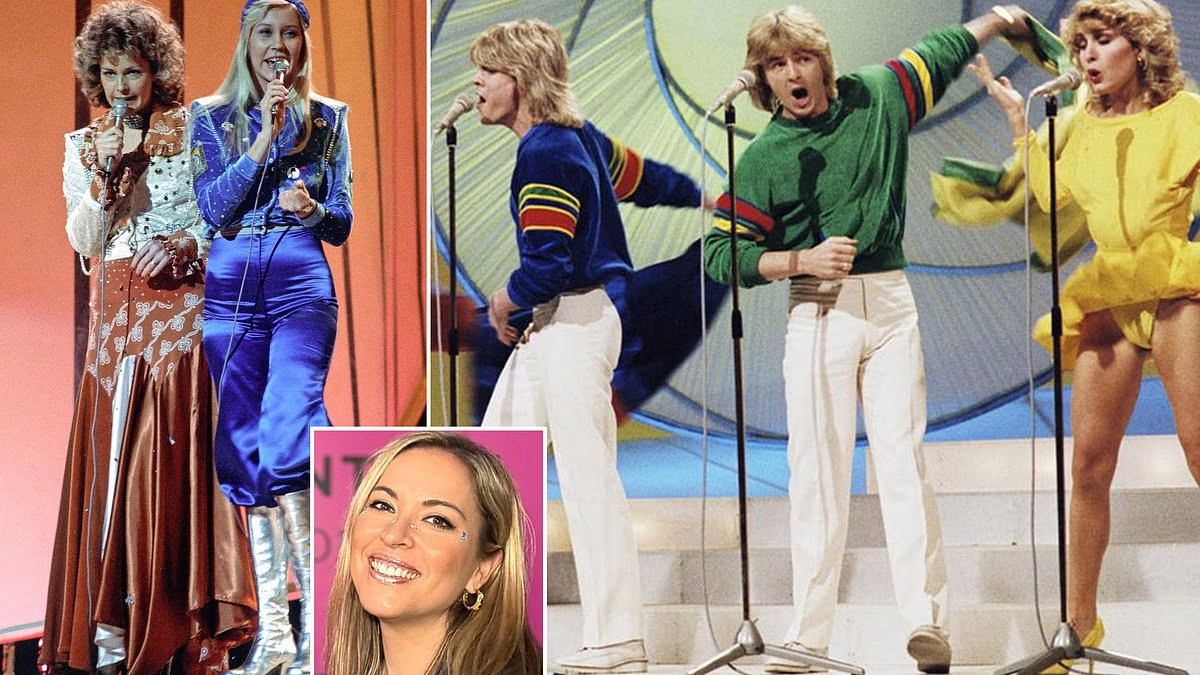
Great Britain’s Bucks Fizz won Eurovision in 1981
According to Dr Leon, the biggest misconception is that Eurovision is merely a kitschy and superficial television show, when in reality it has far greater depth.
She added that, as the world’s most-watched non-sporting event, Eurovision reflects changing history, identity and politics while influencing the real-life experiences of its audience.
Prospective students are told the course will help to ‘build career-enhancing skills in media and content analysis, cultural analysis and commentary, critical thinking, public engagement, communication, and social media outreach’.
The Eurovision is an annual international song competition which was first established in 1956.
It is the world’s longest-running annual international televised music contest and sees participating nations from all over Europe – and a few from outside Europe – send an act to perform.
The winner is then decided by a combination of public and jury votes.
The inaugural Eurovision took place in Switzerland on May 24, 1956, with only seven countries taking part – Belgium, France, Germany, Italy, Luxembourg, the Netherlands and Switzerland.
The UK entrant in Vienna this year was an act called LOOK MUM NO COMPUTER, stage name of Sam Battle, an experimental musician and popular content creator who performed a ‘completely wacky’ song titled ‘Eins, Zwei, Drei’ – ‘one, two, three’ in German.
He finished in last place after scoring only one point. The winner was Bulgaria with the song Bangaranga, performed by Dara.