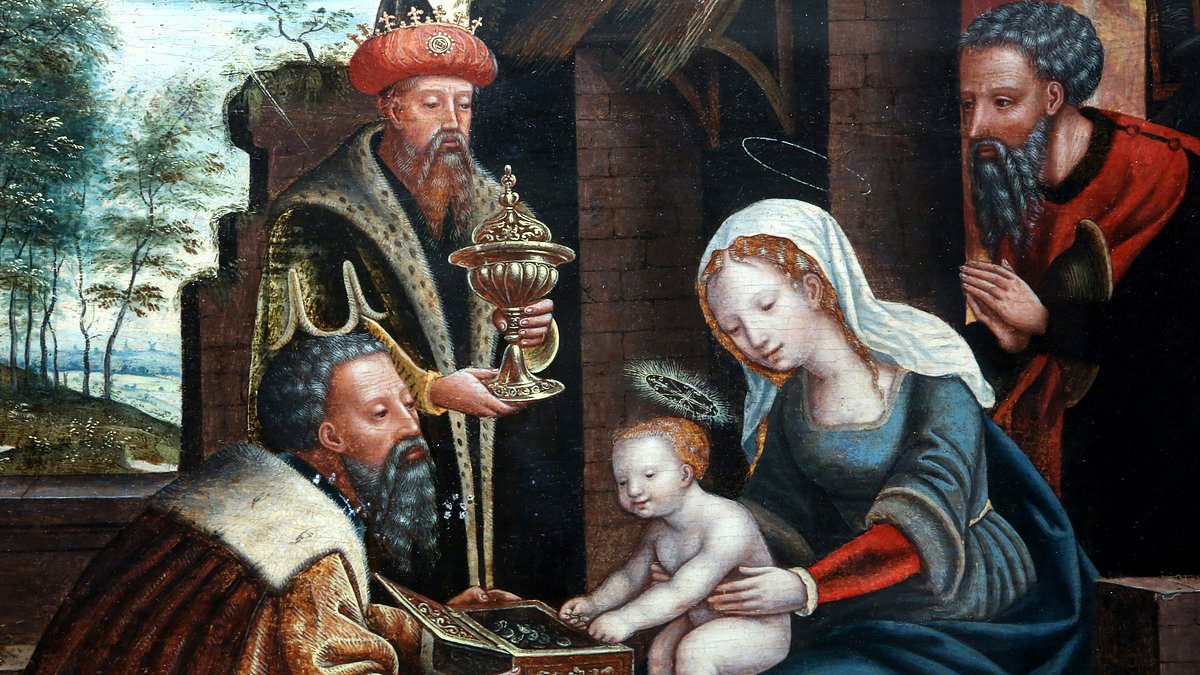

It seems that the long-held belief about the Three Wise Men might be up for debate, as a biblical scholar has proposed a new perspective on their true identities. Contrary to the popular notion of them being three kings from the East, this researcher suggests a different story.
The Associates for Biblical Research conducted a study that led them to believe these figures, traditionally said to have followed a star to witness the birth of Jesus, were likely priests or astrologers hailing from an ancient Middle Eastern kingdom.
Interestingly, the Bible neither names these men nor specifies that there were exactly three of them. The popular narratives of the Three Kings bearing gifts of gold, frankincense, and myrrh were embellishments added over time through Christian lore and traditions.
In a recent video shared on YouTube, researcher Bryan Windle elaborated that the term “magi” might actually have referred to magicians. This term is found solely in the Gospel of Matthew, one of the four canonical accounts detailing Jesus’ life in the Christian scriptures.
“In modern translations, they’re often called Wise Men, but ‘magi’ is perhaps the older term we are familiar with,” Windle remarked.
Windle also pointed out that Matthew’s gospel leaves these figures nameless. Their supposed names, Melkon, King of Persia; Kaspar, King of India; and Balthasar, King of Arabia, were only mentioned in a fifth-century Armenian manuscript.
After reexamining the Bible and comparing it to historical records of the time, Windle believed the Three Wise Men were likely advisors who served in one of the ancient kingdoms that sat in the modern-day Middle East.
Biblical scholars have suggested that they could have either been from the court of the Nabatean kingdom, an ancient Arab kingdom covering modern-day Jordan, Syria, and nearby areas southeast of Jesus’ birthplace, or to the east in the Parthian Empire in modern-day Iran.

The Adoration of the magi by Georg Pencz, painted in the 16th century: Many of the details we associate with the Three Wise Men come from post-Gospel texts

A carving from Persepolis shows King Darius on the throne with Xerxes standing behind him and a magi behind Xerxes
Windle said that there are clues in the Gospel of Matthew, which may include parts of the story that came directly from Mary, the mother of Jesus.
In the Gospel of Matthew, it states: ‘After Jesus was born in Bethlehem of Judea in the days of King Herod, behold, wise men from the East came to Jerusalem, asking, ‘Where is the child who has been born king of the Jews? For we observed his star at its rising, and have come to pay him homage.’
‘When they saw that the star had stopped, they were overwhelmed with joy. On entering the house, they saw the child with Mary, his mother, and they knelt and paid him homage. Then, opening their treasure chests, they offered him gifts of gold, frankincense, and myrrh.’
Wilder noted that the biblical text did not specify that there were three magi, just that they came from the east and left three gifts to honor Jesus’ birth. Some have suggested they were Babylonians, Persian priests, or even Chinese mystics.
However, Wilder explained that the Babylonian astrologer or Persian priest theory would be ‘out of sync’ with what we know of history at the time, as both empires had already ended by the time of Jesus’s birth.
Historical texts have also suggested that the word ‘Magi’ may have been also used as an ethnic term, not just a word for ancient priests and magicians.
Herodotus, an ancient Greek historian from the fifth century BCE, wrote: ‘Deioces, then, united the Median nation by itself and ruled it. The Median tribes are these: the Busae, the Paretaceni, the Struchates, the Arizanti, the Budii, and the Magi. Their tribes are this many.’
In the episode entitled Who Were The Magi? Digging for Truth, Wilder said the meaning may have shifted so that it referred to an order of Persian priests, who started from the tribe of the magi and then became priests.
Join the debate
How does rethinking who the Wise Men were change the meaning of the Nativity story for you?

The Adoration of the Kings is a large oil-on-oak painting by Jan Gossaert in 1510 AD which featured the magi
Xenophon, another ancient Greek historian and soldier from the fourth century BCE, wrote that the founder of the vast Persian Empire, Cyrus the Great, would call upon the magi to perform sacrifices before battle.
By the time of the New Testament, the word had become generally used for magicians of any kind, and various New Testament texts refer to magi, with early Christian missionaries Paul and Barnabas encountering magi in the New Testament book of Acts.
‘Scholars believe the magi came from the area of ancient Babylon or Persia that was now under Parthian control when Christ was born. This would satisfy the criteria of the magi coming from the east,’ Windle said.
Adding to the possibility that the Three Wise Men came from the kingdom of Nabatea, Windle noted that King Herod’s mother was Nabatean, and Nabateans traveled considerable distances, so they would have had a grasp of astrology.
They were also renowned traders who traded frankincense and myrrh, making the case that they were priests or astrologers who served as ‘wise men’ in territories once held by the Babylonians and Persians.
However, this assumes magi still held honored roles in the Parthian courts that their caste had earlier filled for the Persian kings.
‘I also believe the idea of Nabataean magi has merit and needs to be studied in further detail,’ Windle concluded.