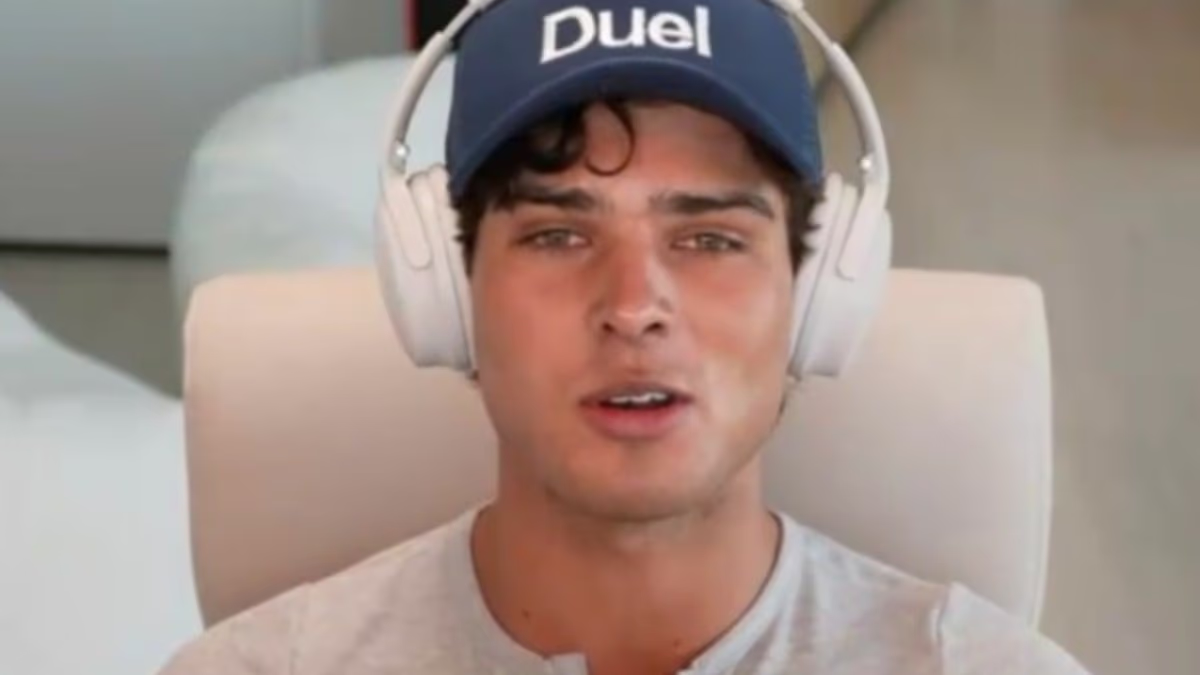

“Ah, s***. Brutal,” influencer Clavicular muttered after the exchange. “At least we’re going viral on Twitter.”
Only moments earlier, I had turned down the 20-year-old influencer’s invitation to go on a date. The question came at the end of a politics-focused interview conducted in an unconventional setting: a live Kick stream watched by thousands.
“Can I ask how old you are? Would you want to go out sometime?” he asked, delivering the line with the confidence of someone attempting a routine cold approach on the street.
“It was lovely to meet you,” I replied, visibly caught off guard.
The moment quickly ignited a reaction online.
“Clavicular got rejected,” one user posted. Another wrote that he had “convinced himself she was interested,” while the sound of cannon fire played in the background.
“This is proof that what he does doesn’t work,” another X user commented.
Clavicular, whose real name is Braden Peters, rose to prominence through provocative content centered on “looksmaxxing” — the online pursuit of improving one’s appearance and perceived attractiveness.
He is also facing serious criminal allegations. Last month, Peters was charged in Cape Cod, Massachusetts, in connection with allegations of rape, drugging someone for sex and providing alcohol to a minor. He has pleaded not guilty.
My reason for speaking with him was political. In particular, I wanted his reaction to Vice President JD Vance’s 600-word explanation for the Republican Party’s heavy losses in the midterm elections.
Vance had attributed the defeat in part to the Iran War.

Our News Outlet spoke exclusively with Clavicular after the Republican Party’s midterm defeat

Clavicular, 20, whose real name is Braden Peters, was charged last month in Cape Cod over allegations including rape, drugging someone for sex and giving alcohol to a minor. He later pleaded not guilty
Peters responded to Vance’s statement with a personal attack, writing: “I bet this took a while to type, since you have sausage fingers, Fatty. Didn’t read a word. Didn’t read a word.”
The remark drew more than 4 million views on X, giving the influencer’s political commentary an enormous audience and potentially exposing a generation of young voters to his message.
That reach was precisely why I wanted to interview him.
During our conversation, we returned to the thinking behind his attack on Vance and his wider views on American politics.
Clavicular does not vote, but said that, for the right price, he could help either major party win the next election “easily.”
His reasoning is rooted in a simple belief: appearance is central to success.
“You shouldn’t vote. You shouldn’t spend all day doomscrolling on X or going to protests,” he said.
Instead, he argued that political candidates should spend more time improving themselves and their appearance — an idea that sits at the heart of his online brand.
“I’m looking at these political PACs, the RNC and DNC, and I’m thinking, what are you actually doing?” he said.
“Come to Camp Looksmax,” Peters added, promoting his own business.
“That would probably be the best consulting fee you could ever spend. Ask me which candidates to put forward and I would probably win elections.”
He claimed that his online influence, combined with his understanding of “lookism” and the halo effect, could allow him to alter the result of almost any election.
Peters recently launched Camp Looksmax from his $53,000-a-month rental property in Los Angeles. The week-long program is marketed to young men seeking to improve their appearance, attractiveness and confidence, although it has faced widespread criticism.

“Looksmaxxing” influencer Clavicular arrived at court in Cape Cod with a barking dog on a leash ahead of a hearing connected to a rape charge

The Republican Party lost significant support among young male voters in the latest midterm elections, despite that group’s strong backing of Donald Trump’s 2024 re-election campaign
Beyond the question of physical appearance, Peters said Republicans had taken young men for granted and needed to rethink their strategy if they hoped to win those voters back.
The GOP suffered a notable decline in support among young male voters in the latest midterms, even though those voters had overwhelmingly backed President Donald Trump’s re-election in 2024.
“Republicans have let their voter base down in a major way,” Peters said.
“The looks would simply be the cherry on top.”
He argued that Trump’s political movement had repeatedly promised action on issues including immigration, while both of Trump’s terms in office had become dominated by events in the Middle East.
“It’s years of broken promises,” he said. “You had your opportunity, and now we’re going to vote Democrat.”
Although Peters has appeared alongside controversial online personalities such as Andrew and Tristan Tate, far-right influencer Nick Fuentes and streamer Sneako, he insisted that those collaborations did not mean he endorsed their political beliefs.
When asked about his livestream appearances with the group, he said working with someone did not automatically amount to support for that person’s ideology.
“Does collaborating with Andrew Tate mean I automatically agree with every one of his political views? That isn’t a logical position,” he said.
“I’m a content creator. I’ve worked with people, and I have my own opinions. That’s it.”
He said he was not surprised that Fuentes had encouraged his followers to vote Democrat, pointing to remarks Vance had made about Fuentes and his supporters.
Peters also criticized Republicans for failing to pay attention to Gen Z men, arguing that the party had assumed voters between 18 and 30 were already firmly on its side.
“They act as though Gen Z is automatically Republican,” he said. “There’s almost no attention paid to us.”
He warned that young men who felt ignored could eventually turn to other political movements, adding: “The Republicans don’t care about me.”
Despite his criticism of the party, Peters offered an unusual proposal for Republicans preparing to choose their next presidential ticket ahead of 2028.
Political organizations, he argued, should take their candidates’ appearance more seriously because attractiveness, presence and charisma can all affect how voters respond to a politician.
He assessed several Republicans being discussed as possible 2028 contenders, including Vance, Florida Governor Ron DeSantis, Texas Senator Ted Cruz and Secretary of State Marco Rubio.

Clavicular delivered a harsh assessment of Vice President JD Vance’s appearance and political appeal
Vance was a particular focus of his anger. The day after Republicans suffered a wave of midterm defeats, Peters described the vice president as “subhuman” and called the Republican Party “a joke” in a post on X.
Vance had published a lengthy explanation on the platform, arguing that the party’s central problem was that voters who supported the Trump-Vance ticket in 2024 had since switched allegiances.
Peters reposted the statement, which has since attracted nearly 4 million views, and I read it aloud to him.
“I bet this took a while to type, since you have sausage fingers, Fatty. Didn’t read a word. Didn’t read a word.”
“Did you read any of what he wrote?” I asked.
“I didn’t read a molecule,” he replied, dismissing Vance’s explanation for the Republican losses as a complete cop-out.
Peters referred to the so-called halo effect to explain his criticism, arguing that a politician’s physical attractiveness can influence the way voters judge their character and competence.
“JD Vance is incredibly difficult to look at, in my opinion, so there’s no way people will connect with him. Think about it — that’s the halo effect.”
He scored Vance just four out of 10, calling him “not good” looking and “certainly below average.”
Peters also accused Vance of concentrating too heavily on international affairs instead of the domestic concerns that helped fuel Trump’s political rise.
DeSantis and Cruz each received 4.5 out of 10. Peters described the Florida governor as “a little bit better looking than JD, but not by much.”
Rubio fared better, receiving a 5.75 rating, although Peters claimed the secretary of state’s appearance had declined since his 2016 presidential campaign.
“He’s losing his hair,” Peters said, arguing that Rubio’s appearance had “descended” in recent years.
He then rated several Democrats whose names have been mentioned as potential 2028 presidential candidates, including California Governor Gavin Newsom, former Vice President Kamala Harris and New York Congresswoman Alexandria Ocasio-Cortez.
Newsom was awarded 6.5 out of 10, while Harris received a score between 4.25 and 4.5. Ocasio-Cortez was rated between six and 6.5.
Even so, Peters said looks should not be the only factor parties consider when selecting a nominee. Charisma and the ability to hold an audience’s attention, he argued, matter just as much.
He praised Newsom’s public speaking skills and said the California governor was effective at commanding an audience.

Clavicular gave Marco Rubio a 5.75 out of 10 for appearance but said the secretary of state was losing his hair
Height, he added, could also shape the way voters view political figures. He cited the contrast between Trump and Rubio during their political clashes.
“Height mogs are brutal,” he said, using online slang to describe one person’s physical presence overshadowing another’s.
Peters also offered his views on three Senate winners often praised for their appearance: Georgia Senator Jon Ossoff, Michigan’s Abdul El-Sayed and James Talarico.
Ossoff emerged as his favorite of the three.
He was more critical of Talarico, saying his face was “too short,” and El-Sayed, whose face he described as “too long.”
Peters also said he did not believe the United States was ready to elect a female president.
He argued that older Democratic voters were still reluctant to support a woman for the White House — and suggested the Democratic National Committee understood that reality.
“I think a lot of older Democratic voters simply aren’t willing to vote for a woman yet,” he said.
He predicted that it could take “definitely two election cycles” before that changed.
At the same time, he acknowledged that it would be unreasonable to claim no woman was qualified to lead the country. “Out of 4 billion people, saying that none of them is qualified would be silly,” he said. “I just haven’t seen one yet.”
Sign up to our DC Insider newsletter – your guide to the latest political news and Washington’s biggest stories


