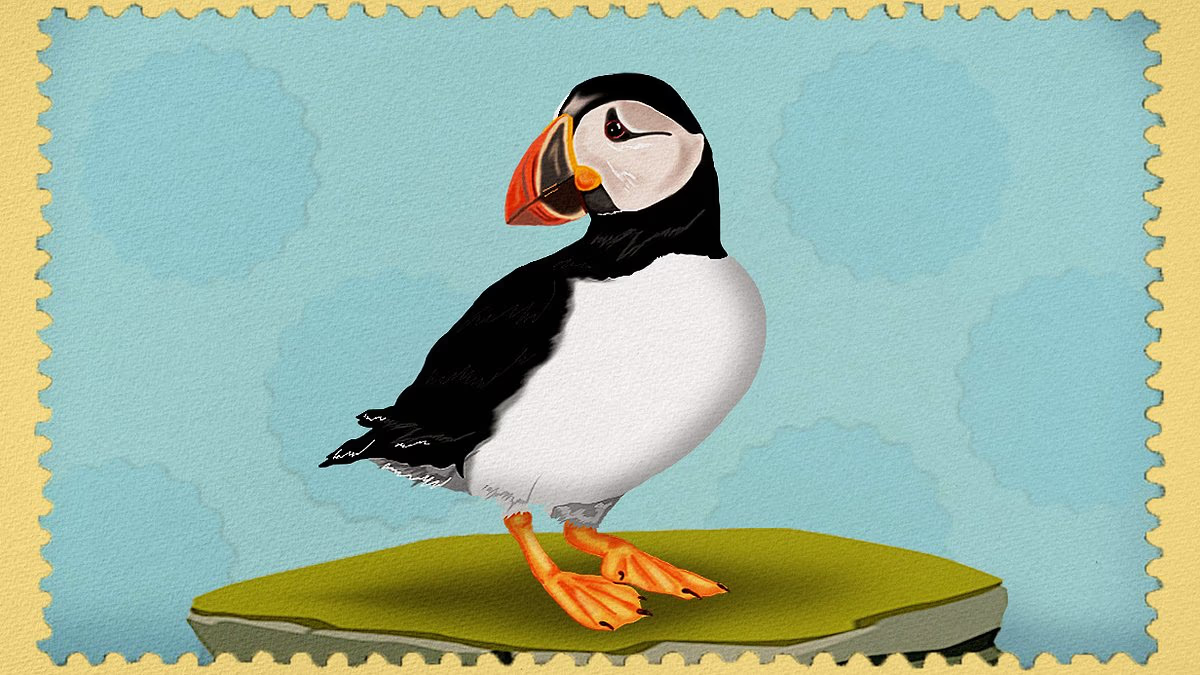

The first glimpse of a puffin is enough to prompt an instant burst of delight.
A small, plump shape suddenly streaks across the sky, moving far faster than expected. Its oversized, multicoloured bill and mischievous, curved eye seem to demand one wonderfully satisfying cry: ‘Puffin!’
Preacher, sea parrot, lundy, bottle nose, little friar and clown of the sea: the number of affectionate nicknames we give an animal is a reliable measure of how deeply we admire it.
Few birds, or indeed land animals, inspire quite as much affection as Fratercula arctica — the Atlantic puffin.
Yet this most charismatic and distinctive of seabirds is facing a growing threat. Britain has around 580,000 breeding pairs of Atlantic puffins, representing roughly 9 per cent of Europe’s population. This week, however, the British Trust for Ornithology warned that climate change and declining food supplies could eliminate as many as 90 per cent of Britain’s puffins by 2050.
The prediction is alarming, although it is not necessarily the final chapter in the puffin’s story. Local colonies have suffered serious declines before — and, in some cases, managed to recover.

Puffins are intensely loyal and mate for life, with the longest known pairing lasting well over 30 years
In Pembrokeshire, several puffin colonies collapsed between the 1890s and 1920s before expanding dramatically during the 20th century, helped in part by conservation work.
On Lundy, off the north Devon coast, numbers rebounded after predators including rats were eradicated. Scottish islands experienced declines during the 2000s followed by growth in the 2010s, reflecting changes in the population of sand eels — the puffins’ principal food source.
Puffins clearly need protection. But if any species was created to inspire public support — and endowed with the resilience to endure — it is surely this extraordinary ‘circus’, the collective term for puffins on land. They may also be described as a ‘colony’ or a ‘burrow’.
At sea, a group is known as a ‘raft’; in flight, it becomes a ‘whirl’ or a ‘wheel’. I have been captivated by puffins since the age of 16, when I worked as an assistant warden on Skomer, off the Pembrokeshire coast. The island’s puffins have bred there since the end of the last Ice Age.
I arrived in May, when puffins typically return to land to breed after spending as long as eight months at sea. Spring transforms the coastline into something extraordinary, with golden gorse brightening the cliffs and pink thrift flowers scattered across them.
Puffins skim just above the surf, rise and fall on the waves, then burst from the water with sand eels clamped in their bills.
Their apparently comic bills are remarkably versatile. Blue at the base, scarlet at the tip and edged with butter-yellow, they serve as weapons, digging tools, courtship displays and signalling devices.
The bill’s colours shift with the seasons. During the spring and summer breeding period it becomes vivid and bright; in autumn and winter, while the puffin is at sea, it fades to grey-brown.
Inside the mouth, Velcro-like spikes along the roof help the bird retain fish as it catches them one after another. Puffins can dive to depths of around 200 feet, snapping from side to side and arranging each sand eel crosswise, like sardines packed in a tin.
Michael Harris, one of the leading seabird ornithologists, recorded a remarkable bird in 1994 that carried ‘61 sand eels and a rockling [an eel-like fish] clamped in its beak’.

Britain has around 580,000 breeding pairs of Atlantic puffins, accounting for about 9 per cent of Europe’s population

Climate change and shrinking food supplies could cause up to 90 per cent of Britain’s beloved puffins to disappear by 2050
After wintering in the open Atlantic, puffins return in sweeping approaches, extending their bright orange, webbed feet wide as they come in to land — natural air-brakes bringing them safely back to shore.
KEEP READING: Retired NYPD Detective Charged in George Washington Bridge Killing
That vivid hue means their diet has been rich in antioxidants, signalling these feet belong to a healthy and potent potential partner.
Next, male puffins see off their rivals with thrusts and sweeps of their beaks. They are intensely territorial, fiercely defending the small patch of earth in front of their burrows, which tend to be only 10in wide – a whole world to a puffin, which typically stand at just 8in tall. Nearby, ideally, there will be a ‘loafing rock’, where off-duty birds hang out, watching and talking in ‘arr-arr-arr’ sounds, like parrots swapping dirty jokes.
When they wish to make peace, they toss their heads and tuck their bills downwards. When males and females fall for each other, they put their bills together, courting and caressing like cherubs wearing false noses.
The writer Adam Nicolson lived alone with puffins for months at a time on the Shiant Isles in Scotland – a group of largely uninhabited islands south-east of Lewis in the Outer Hebrides.
He does not see them as cute sea parrots, but rather as astounding survivors.
‘They are five million years old – they survived ice ages,’ he says.
‘After finding a mate, young puffins spread out alone across the Atlantic in winter, from Newfoundland to Morocco, learning the ocean. They memorise an entire map of the fish, the currents, the feeding grounds, and they are alone all that time.
‘Then somehow they find their way back. Thousands of them gather in rafts offshore, and then Mr and Mrs Puffin find each other again.’
They are also intensely loyal and mate for life – the oldest known pairing lasted well over 30 years. But the birds separate at the end of the breeding season, only finding each other again in May if both survive their pelagic odysseys. And there is another twist.
‘Studies found that they are actually more loyal to the burrow than the mate,’ says Nicolson. ‘Sit in a puffin colony – it is a theatre of sex and territory and display.’
Rather like humans, puffins set about life with mighty determination. In making and maintaining their burrows, their bill becomes a chisel, pliers, shovel and catapult – puffins have been seen kicking out rocks more than twice their height, and flinging earth 3ft in the air. Breeding colonies are so intensely mined and burrowed that islands can be partly reshaped by them.

Writer Adam Nicolson, who lived alone with puffins on the Shiant Isles in Scotland, says the birds are incredible survivors and can ‘memorise an entire map of the fish and the currents’
‘It seems to be a habit of puffins to colonise a turfy island, work it to ruin, and, perforce, depart for new territory,’ observed Ronald Lockley, a naturalist who lived on the next island along from Skomer, Skokholm, in the 1950s and is commemorated as one of the great naturalists of his time.
They line the inside of the nest with feathers, grass and vegetation including clifftop flowers, a bower for one precious egg.
The puffling – yes, the puffling – hatches after 40 nights or so, and is fed by both parents.
Our species and theirs have known one another since the Stone Age, when archaeological records show that puffins were probably being eaten at Inchnadamph in the Scottish Highlands. In the ninth century they were a staple diet in Shetland.
On a visit to the Faroe islands four years ago I was mildly horrified to discover that the Faroese still eat them. Recipes vary but one involves burying dead puffins until they ferment, then boiling them. No thanks.
It seems right that some birds should be just too marvellous, too charming and too splendid to consume with any pleasure.
‘They are intensely local,’ says Nicolson. The north Pacific and the Arctic are home to millions of horned puffins – named for the ‘horn’ or spike above their eyes – and tufted puffins known for having black feathers.
The loss of the Atlantic puffin from our waters would be a tragedy for anyone who longs to see one, but if they have to move north these resilient seabirds will. ‘They aren’t cute! They’re ferocious,’ says Nicolson. ‘It’s one of the reasons we love them.’