In response to a powerful earthquake off Japan’s northeastern coast, authorities have issued a tsunami warning and urged residents to evacuate immediately.
A tsunami wave, anticipated to reach up to three meters (approximately 10 feet), is expected to strike Iwate Prefecture and parts of Hokkaido soon after the 7.5-magnitude earthquake was recorded at 4:53 PM local time (7:53 AM UK time).
Reports from Japanese media suggest that smaller tsunami waves, about three feet high, are predicted to impact Aomori, Miyagi, and Fukushima within the next hour.
The earthquake’s epicenter was located in the Pacific Ocean, approximately six miles below the surface.
Japan’s Meteorological Agency (JMA) has issued a stern warning, advising those near the water to seek refuge: “Evacuate immediately from coastal regions and riverside areas to safer locations such as high ground or designated evacuation buildings.”
The JMA cautioned that tsunami waves may strike repeatedly and advised residents to remain in safe areas until the warning is officially lifted.
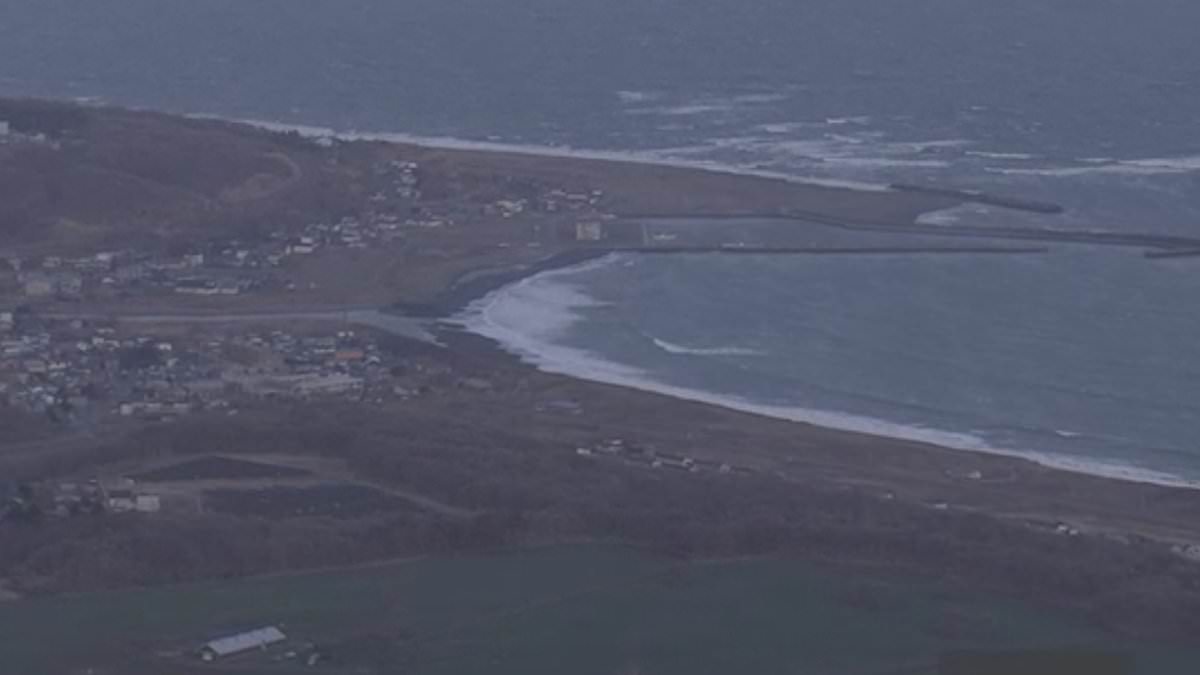
The tremor was reportedly strong enough to shake large buildings as far as Tokyo, hundreds of miles away, while aerial footage showed huge waves dominating the shorelines of Japan.
Footage taken from inside a cafe in Japan showed signs and hanging lights swaying side to side.

Massive waves were seen consuming vast swathes of Japan’s coastline
Another clip showed the light from an ornate chandelier rapidly flashing while the ornamental piece of lighting swayed.
Broadcaster NHK showed ships sailing out of Hachinohe port in Hokkaido in anticipation of the waves, as an alert ‘Tsunami! Evacuate!’ flashed across the screen.
Bullet train services in Aomori at the northern tip of Japan’s main Honshu island were halted due to the tremors, Kyodo news agency reported.
Prime minister Sanae Takaichi’s office has said that it has set up a crisis management team in the wake of the earthquake.
She said at a press conference: ‘For those of you who live in areas for which the warnings have been issued, please evacuate to higher, safer places such as higher ground.’
The US’ National Weather Service said following the quake that a tsunami is not expected to hit California, Alaska, Washington or Oregon in America, nor will anything hit British Columbia in Canada.
Japan is one of the world’s most seismically active countries, sitting on top of four major tectonic plates along the western edge of the Pacific ‘Ring of Fire’.
The archipelago, home to around 125 million people, typically experiences around 1,500 jolts every year and accounts for about 18 percent of the world’s earthquakes.
The vast majority are mild, although the damage they cause varies according to their location and the depth below the Earth’s surface at which they strike.
In 2011, a magnitude-9.0 quake triggered a tsunami that left 18,500 people dead or missing and caused a devastating meltdown at the Fukushima nuclear plant.
In 2024, the JMA issued its first special advisory of a possible ‘megaquake’ along the Nankai Trough.
This nearly 500-mile-long undersea trench is where the Philippine Sea oceanic tectonic plate is ‘subducting’ – or slowly slipping – underneath the continental plate that Japan sits atop.

Japanese authorities have issued a tsunami warning and told people to evacuate after an earthquake was detected off the country’s northeastern coast
The government has said a quake in the Nankai Trough and subsequent tsunami could kill as many as 298,000 people and cause up to $2 trillion in damage.
The JMA lifted the 2024 advisory after a week but it led to panic-buying of staples like rice and prompted holidaymakers to cancel hotel reservations.
It issued a week-long second ‘megaquake’ advisory in December 2025 after a magnitude-7.5 tremor struck off the northern coast.
The December 8 quake triggered tsunami waves of up to 28 inches and injured more than 40 people, but no major damage was reported.
More to follow.