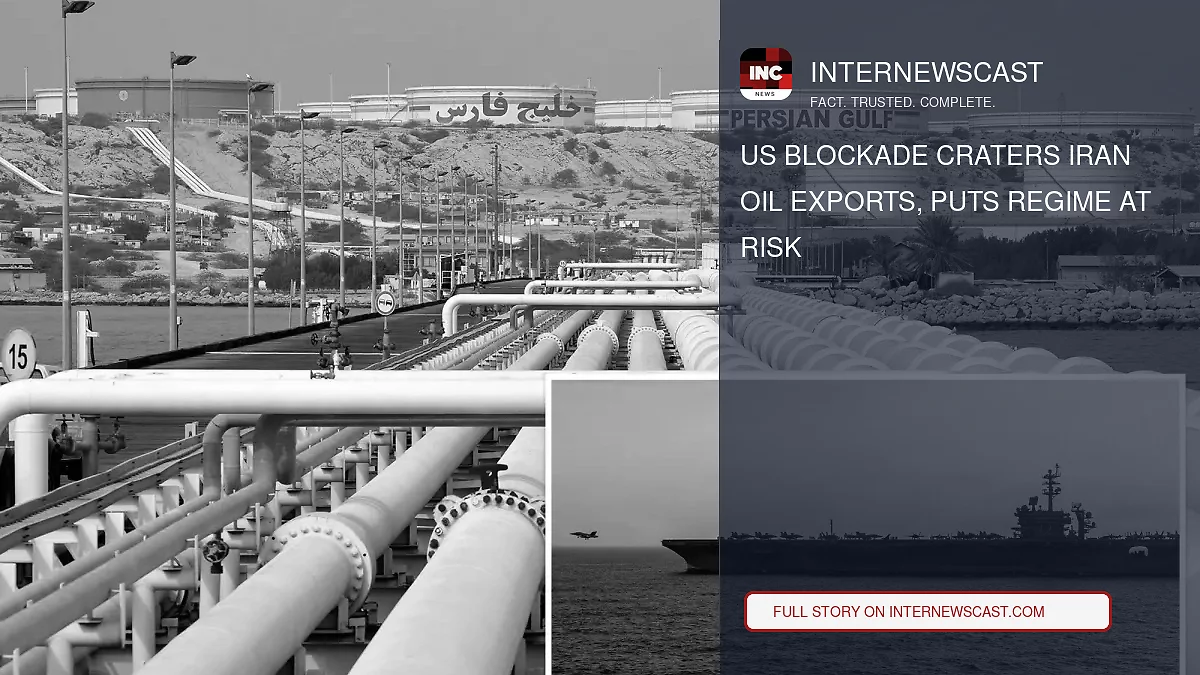

Iran’s oil exports have reportedly slowed to almost nothing under a renewed US naval blockade, a former senior US Treasury official says, warning that the financial fallout could begin pressuring the country’s power brokers and threatening regime stability within the next two to three months.
Tehran’s effort to move crude through the Strait of Hormuz — a key route it has relied on to soften its deepening economic troubles — appears to have stalled. Recent satellite imagery shows little to no visible activity at Kharg Island, Iran’s main oil export terminal.
With Washington and Tehran both leaning on economic pressure in a high-stakes test of endurance, Miad Maleki, who served at the Treasury Department under both Presidents Donald Trump and Joe Biden, said Iran’s leadership may be running out of financial breathing room by the fall.
“The blockade has exposed Iran’s biggest economic vulnerability,” said Maleki, now with the Foundation for Defense of Democracies, a Washington-based think tank.
“Iran’s oil clock is running down and the real fiscal shock is going to hit in the fall when all their payments come due,” he added.
According to Maleki, Iran pays soldiers, government workers, security personnel and industrial employees on set cycles, and roughly 60% of that funding is tied to oil export revenue.
If crude shipments remain severely restricted into the next payment period, the regime may have limited tools left to cushion its military ranks and political elite from the blow.
Maleki said Tehran has shown it can withstand widespread hardship among ordinary Iranians, but the calculation could shift quickly if members of the Islamic Revolutionary Guard Corps and wealthy insiders begin feeling the squeeze themselves.
Trump, who has previously boasted that Iran has no money to pay its troops, signaled that he would maintain full economic pressures on Iran.
Treasury Secretary Scott Bessent has also threatened more penalties to come for the Islamic republic.
Bessent warned that the so-called Operation Economic Fury would roll out additional measures after already taking increasingly aggressive actions to sanction money-changers, cryptocurrency and other sources of revenue for Iran.
The goal is be to hit Iran with “economic isolation like the world has never seen before,” he told Newsmax’s Rob Schmitt last week.
Iran, meanwhile, believes it can outlast the US in a game of economic chicken as the war has also taken its toll on America’s economy and created some backlash against the president.
Oil prices have remained stubbornly high as the Strait of Hormuz remains closed, with Brent crude, the international benchmark, hitting about $90 per barrel on Monday.
The average price of gas has also remained above $4 per gallon in the US in recent weeks, according to AAA.