The US Navy reportedly carried out a highly sensitive, months-long operation to remove naval mines from the floor of the Strait of Hormuz, one of the world’s most strategically important shipping corridors.
Iranian forces had allegedly seeded the critical waterway with mines following US and Israeli strikes on Iran in February. The strait is a vital artery for global energy markets, with roughly one-fifth of the world’s oil supply passing through it.
By June, around 80 mines were believed to have been laid in key shipping lanes, according to estimates from the International Maritime Organization.
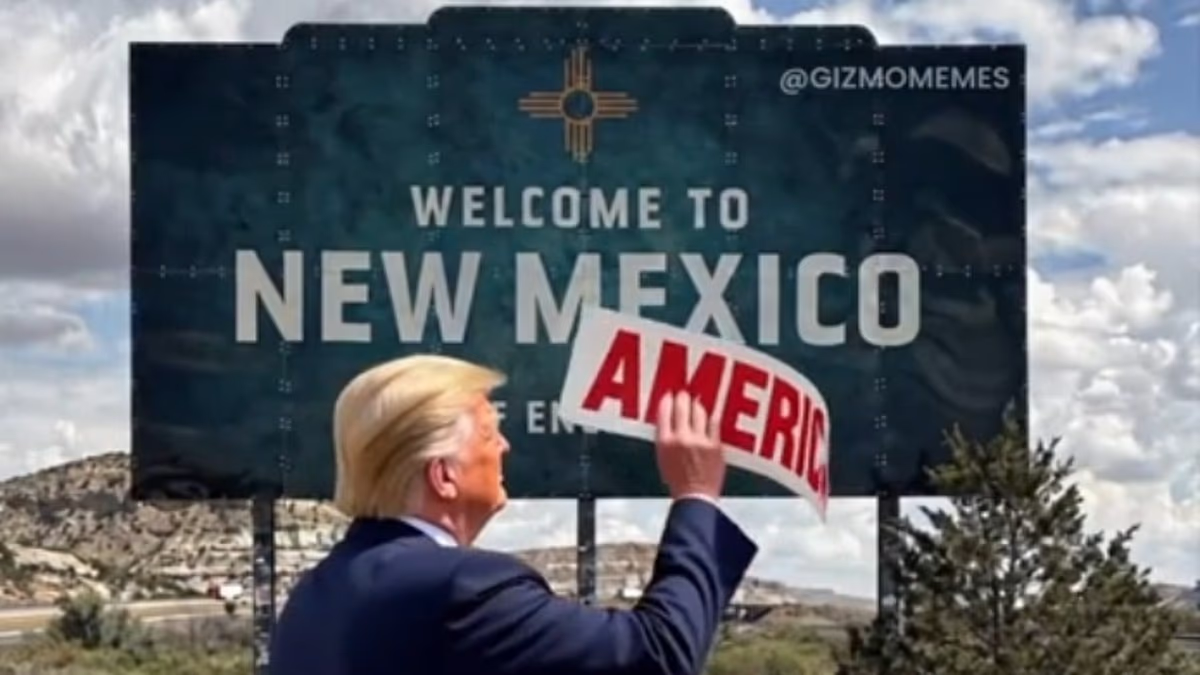
Last week, President Donald Trump said that “all mines” in the strait’s international waters had been removed or blown up, while also describing the narrow passage as “American territory.”
That dramatic claim followed a covert four-month effort in which Navy SEAL divers operated largely at night to locate and neutralize the explosives, the Financial Times reports.
According to the report, small teams moved under cover of darkness in inflatable-hulled craft, using robotic boats and submersibles equipped with towed sonar arrays to find mines resting on the seabed.
The systems rely on high-resolution, side-scan sensors capable of identifying objects such as mines on the ocean floor, allowing crews to search wide areas while limiting the danger to personnel.
Even with that technology, the most dangerous work still fell to divers, who had to approach the explosives underwater and attach charges to destroy them.
Alternatively, they could use robot submersibles like the UK’s SeaFox or the newer US AN/ASQ-235 Anchorfish to destroy the mines with explosives, according to demining expert Bryan Clark.

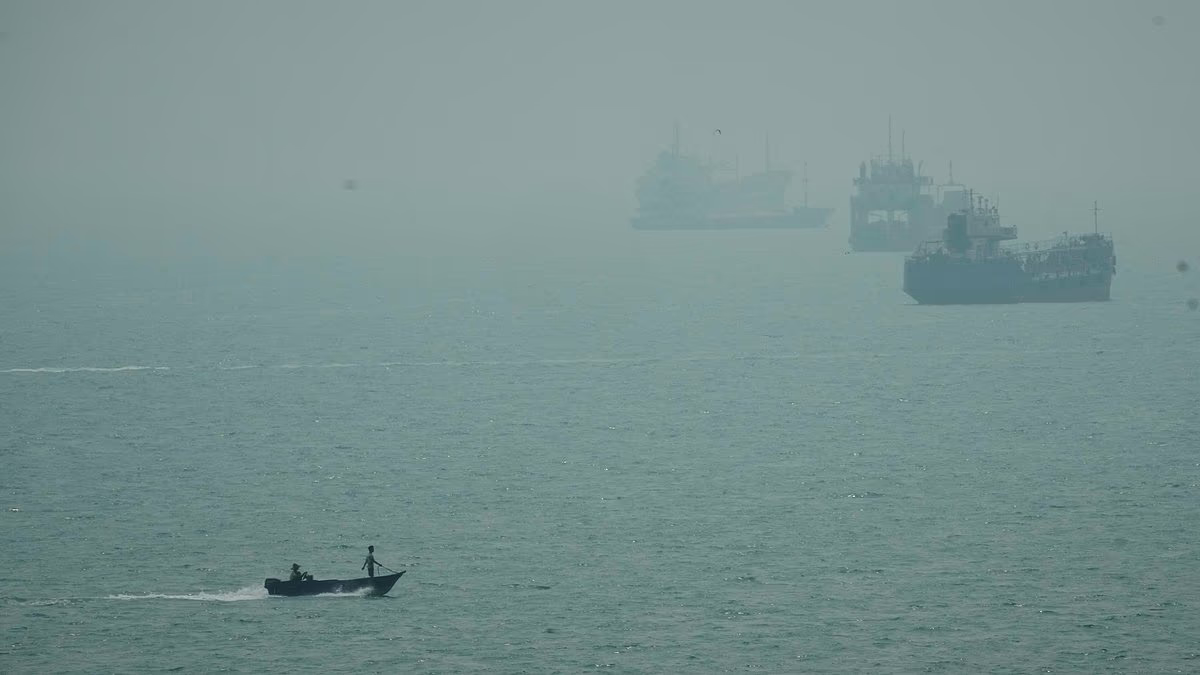
The US Navy engaged in a covert four-month operation to remove mines from the Strait of Hormuz. A motorboat is pictured passing commercial vessels in the waterway on Monday

US Navy SEALs reportedly worked in small teams at night using inflatable-hulled crafts and located the mines on the bottom of the strait with the help of robot boats and submersibles operating towed sonar array. Navy SEAL are pictured in Alaska in 2024

President Donald Trump last week announced that ‘all mines’ in the strait’s international waters had been removed or detonated
Either way, it is ‘an extremely time-consuming process,’ Nitya Labh, associate fellow at Chatham House, told the Financial Times.
‘They are doing, essentially, active bomb detonation underwater,’ she noted.
Clark also explained that ‘mine-clearing forces are vulnerable because the operation is slow and their boats or helicopters lack defenses.’
Fortunately, no US casualties have been reported specifically linked to the demining operation.
Ship owners and security advisors now say they are optimistic that the southern half of the strait near Oman’s coast – through which the US has been guiding ships – is genuinely mine-free.
But they expressed their doubts that the entire 104 mile waterway is clear, as only a handful of commercial ships have traveled through the strait since the war began.
And even the threat of mines has forced insurers to jack up their prices, up to 10 times their prewar costs. For a typical supertanker, that could mean insurance costs of about $10 million to traverse the waterway without Iranian permission.
Officials in Tehran have also dismissed the US’s claims that the waterway is mine-free, with Foreign Minister Kazem Gharibabadi saying in late August that ‘no one except Iran knows the location of these mines.’
The US Navy-directed Joint Maritime Information Center further warned there was a ‘continued risk of drifting or unchartered mines’ even as Trump declared the strait mine-free.

The divers could use robot submersibles like the UK’s SeaFox (pictured) or the newer US AN/ASQ-235 Anchorfish to destroy the mines with explosives
Military analysts note that the Iranian regime has thousands of Maham mines, similar to those used in World War II.
Some sit just below the surface and detonate when a ship hits lead horns on the mine itself, while others detect changes in electromagnetic fields as vessels pass overhead.
Iranian media has since claimed that at least two tankers struck mines in the past week, though no mine attacks have been reported or confirmed by maritime authorities.
An Iranian military spokesman also claimed on Thursday that Tehran has laid more mines close to Oman, near where US forces are directing cargo ships.
Yet on August 30, the US military announced that it struck Iranian rocket launchers preparing to fire sea mines into the strait.
‘It’s hard to know what to believe,’ said Ethan Connell, assistant director of Taiwan Security Monitor and an expert on mines.
‘Iran is certainly trying to re-mine,’ he noted as he acknowledged ‘it’s always possible the [US] Navy missed some.’
Amid the uncertainty, cargo ships have been forced to either comply with Tehran’s recently established Persian Gulf Strait Authority and request permission to pass through the strait – potentially risking US sanctions – or take the route around Oman.
‘The Iranians have realized that their strongest card is the perception that they control the Strait of Hormuz,’ said Bill Hamblet, a retired US Navy captain who often operated in the Gulf.
‘If they can convince the world that they can threaten the strait, that’s their strongest source of strategic leverage.’
On the other hand, the United States does not have to prove that every mine has been removed; it simply needs to establish sufficient confidence that shipping can resume.
That may prove to be a difficult task as about one out of every 30 ships in the strait continue to be attacked by missile and drone strikes.
‘The bigger game is on the information side,’ Hamblet said. ‘That may be as important, if not more important, than what’s actually happening in the water or on the bottom of the strait.’

US cruise missiles were launched at Iranian military targets along the Strait of Hormuz on September 1
Trump has made the reopening of the waterway a key plank of ending the war in Iran.
But the war could last a little while longer after the Pentagon began extending troop deployments overseas at Hegseth’s request, The Wall Street Journal reported.
The military is planning to keep 50,000 soldiers in the area to help with missions that involve intercepting missiles and protecting commercial ships in the Strait of Hormuz.
However, Trump has denied that the more than six-month military campaign in Iran is a ‘war,’ calling it ‘small potatoes.’
Speaking to reporters in the Oval Office on Friday, the commander-in-chief was asked about the ongoing operations in Iran, and to respond to Vice President JD Vance’s claim, one day earlier, that the ongoing conflict is ‘not a war.’
‘I’ll tell you what,’ Trump said. ‘A lot of people call it a war. I call it a military conflict, because it’s small potatoes,’ Trump said.
He then characterized the military conflict as a small-scale operation compared to previous conflicts, such as the Vietnam War, which he invoked several times.
‘It’s not a big thing,’ Trump continued. ‘We did Venezuela, and we did this, and Venezuela [we] lost nobody,’ Trump said, referring to the US capture of former Venezuelan leader Nicolas Maduro, ‘and [in] this, we lost 18 people.’
At least 18 US service members have been killed in the war with Iran since it began in February 2026, according to data from the Department of Defense, and a much higher number, at least 767 US service members, have been injured.
‘It’s intermittent. We do intermittent conflicts,’ Trump said of the war with Iran. ‘It’s very intermittent.’
‘We’ve been in there for five months,’ Trump said of the US war with Iran, which stretched past the six-month mark roughly seven days ago. ‘And in five months, what did we do? We stopped them from having an Israeli war,’ Trump said of the US strikes in Iran.
‘If we didn’t go in there, you wouldn’t have Israel right now,’ Trump told reporters. ‘You wouldn’t have the Middle East. And they probably would go [at] European cities, and our cities next,’ he continued. ‘But we stopped them, in five months.’
Pressed by a reporter about the conflict, Trump responded by firing back, ‘How long were we in Vietnam?’
‘I don’t think it matters what you call it,’ Trump added, a moment later. ‘What matters is we had tremendous success.’