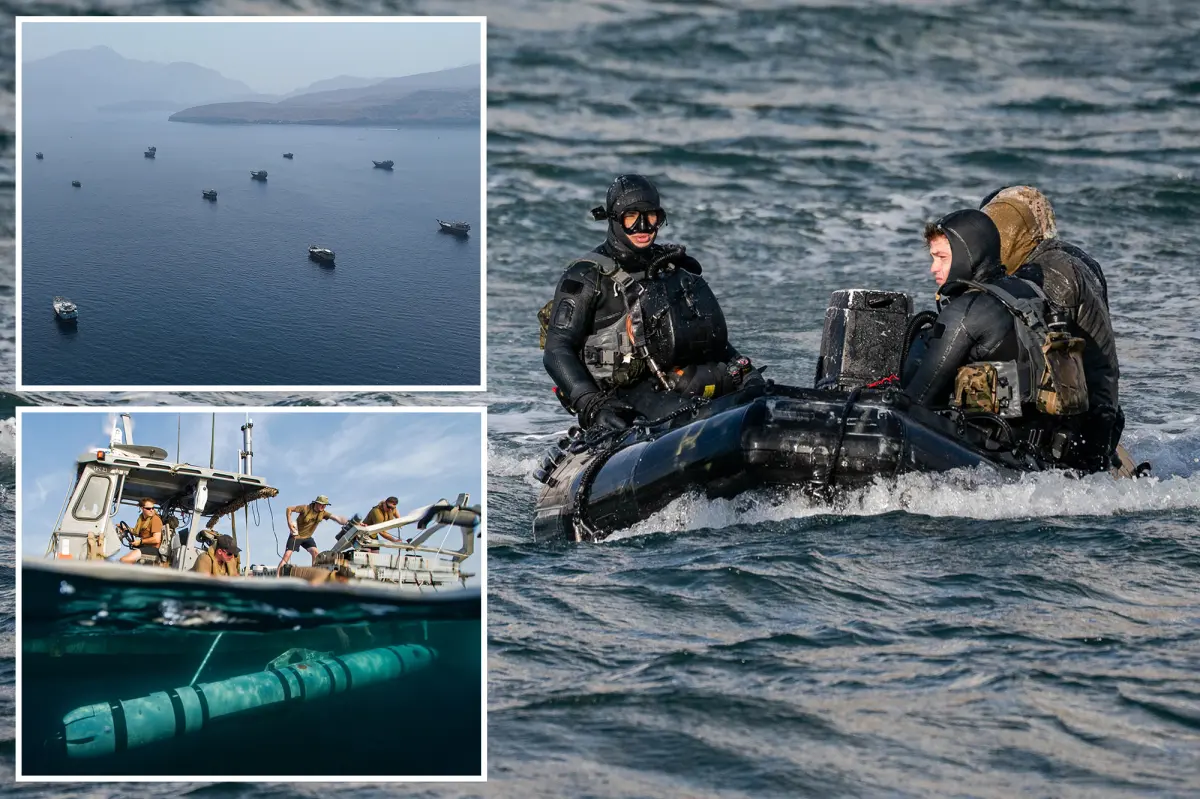

The US Navy quietly conducted a high-risk, four-month operation to remove Iranian mines from the Strait of Hormuz, relying on SEAL divers, drones and sonar systems, according to a new report.
Much of the covert minesweeping effort unfolded under cover of darkness, as teams equipped with robotic boats and specialized underwater vehicles moved through one of the world’s most strategically important oil corridors to locate and neutralize explosives, The Financial Times reported.
Navy SEALs initially worked to find the mines and secure the surrounding area before moving into the most dangerous and painstaking phase of the mission.
“That is usually followed up by a navy diver who’s got to get in the water and approach the mine, and then put a charge on it and destroy it,” Bill Hamblet, a retired US Navy captain with extensive experience operating in the Gulf, told the FT.
The Navy also likely deployed robotic drones to move in on the mines and detonate them with explosives — a method that can reduce risk to personnel but often requires significant time and precision.
One key system reportedly available to the teams was the Navy’s Common Uncrewed Surface Vessel, or CUSV, a drone boat designed to tow advanced unmanned underwater vehicles such as the MK 18 Mod 2 Kingfish, which uses sonar to map and scan the seabed.
Despite the hazards involved in the clandestine operation, no US casualties have been reported in connection with the minesweeping mission.
In June, the United Nations’ International Maritime Organization estimated that about 80 mines had been placed in the Strait of Hormuz, a vital shipping lane through which roughly 20% of the world’s oil transport passes.
By August, President Trump declared that all mines had been removed from the Strait, with the US carrying out repeated attacks on Iran last week sparked by an alleged operation to refill the waterway with explosives.
The ease of re-mining the Strait of Hormuz, however, has stirred uncertainty among the ships undergoing the trips through the waterway.
Iran has repeatedly claimed that its mines are active in the Strait, with its military claiming two attacks on oil tankers last week.
While shipping companies and maritime analysts agree that the areas near the Omani coast, where the US has been escorting ships, are likely cleared, there is less consensus on the status of the rest of the waterway.
“It’s hard to know what to believe,” Ethan Connell, assistant director of Taiwan Security Monitor and an expert on mines, told the FT. “Iran is certainly trying to re-mine.”
The threat of the mines and repeated missile and drone attacks in the Strait has kept visible traffic along the waterway down to its lowest level since May, according to the Kpler maritime intelligence firm.
Only two ships crossed the Strait on Saturday, with six making the trip on Sunday, most of which were done through Iran’s approved route.
It remains difficult to calculate the total traffic as ships have been sneaking through by turning off their responders and sailing in the dark of night under US military escorts.
With Post wires