
The United States is preparing to close several overseas consulates, including posts in Canada and Japan, as President Donald Trump pushes ahead with a broader effort to shrink what he has described as an overgrown federal bureaucracy.
Since Trump returned to the White House, agencies across the federal government have faced deep spending and staffing reductions, with the State Department alone hit by major layoffs last year.
Now, the State Department has informed Congress that it intends to close five foreign missions, marking an unusual contraction of America’s global diplomatic presence, according to people familiar with the notification.
In a notice sent to congressional committees last week, the department said the planned closures would affect U.S. posts in St. George’s, Grenada; Nagoya, Japan; Medan, Indonesia; Douala, Cameroon; and Winnipeg, Canada.
The individuals familiar with the State Department notice spoke to Reuters on condition of anonymity because the document has not been made public.
The anticipated shutdowns, which have not previously been reported, amount to a rare move by Washington to close multiple foreign missions in a downsizing effort not directly linked to a specific geopolitical crisis or event.
Early last year, in the first months of the Trump administration, the State Department began laying the groundwork to shutter nearly a dozen foreign missions, according to media reports at the time. The planning was part of a wider campaign by the Republican president to reshape the U.S. government around his “America First” agenda.
The White House Office of Management and Budget had pushed for an even larger reduction, advocating a closure plan that could have affected as many as 30 foreign missions.

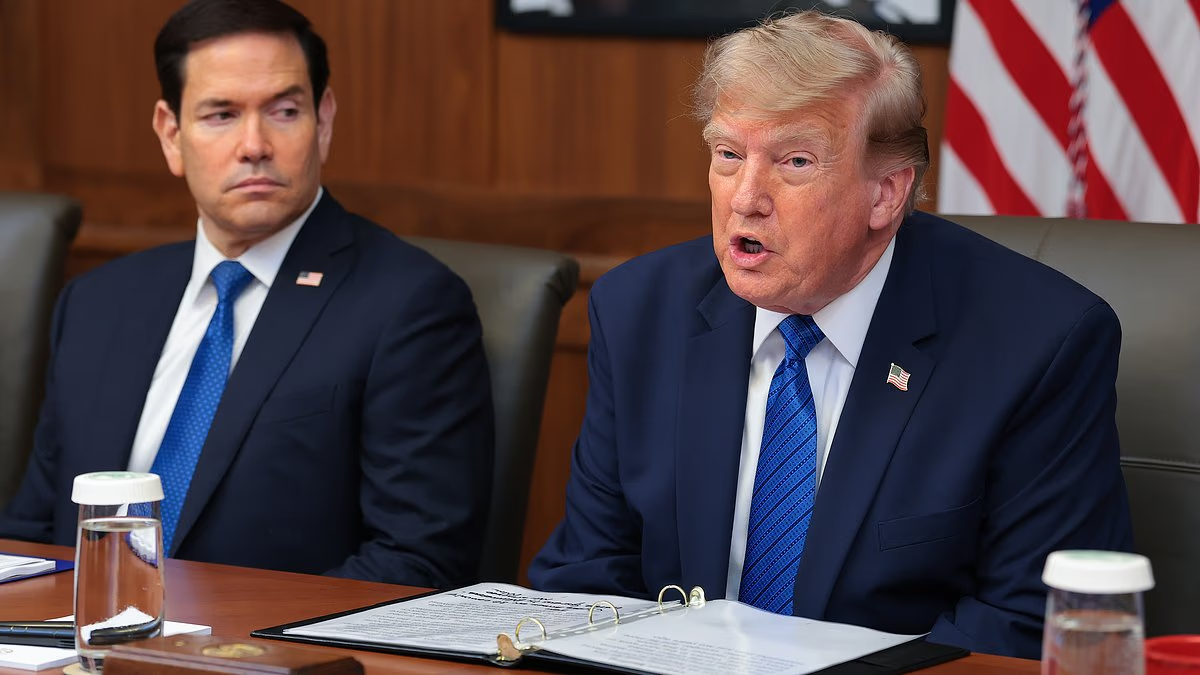
The United States is set to shut down foreign consulates, including ones in Canada and Japan as part of Donald Trump’s (pictured right) attempt to cut bloated government bureaucracy

Harry S. Truman Federal Building, headquarters of the U.S. Department of State
Join the discussion
Is slashing US diplomatic posts abroad a smart move or does it weaken America’s global influence?
Some administration officials have privately argued that some smaller foreign missions are inessential and not cost effective.
Democrats and some former foreign policy and national security officials argue that cuts to the US diplomatic footprint – coupled with the dismantling of the US Agency for International Development, which provided billions of dollars worth of aid globally – risks undermining American leadership, while leaving a dangerous vacuum for adversaries like China and Russia to fill.
While the State Department did undergo a broad bureaucratic overhaul last year – cutting dozens of bureaus and hundreds of staff – no foreign missions were shuttered.
Asked for comment on Sunday, the State Department issued a statement that did not confirm the closures but said it was focused on ensuring that the nation’s diplomatic footprint was efficient and effective.
The department added that it was committed to following congressional notification procedures.
Secretary of State Marco Rubio has portrayed cost-cutting measures as necessary to right-size an organization many conservatives see as bloated and overly bureaucratic.
The US mission in St. George’s, Grenada, is an embassy. The posts in Medan, Winnipeg and Nagoya are consulates, while the post in Douala is an ’embassy branch office.’
Consulates and branch offices typically represent US interests in regions outside a foreign country’s capital city, where the US embassy is typically located.

The building in Nagoya, Japan where the United States consulate is located
During the administration of former President Joe Biden, the US government opened several foreign missions, all of them in the Pacific region, where the US is competing for influence with China.
While China does not have a functioning foreign mission in Douala or Winnipeg, it does have a diplomatic presence in St. George’s, Nagoya and Medan.
In July 2025, Marco Rubio announced a sweeping reorganization of the State Department and claimed the ‘bloated’ bureaucracy and ‘radical political ideology’ had to be eliminated.
It was part of Trump’s agenda to ‘deconstruct the administrative state’ and reduce the size of the federal government, starting with the State Department where nearly 1,800 positions were slashed.
Rubio said officials took ‘a very deliberate step to reorganize the State Department to be more efficient and more focused.’
‘It’s not a consequence of trying to get rid of people. But if you close the bureau, you don’t need those positions,’ he told reporters in Kuala Lumpur, Malaysia, where he’s attending the annual Association of Southeast Asian Nations Regional Forum.
‘Understand that some of these are positions that are being eliminated, not people.’
He said some of the cuts will be unfilled positions or those that are about to be vacant because an employee took an early retirement.