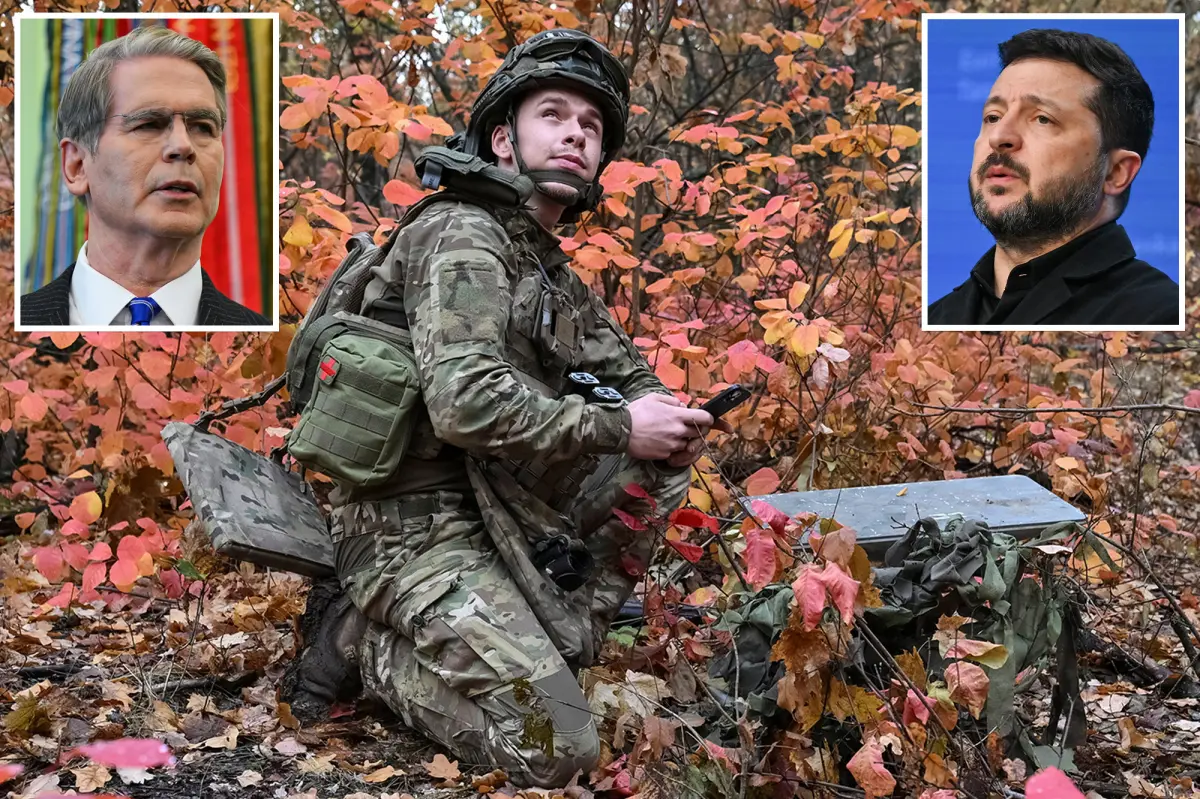

WASHINGTON — Treasury Secretary Scott Bessent criticized Ukrainian President Volodymyr Zelensky after Zelensky publicly accused the Trump administration of restricting Ukraine’s access to Starshield, the military-grade satellite communications network that has played a vital role on the battlefield.
Zelensky said Ukrainian officials believed someone within the administration had ordered satellite service to be slowed for objects traveling at speeds of roughly 160 kilometers per hour or faster, a restriction he said had disrupted Ukraine’s drone operations.
“President Trump and Secretary Rubio have categorically said that no one in the Trump administration did that,” Bessent said Sunday on NBC News’ “Meet the Press.” “I think it is very reckless for President Zelensky to make such a charge.”
Bessent said he had no personal knowledge of the alleged restriction but insisted the administration’s position was clear. “President Zelensky should be very careful about making statements like this that aren’t true,” he said.
The dispute over Ukraine’s Starshield service has unfolded amid conflicting accounts, with officials on all sides offering different explanations for who ordered the alleged limitations.
Early on, senior Ukrainian and European officials pointed to billionaire technology entrepreneur Elon Musk and accused him of restricting “Starlink” service. Musk later clarified that the issue involved Starshield, Starlink’s military counterpart, and suggested the decision originated with the Trump administration. Musk and a senior Ukrainian official subsequently indicated that access was being restored.
Zelensky, however, said in a prerecorded interview broadcast Sunday on NBC’s “Meet the Press” that the restriction remained in place.
“We [still] have [a] limitation. The speed is [a] maximum [of] 161 kilometers. Not miles, kilometers,” Zelensky said.
The reported Starshield slowdown came as Trump was urging Kyiv to halt or reduce drone attacks targeting Russian energy infrastructure.
Trump and Secretary of State Marco Rubio both rejected the claim that the administration directed the service restriction. A Reuters report, however, said an unidentified administration official had ordered the move.
“Of course, the message came from government. I don’t know from whom, what cabinet, and et cetera. And I think it doesn’t work either way,” Zelensky said. “But it’s not my opinion. It’s [the] opinion of our generals, of our government.”
Zelensky also said that, around the time the Starshield issue emerged, the United States had temporarily stopped providing Ukraine with intelligence about Russian ballistic-missile attacks. According to Zelensky, that intelligence sharing has since resumed.
Bessent also defended Trump’s decision to relax restrictions on Russian diesel and delay the implementation of additional Russia sanctions contained in a bipartisan bill named for the late Sen. Lindsey Graham.
“The only thing that has been lifted is the diesel embargo,” Bessent said. He noted that Britain had also waived its embargo in May on diesel and jet fuel produced with Russian crude.
“Where’s the outrage for the rest of the world? President Zelensky does not criticize his European partners,” Bessent said. “The Europeans are financing the Russian war machine. The US imports $4 billion of Russian products. One-point-eight billion of that [is] fertilizer. Europeans import more than ten times that.”
As tensions with Washington continued to rise, Zelensky met Sunday with US special peace envoys Steve Witkoff and Jared Kushner. He later wrote that a lasting peace would require “cooperation built on trust.”
Trump’s agreement with Russian President Vladimir Putin on diesel came as the administration faced mounting political pressure over elevated fuel prices, a particularly sensitive issue for farmers ahead of the midterm elections.
Bessent also emphasized that the Trump administration has maintained a tough sanctions policy toward Russia since Trump returned to office in January of the previous year.
“First of all, the sanctions were doubled. The Biden administration, in an act of incredible bravery,” Bessent said sarcastically, “doubled the sanctions on the way out, in January of 2025. But we did not take those down.”
“President Trump sanctioned the two largest Russian energy companies, Rosneft and Lukoil, which dealt a catastrophic blow to the Russian energy industry,” he went on. “So no one has been tougher on Russian sanctions than President Trump.”