
Rabbi Arnold Resnicoff never planned to be in Beirut, Lebanon, on Oct. 23, 1983—the day a suicide bomber drove an explosives-packed truck into the U.S. Marine barracks, killing 241 American service members. Yet his unexpected presence at the scene, followed by years of advocacy, would provide comfort and support to generations of U.S. troops. The experience reinforced his belief that “a coincidence is just God acting anonymously.”
Assigned to the U.S. Navy’s 6th Fleet, Resnicoff served on a three-chaplain team responsible for supporting personnel aboard 40 ships in the Mediterranean. He reached Beirut on Friday, Oct. 21, to lead a memorial service for Jewish Marine Staff Sgt. Allen Soifert, who had been killed in the line of duty. Navy officials planned to send him back to his ship the next day, but Resnicoff, an observant Jew, would not travel on the Sabbath.
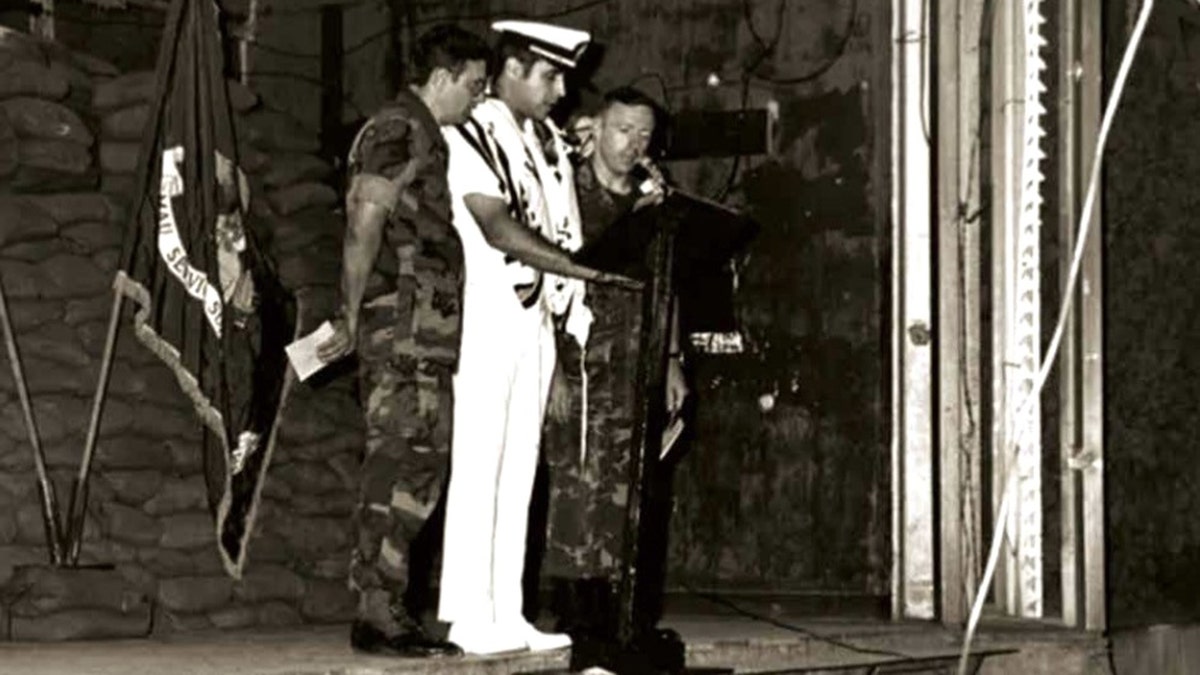
Protestant chaplain Danny Wheeler, Rabbi Arnold Resnicoff and Catholic chaplain George Pucciarelli, shown from left, attend the Oct. 21, 1983, memorial service for Jewish Marine Staff Sgt. Allen Soifert, two days before the terrorist bombing. (Courtesy of Rabbi Arnold Resnicoff)
At 6:22 a.m. on Oct. 23, Resnicoff was brushing his teeth when the building around him began to convulse. Doors were blown from their frames and windows shattered. He and the others dropped to the floor for cover, initially assuming the building had been struck by rockets or mortar fire.
Once the blast subsided, the men heard “these terrible, terrible screams” rising from the building about 50 yards away, where Protestant chaplain Danny Wheeler was staying with a large group of Marines.
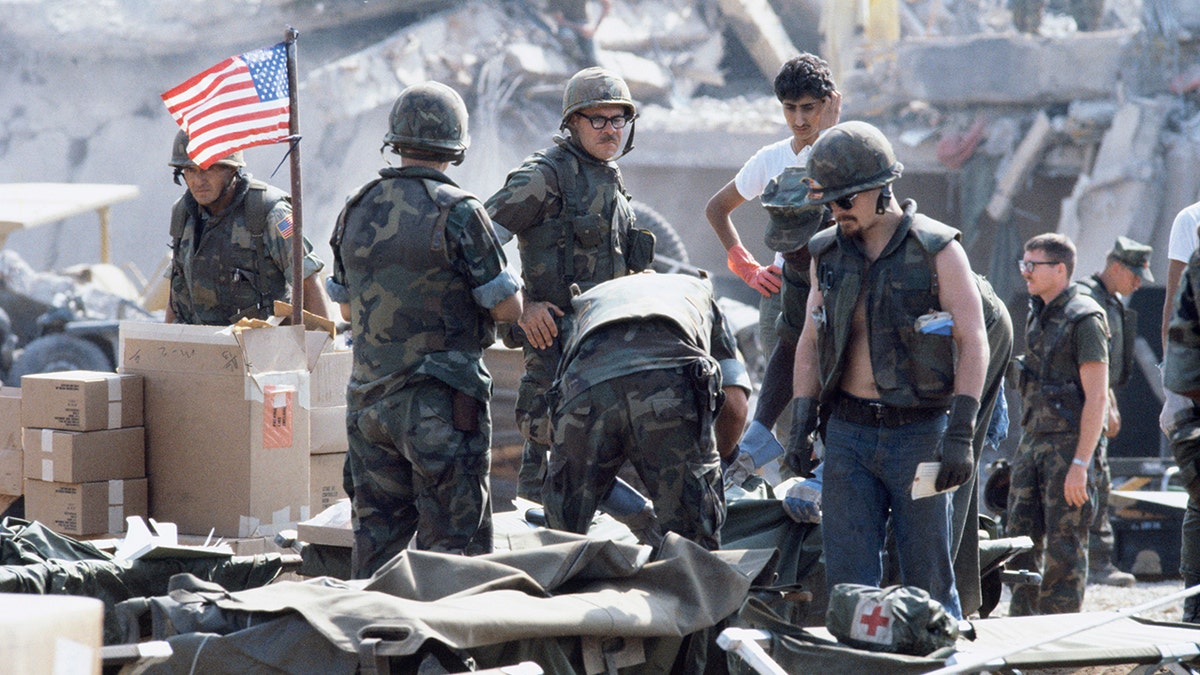
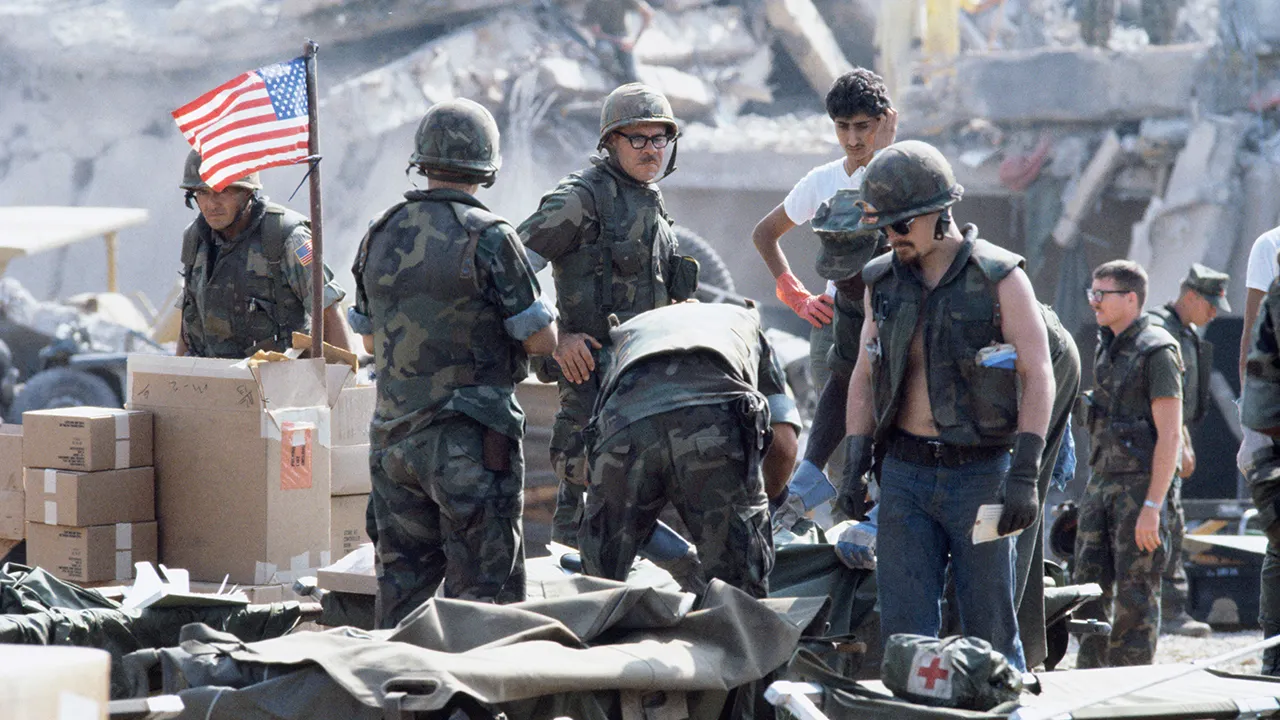
American Marines comb through rubble for survivors and bodies after a terrorist suicide car bomb destroyed their Beirut barracks headquarters, killing 241 U.S. service members and injuring more than 60. The American military presence in Beirut was part of a multinational peacekeeping force. (Peter Charlesworth/LightRocket via Getty Images)
During his Beirut visits, Resnicoff usually alternated between staying with Catholic chaplain George Pucciarelli and Wheeler. He was expected to spend Friday night with Wheeler, but instead chose Pucciarelli’s quarters because the Catholic chaplain wanted to discuss something with him. “Who knows what it was we talked about,” Resnicoff later said. “But that probably saved my life.”
As the scale of the disaster became clear, Resnicoff saw Pucciarelli place a purple stole around his neck, “probably because he knew he was going to have to say many last rites.” Pucciarelli then turned to Resnicoff and said, “Follow me.”
Outside, Resnicoff saw that “the big, four-story building was gone with the smoke.” Beneath the rubble lay 241 American service members: 220 Marines, 18 Navy sailors and three Army soldiers. Among the Navy dead was an entire medical detachment, meaning there were no medically trained personnel left to treat those who had survived.
Resnicoff, Pucciarelli and other first responders picked through the wreckage in search of survivors. Pucciarelli, Resnicoff recalled, “went to one body on the ground, I went to another. We just cradled these wounded men and said, ‘Help is coming.’” They tore away pieces of clothing to clean blood, dust and dirt from the injured men’s faces. After destroying his own shirt, Resnicoff used his Jewish head covering, or kippah, until it became “bloody and dirty and lost.”
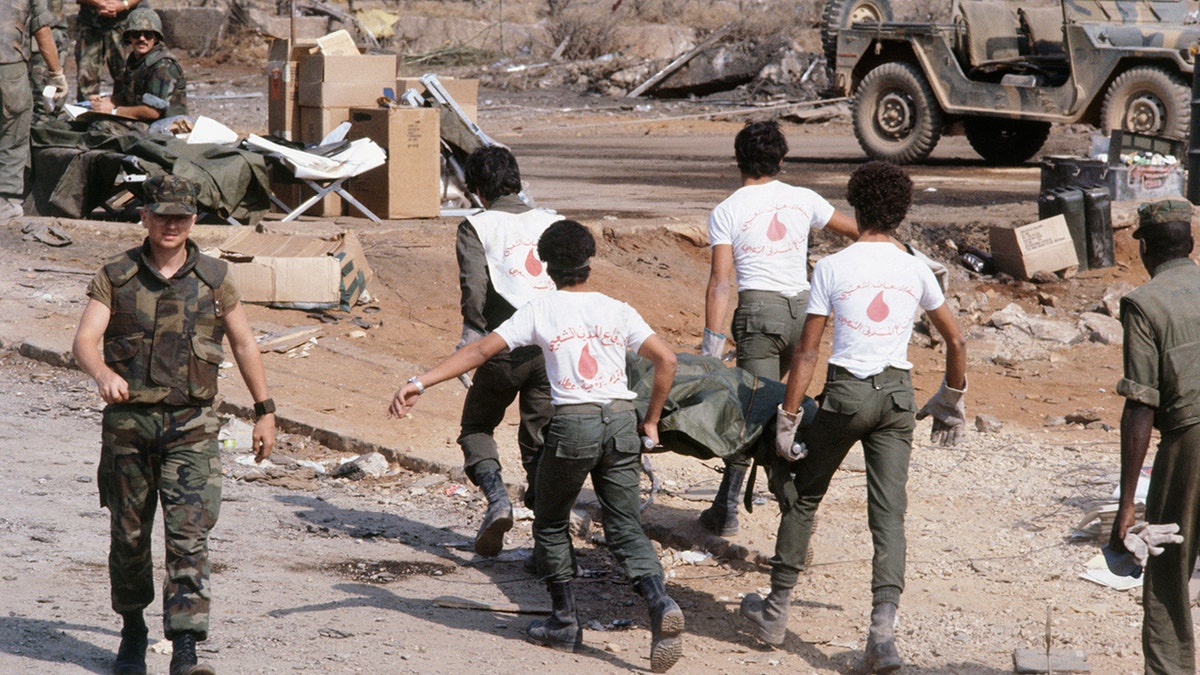
Lebanese volunteer rescuers carry the body of an American Marine from the wreckage of the U.S. Marines barracks after the terrorist truck bombing on Oct. 23, 1983. (Peter Charlesworth/LightRocket via Getty Images)
CONTINUE READING: New Mexico Floods Swamp Homes, Force Dramatic Rooftop Rescues
Ambulances and helicopters eventually reached the site, giving the two chaplains a brief chance to recover. Pucciarelli then noted that he had never seen Resnicoff without a head covering. After Resnicoff explained what had happened to his kippah, Pucciarelli cut a piece from his camouflage uniform and fashioned it into a covering for the rabbi’s head.
Pucciarelli told Resnicoff that, “In this country where every religion is killing every other religion, I want everyone here to remember not only that you and I, the chaplains, were helping everyone regardless of whether they had a religion or what religion they had, but that you and I had different religions [and were] standing together.”
Wheeler became the last living service member rescued from the wreckage, pulled out five hours after the blast. Resnicoff said recovery crews spent four days removing the hundreds of bodies buried beneath the ruins. “These tough Marines were crying, helping their fellow military personnel,” he recalled.
As he comforted grieving Marines and worked beside them in the rubble, Resnicoff drew on Jewish mourning customs. “After the death, we have a week of family gathering around and telling stories about the person who died,” he explained. “The tradition is if you visit the family during that period, you don’t initiate the conversation, just show your concern and love through your presence, and if the mourners talk to you, then you have a conversation. So, when I would go from Marine to Marine, they were digging up the bodies of their comrades, I used that Jewish approach. I didn’t start the conversation, I just stood next to them to show them I was there, and then if they wanted to talk, I talked.”
Resnicoff said the practice also reflected the teaching associated with Catholic friar St. Francis of Assisi: “Preach the gospel everywhere. Use words only if absolutely necessary.”
The Legacy of the Camouflage Kippah
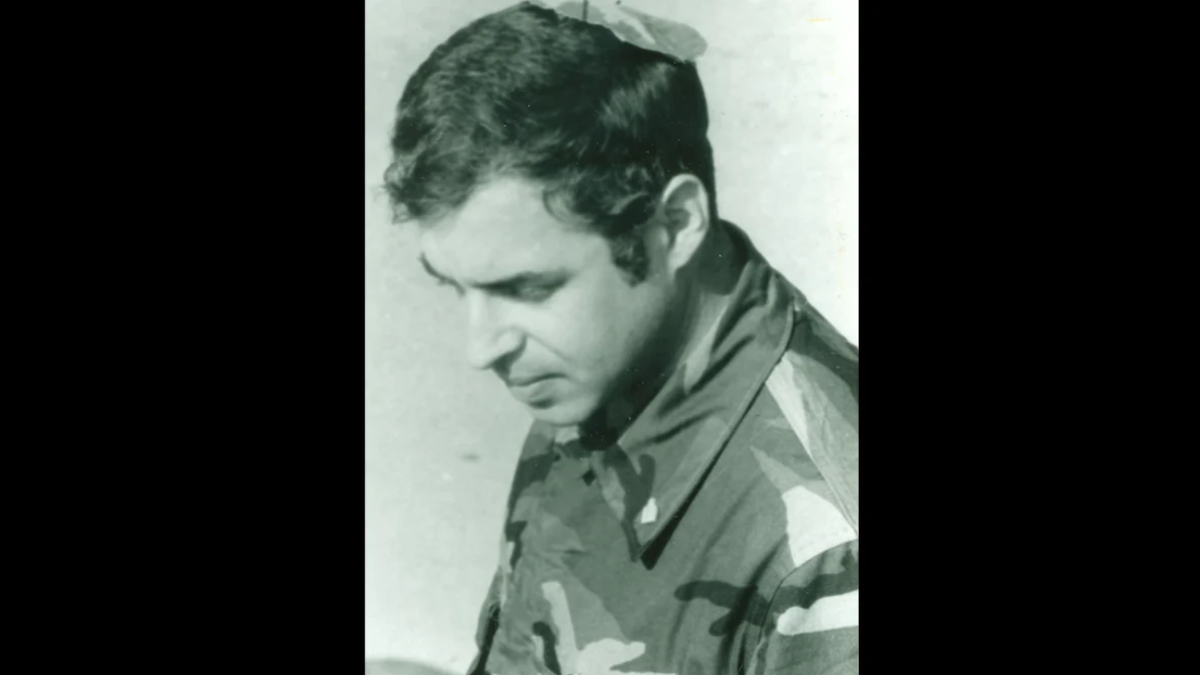
Rabbi Arnold Resnicoff is pictured wearing the camouflage kippah created from a piece of his uniform. (Courtesy of Rabbi Arnold Resnicoff)
Before the Iran-backed Hezbollah bombing in Beirut, Resnicoff said Jewish service members routinely faced resistance when seeking permission to wear a kippah while in uniform.
In the early 1980s, Congress was considering the Religious Apparel Amendment, legislation that would permit Jewish military personnel to cover their heads. Resnicoff said the measure had failed for two years. Then lawmakers included the story of Pucciarelli making a head covering for him in the Congressional Record. “The amendment passed,” Resnicoff said. “They understood that it was a matter of pride that we could work side by side from different religions.” Vice President George H. W. Bush later asked Resnicoff to write a report about the experience. Former President Ronald Reagan shared that account with approximately 20,000 Baptists, an audience Resnicoff recalled had responded favorably.
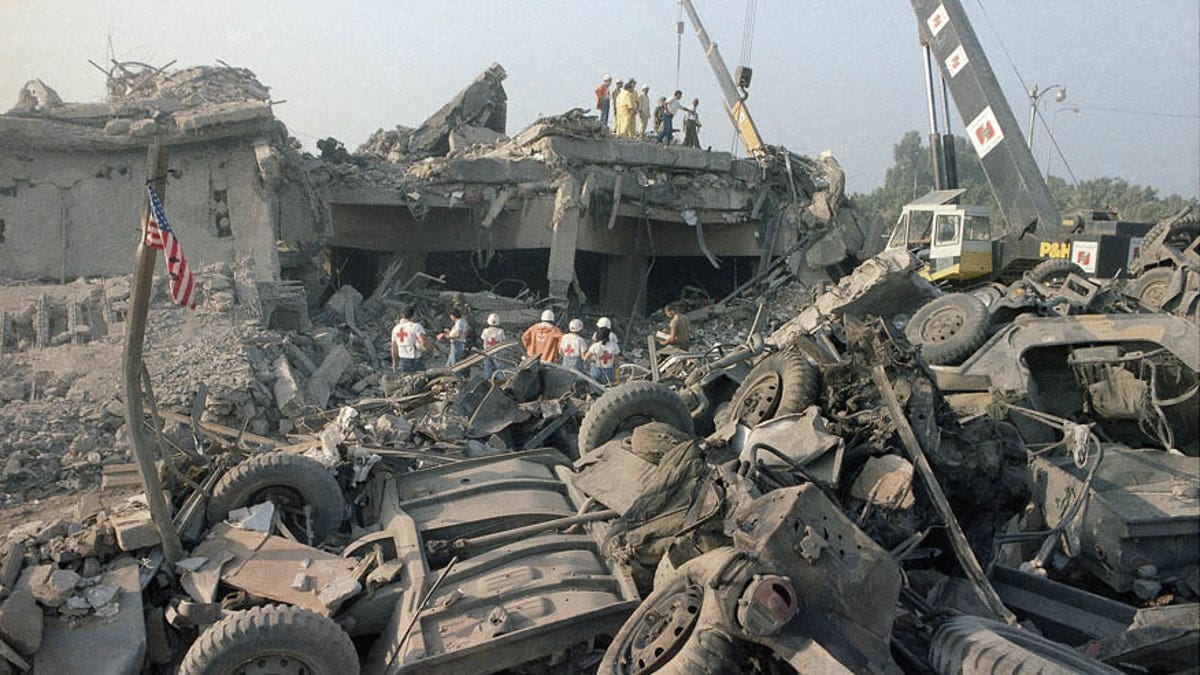
The aftermath of the bombing of the U.S. Marine barracks in Beirut, Lebanon, is shown in this Oct. 23, 1983, file photo. (AP)
In chaplain school, Resnicoff said that chaplains were trained to attend to severely wounded personnel from different religious backgrounds than their own. “But it turned out none of the people I comforted in Beirut asked me a religious question. It was just ‘if I die, tell my mother I love her.’ Most of those Marines were too young to have their own children.” He says that “I was reminded that the role of the chaplain is so much broader and bigger than just being a religious representative.”
“I always used to believe that the military was ahead of the civilian world when it came to understanding and working together. And when you’re in a foxhole or a bunker, you don’t really care if the guy next to you is a Democrat or Republican or independent, you don’t really care what their religion is. You just care that they’re going to protect you like you’re going to protect them and we’re all in this together.”
Resnicoff says that the Beirut bombing showed him that “if the world had more interfaith foxholes, we would have less need for foxholes and more room for faith.”