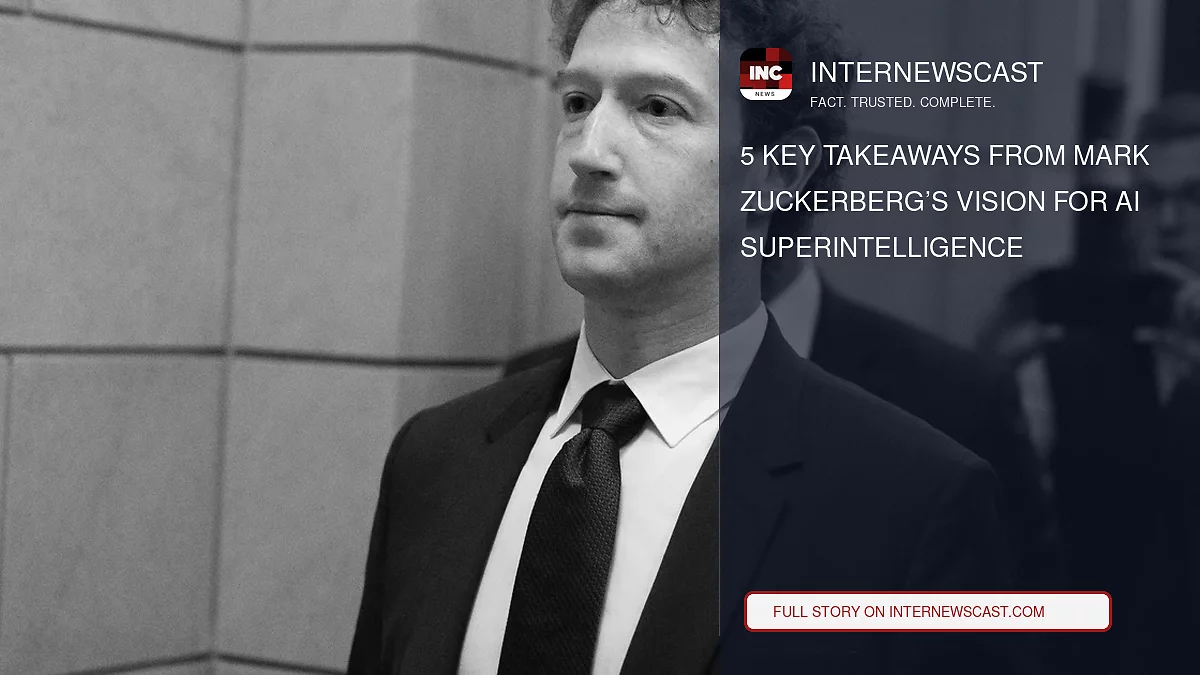

Mark Zuckerberg argued in an essay published Monday on Meta’s website that artificial intelligence should be made available to “as many people and businesses as possible.”
Across the 6,500-word post, the Meta founder laid out his broader vision for AI, saying he believes “superintelligence” — a still-theoretical form of artificial intelligence that would surpass human cognitive abilities — could strengthen national security, expand economic prosperity, and accelerate scientific and creative progress.
“Humanity has witnessed many transformative advances. Each time there is fear that people will be left behind,” Zuckerberg wrote. “But each time humanity has come out with more people sharing greater prosperity, health and freedom. We believe this will be true with AI as well, and the abundance of the future can be shared by everyone.”
While Zuckerberg emphasized the promise of superintelligence — and Meta’s role in helping build it — he also cautioned that decisive action will be necessary to preserve America’s competitive advantage and ensure people remain in control of the technology.
Here are five key takeaways from Zuckerberg’s essay.
“Free or affordable access” to AI for all
One of Zuckerberg’s central predictions is a future where each person has a personal AI agent that can help manage everyday matters, from health and careers to finances and relationships.
To drive wider adoption, the tech billionaire said Meta plans to offer free versions of its AI tools to “billions of people” while working to make access to its technology available at the “lowest price possible.”
Zuckerberg also said Meta will develop a “fully private mode” for personal AI agents, designed to keep Meta and other providers from being able to view users’ information.
Jobs won’t disappear
Disputing widespread concerns that AI will displace workers, Zuckerberg said the technology will create new kinds of jobs that don’t exist today and allow people to do more with less. In his essay, he referred to superintelligence as a “tool of invention” rather than of automation.
“Company sizes may shrink — just as they did in the transition from industrial giants to tech companies,” Zuckerberg said. “But this doesn’t mean fewer jobs overall. It implies a larger number of companies with fewer people each.”
Data center community investments
Meta is among the so-called hyperscalers, along with rivals such as Alphabet, Amazon and Microsoft, rushing to build data centers as growing AI demand spurs a need for more computing power. Yet the push is drawing intense public opposition over environmental, economic and other concerns.
Seeking to address such concerns, Zuckerberg said Monday that Meta will create an investment fund called the “Future is for Everyone Fund” to benefit communities where data centers are being built. The fund size will be $1 billion, according to The Wall Street Journal.
Zuckerberg also committed to keeping electricity prices low, restoring local water supply and training workers to support its data center buildout. Meta’s 2026 capital spending budget of $145 billion will be used “largely to build data centers,” he noted.
Releasing open-source models
Zuckerberg argues in his essay that the U.S. should lower barriers that he said make it harder for U.S. open-source AI models to compete with those of foreign competitors. While there are risks to releasing models, allowing AI labs to keep them under lock and key as proprietary AI tools would be worse, he said.
To that end, Zuckerberg said Meta will “resume releasing some open source models soon.” According to The Wall Street Journal, Meta is planning to launch a new model with open weights — numerical values that determine a model’s behavior — called Muse Glimmer, as well as an open-weight version of Muse Spark 1.2, its most advanced AI coding model.
Working with the authorities
Zuckerberg also offered policy suggestions for how AI companies and the government can work together to advance AI safely. Those include sharing “intermediate training checkpoints of new models” with the government — allowing it to tackle potential security issues early on. AI labs should also work with law enforcement to prevent bad actors from misusing the models, he said.
Alain Sherter