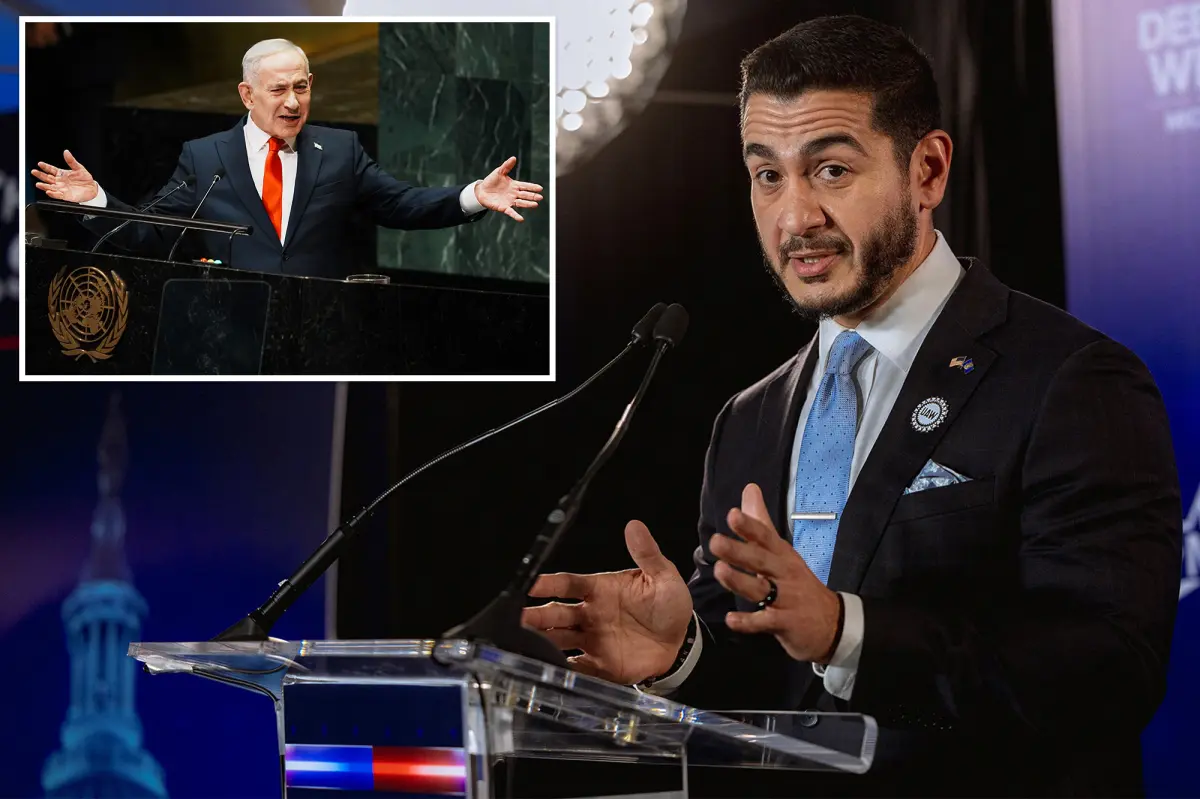

Abdul El-Sayed is facing renewed criticism over his views on Israel after a tense debate with Republican opponent Mike Rogers. The exchange has left some Jewish Democrats questioning whether they can support the Democratic Senate nominee, while political analysts warn that his comments could become a liability.
The controversy erupted Thursday night when El-Sayed said he would not regard Israel as an ally if the country pulled the United States into wars it did not need to fight. He declined, however, to directly compare the threat posed by Israel with that of Iran.
“He, himself, has created this predicament and he now comes off as confused and inauthentic,” Jeff McCall, a DePauw University professor, told The Post.
McCall said the debate demonstrated that El-Sayed was “failing the rhetorical challenge.”
“I don’t consider an ally a country that takes us to wars we don’t need to fight,” El-Sayed said during the Grand Rapids, Michigan, debate, which was hosted by NewsNation and Nexstar’s WOOD-TV.
The exchange followed Rogers’ criticism of El-Sayed for not issuing a statement commemorating the third anniversary of Hamas’ Oct. 7, 2023, terrorist attack on Israel.
El-Sayed said he had condemned the attack, while accusing Rogers of exploiting other people’s suffering as “political theater.”
His remarks have reopened questions about his standing with Jewish Democrats, some of whom have voiced reservations about supporting the progressive candidate because of his positions on Israel.
The Michigan Democratic Jewish Caucus has yet to endorse El-Sayed, even though it has backed other candidates in federal races.
The Post contacted the group for comment but had not received a response.
El-Sayed also faced additional scrutiny after dismissing questions about his response to the Oct. 7 anniversary in the aftermath of the debate.
David Dulio, a political science professor at Oakland University, told The Post that Thursday’s debate carried particular weight because El-Sayed is “arguably more to the left” on foreign policy than other progressive figures, including Sen. Bernie Sanders (I-VT) and Sen. Elizabeth Warren (D-Mass.).
Dulio said the debate’s defining moment came when El-Sayed was asked whether Israel or Iran represented the greater threat to the United States — a question the Democratic candidate refused to answer.
“Many Jewish Democrats in Michigan have been skeptical of El-Sayed and have expressed uncertainty about his candidacy,” Dulio said. “They were likely listening for a question like this to help them make up their minds.”
Dulio said El-Sayed’s response could create a “wobble” in a campaign that had moved steadily forward since the primaries, particularly if Jewish Democrats prove decisive in the race.
“These positions could come back to haunt him,” Dulio said. “‘Dems for Rogers’ is real but we don’t know how big it is. I imagine this is something that’s exceedingly difficult to poll. Rogers will look to grow this group and I imagine Rogers’ campaign will have those debate clips in an ad very soon.”
A Democratic insider told The Post that winning over Jewish Democrats remains “an area of continued focus” for the El-Sayed campaign.
“There will still be Jewish Michiganders who don’t vote for him, but I think he’s reaching those who are open to voting for him,” the source said.
CHECK THIS OUT: Andrew Mountbatten-Windsor’s Public Comeback Efforts Gain Momentum
Former Republican Rep. Peter Meijer, an Iraq War veteran, also criticized El-Sayed’s response to the question of whether Israel or Iran posed the greater danger to the United States.
El-Sayed dismissed the question as “dumb” and called it a “ridiculous hypothetical.”
Meijer agreed that the question was poorly framed but argued that El-Sayed could have given a straightforward answer about the two countries’ relationship with the US.
“He criticized Mike Rogers for asking him to condemn Hamas, Hezbollah, Al Qaeda, saying they’re scary words, but he hasn’t condemned them,” Meijer said on CNN.
Meijer added that El-Sayed’s response raised questions about whether his approach was political strategy, or reflected a deeper reluctance to address the issue.
“At a certain point, it goes from either this is political malpractice at best, or he [El-Sayed] can’t, or he won’t because of something deeper — and that’s far more troubling. And I just don’t get it because I don’t want to get it because it really is dark,” he added.
The controversy follows weeks of public disagreement among Jewish Democrats over whether El-Sayed’s positions on Israel should disqualify him from their support.
In an Oct. 6 MS NOW interview, one lifelong Democratic voter said her decision hinged on Israel.
“I just would love for him to make a definitive statement, like just saying ‘I would like everyone to know I support Israel,’” she said.
An Oct. 7th Republican Jewish Coalition ad featured lifelong Jewish Democrats in Michigan who said they “will never vote for Abdul El-Sayed.”
“I will never forgive El-Sayed for excusing the terrorists who caused this terrible incident,” one voter said.
Another criticized his response in the immediate aftermath of a Michigan synagogue attack, recalling his comment that “hurt people, hurt people.”
“And he is giving permission for another person to do it again,” the voter said.
El-Sayed was also pressed by reporters Friday about whether he was still mourning the death of Iran’s Supreme Leader Ayatollah Ali Khamenei. He declined to discuss the subject, telling reporters he was “not interested in talking about this” and urged them to ask about health care instead.
At the beginning of El-Sayed’s Senate bid, he campaigned more heavily on foreign affairs.
McCall said that given El-Sayed’s prior statements, it would seem “unlikely” for him to modify his rhetoric “enough to ease the minds of supporters of Israel.”
During Thursday’s debate, El-Sayed reiterated that he does not want US tax dollars funding weapons for foreign countries, including Israel. He also said he would not support being drawn into a war with Iran.
Rogers, meanwhile, defended Israel’s right to exist and protect itself, arguing that the US should stand by the Jewish state.