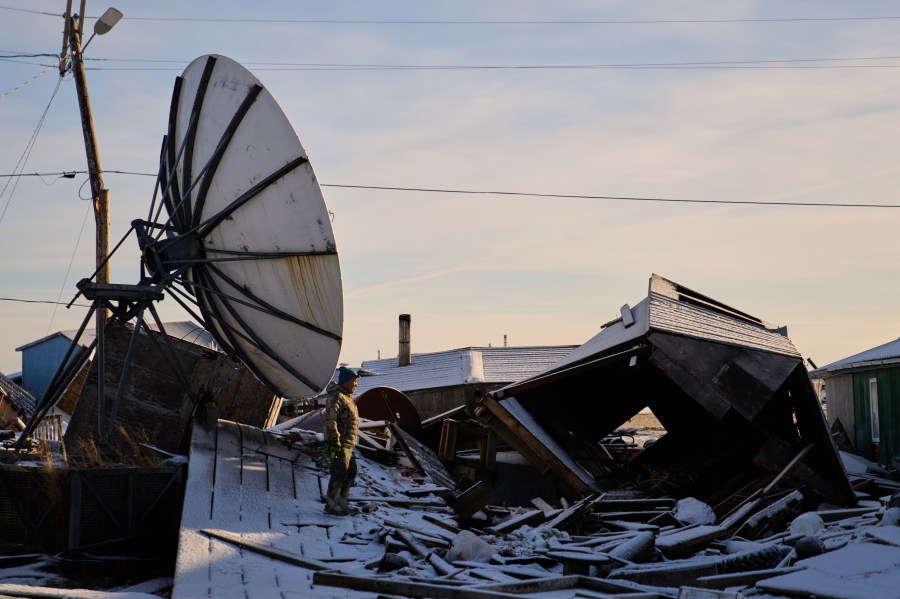


KWIGILLINGOK, Alaska (AP) — As the last evacuees left the village of Kwigillingok on Alaska’s western coast, Darrel John watched them depart in helicopters and small planes. He then made his way home, navigating around the debris scattered across the boardwalks that cross the swampy terrain.
John is one of just seven residents who opted to remain behind after Typhoon Halong’s remnants wreaked havoc on the village last month. The storm uprooted homes, sweeping many away for miles, with some residents still inside. Tragically, one person lost their life, and two others are still unaccounted for.
“I just couldn’t leave my community,” John expressed while at the local school, which now serves as both a shelter and command center, where he has been actively involved in addressing post-storm challenges.
The future of Kwigillingok and other affected communities hangs in uncertainty as winter approaches, raising questions about whether residents, including John’s own children, will return.
Alaska Governor Mike Dunleavy’s office has stated that the state’s priority is to repair the villages and assist the over 1,600 people displaced by the storm. This recovery process could extend up to 18 months. Many of the evacuees are currently residing in temporary accommodations in Anchorage, where they are adjusting to a lifestyle markedly different from their traditional subsistence way of living.
Despite ongoing short-term repair efforts, there are growing concerns about the sustainability of these villages in their current locations. Rising sea levels, erosion, thawing permafrost, and increasingly severe storms pose annual threats of inundation. John remains hopeful that the repairs will buy enough time for the community to devise a plan to relocate the village, ensuring its survival.
Around the country, a few communities imperiled by human-caused global warming have taken steps to relocate, but it’s enormously expensive and can take decades.
“A lot of people have claimed they’re not returning. They don’t want to do this again,” said Louise Paul, a 35-year resident of Kipnuk, the hardest-hit village, who evacuated about 100 miles away to the regional hub city of Bethel. “Every fall, we have a flood. It might not be as extreme as this one was, but as the years have set in, we’re seeing it. The climate warming is increasing the storms and they’re just getting worse and worse.”
A region of natural abundance — and floods
Where the Yukon and Kuskokwim rivers enter the Bering Sea is one of the largest river deltas in the world — a low-lying area roughly the size of Alabama, with dozens of villages and a population of about 25,000 people.
For thousands of years Athabascan and Yup’ik people were nomadic, following the seasons as they fished for salmon and hunted moose, walrus, seals, ducks and geese.
They settled into permanent villages around churches or schools after missionaries and then government arrived. Those villages remain off the road system — connected by plane or boat, with all-terrain vehicles or snowmachines in winter.
Flooding has long been a problem. Strong winds can push high tides and even sheets of ice onto land. In the 1960s, tidal floods prompted some frustrated residents of Kwigillingok to start another village, Konkiganak, about 10 miles (16 kilometers) away.
Alaska Native villages on the front lines of global warming
With climate change, storms have grown more intense. Shorter periods of ice coverage means less protection from erosion. Melting permafrost undermines villages.
Kwigillingok spent years seeking state and federal help as well as working to raise some houses on pilings and to move others to higher ground, according to a 2019 report from the Alaska Institute for Justice. But that “high ground” is only about 3 feet (0.9 m) above the rest of the village on the flat, treeless tundra.
In Kipnuk, the Kugkaktlik River has cut ever closer. This year, the Trump administration canceled a $20 million grant for a rock wall to reinforce the riverbank — a step recommended by the Army Corps of Engineers in 2009 — amid the administration’s efforts to cut government spending.
Some 144 Alaska Native communities face threats from warming, said a 2024 report from the Alaska Native Tribal Health Consortium. Over the next 50 years, some $4.3 billion will be needed to mitigate damage, it found.
Relocating villages is no easy task. Newtok began planning in the mid-1990s and only moved its last residents into the new town of Mertarvik, northwest of Kwigillingok, last year. The relocation cost more than $160 million in state and federal money.
A storm surge unlike others
Harry Friend has lived through many floods in Kwigillingok in his 65 years, but nothing like what the remnants of Typhoon Halong brought the night of Oct. 11. Other homes, loosed from the ground, bashed his before floating upriver. The Coast Guard plucked dozens of survivors from rooftops.
“When the water started coming in, my house was floating, shaking, floating, shaking,” he said. The next morning, the homes of his older sisters and brother, who lived next door, were gone.
His family has settled with relatives in a nearby village, but he returned to see what he could salvage and to retrieve his shotguns so he can hunt.
Unmoored homes are scattered across the tundra like game pieces on a board. One building rested on its corrugated metal roof and rocked in the wind. Others had smashed into boardwalks. Coffins lodged in above-ground cemeteries washed away.
But work crews have arrived with large earth movers, gravel and other material brought by barge. Some residents have come back to help, such as by repairing boardwalks, recovering coffins or righting fishing boats that overturned.
Efforts to rebuild, which include repairing water and fuel lines, will proceed as long as the weather allows, said state emergency management spokesman Jeremy Zidek.
Kwigillingok resident Nettie Igkurak stayed behind to cook traditional food for the workers, search crews and remaining residents. The school freezer works, and it’s stocked with moose meat.
“I knew I had to stay and cook for them because they had no one,” she said.
Friend has since rejoined his family. He couldn’t remain at the home for the winter: The power outage spoiled his stockpile of seal, walrus, moose and beluga whale. And because the storm surge forced salt water from the Bering Sea into the village, there’s little access to fresh water.
He knows the village will likely need relocation.
“This is our land,” Friend said. “You’ve got to come back to your home.”
A different way of life
Some 500 miles (800 km) away, Darrell John of Kipnuk — not related to the Darrel John who remained in Kwigillingok — is realizing his idyllic subsistence life may be over.
“We’re probably never going back home,” he said as he took a break from filling out assistance applications at a shelter in Anchorage.
Like other residents, he was airlifted twice — first to the regional hub of Bethel, and then to Anchorage when shelters in Bethel became too crowded. He and his family are staying in a motel room.
They abandoned their home for the village school as the water rose at 2 a.m. When he returned, it was gone, along with his shed full of freezers packed with berries, fish, moose and seal.
He got in a boat, found his house far upriver, and retrieved some clothing and birth certificates.
As they were airlifted out, he saw that most of the village cemetery’s graves were gone. He felt like he was abandoning his late mother and brother.
Anchorage has its advantages, he said: “Flushing toilets; we don’t have them back home.”
But to hunt, he now needs permits and for the animals to be in season — hurdles foreign to subsistence hunters.
And he will need a job — but what?
“I have no idea,” John said. “This was not a plan to be here.”
___
Johnson reported from Seattle and Bohrer from Juneau, Alaska.
___ The Associated Press’ climate and environmental coverage receives financial support from multiple private foundations. AP is solely responsible for all content. Find AP’s standards for working with philanthropies, a list of supporters and funded coverage areas at AP.org.