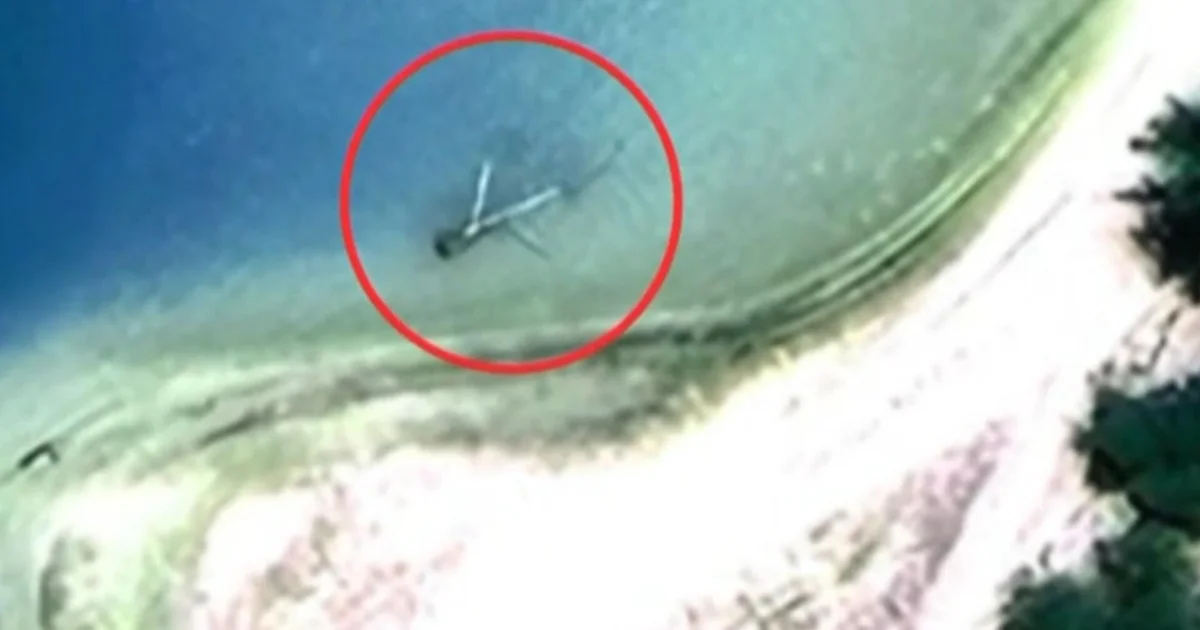

A puzzling object found near a remote Pacific island is not the wreckage of Amelia Earhart’s missing plane, researchers have concluded. The finding represents another disappointment for investigators trying to resolve one of aviation’s most enduring mysteries nearly 90 years after the famed pilot vanished.
Evidence collected at the Taraia Peninsula on Nikumaroro showed that the anomaly first detected in satellite images in 2020 was probably a group of large trees washed onto the peninsula’s sandspit, the researchers said. Much of the debris had broken apart and been carried away by the time the expedition arrived, leaving behind a lone Y-shaped section—the feature the team had initially hoped might be part of Earhart’s aircraft.
The object’s glossy, reflective surface initially suggested it could be metal. Researchers determined instead that the shine came from a carbonate coating. Other nearby materials had a similar layer, described as “a shiny concretized amalgam of coral sand.”
On Oct. 14, a 17-member expedition team headed by Purdue University’s Steve Schultz and Richard Pettigrew of the Archaeological Legacy Institute set out to examine the feature. In aerial photographs, the Taraia Object appeared to resemble possible wreckage from Earhart’s Lockheed Electra 10-E.
The team had five days scheduled for the search, but dangerous weather forced researchers to remain aboard their ship for three of them. With fuel and supplies running low, the expedition could not be extended. Reaching the isolated search site required five days at sea.
Investigators concentrated on a lagoon near Nikumaroro, where they inspected the Taraia Object, an anomaly first noticed in satellite imagery by a Navy veteran during the COVID pandemic. Although the feature can be seen in aerial photographs dating to 1938, it was not identified until 2020. Before the expedition reached the site, Pettigrew said the team believed the object might be metal rather than a tree, but an on-site examination was needed.
Rick Pettigrew, Archaeological Legacy Institute
“Amelia Earhart’s spirit of courage and curiosity drove every step of the search,” Pettigrew said Sunday. “We accomplished our goal to determine what the Taraia Object was, and we’re deeply grateful to the private donors who shared our vision and made this journey possible. Our team remains in great spirits and proud of what was accomplished.”
Before reaching the island, the researchers planned to photograph and record the lagoon and Taraia Object, then use magnetometers and sonar to survey the surrounding area. The team also intended to recover the object for closer identification. The Archaeology Channel chronicled the expedition with short video reports on its Heritage Broadcasting Service streaming platform.
In an earlier news release, the research team said there was “very strong” evidence that the anomaly could be Earhart’s lost aircraft.
EXPLORE MORE: Firefighters Save Historic Godfather Church From Massive NYC Warehouse Fire
Earhart and her navigator, Fred Noonan, disappeared on July 2, 1937, after traveling about 22,000 miles. Earhart was attempting to become the first woman to fly around the world—and the first pilot to complete the journey along the equator, the Earth’s widest point.

Getty Images
More recently, President Trump ordered the declassification of records related to Earhart.
Nikumaroro belongs to Kiribati, an archipelago nation situated roughly halfway between Australia and Hawaii. The island is about 400 miles southeast of Howland Island, Earhart and Noonan’s destination when they disappeared during their around-the-world flight.
Pettigrew maintains that Earhart and Noonan landed on Nikumaroro and survived there for a period of time. He cites 1930s-era artifacts and human remains found on the island, although the remains were later lost, as possible support for the theory. Still, multiple explanations for the aviator’s disappearance have circulated over the decades, and many remain unproven.
The search for Earhart’s plane has continued for generations, with researchers hoping the aircraft could finally explain what happened to the pilot and her navigator. In 2024, an expedition recorded a sonar image of what appeared to be an aircraft on the seafloor. Further investigation showed that the object was actually a rock formation.