
Share this @internewscast.com

Archaeologists have made an extraordinary discovery near the Sea of Galilee, unearthing an artifact that could offer fresh insights into early Christian baptismal practices.
This 1,400-year-old relic was discovered in the ancient city of Hippos, a significant center of ecclesiastical authority during the Byzantine period, as reported in a press release on March 30 and shared with Fox News Digital.
Historically, Hippos was the sole Christian city encircling the Sea of Galilee, a region intimately connected to the ministry of Jesus.
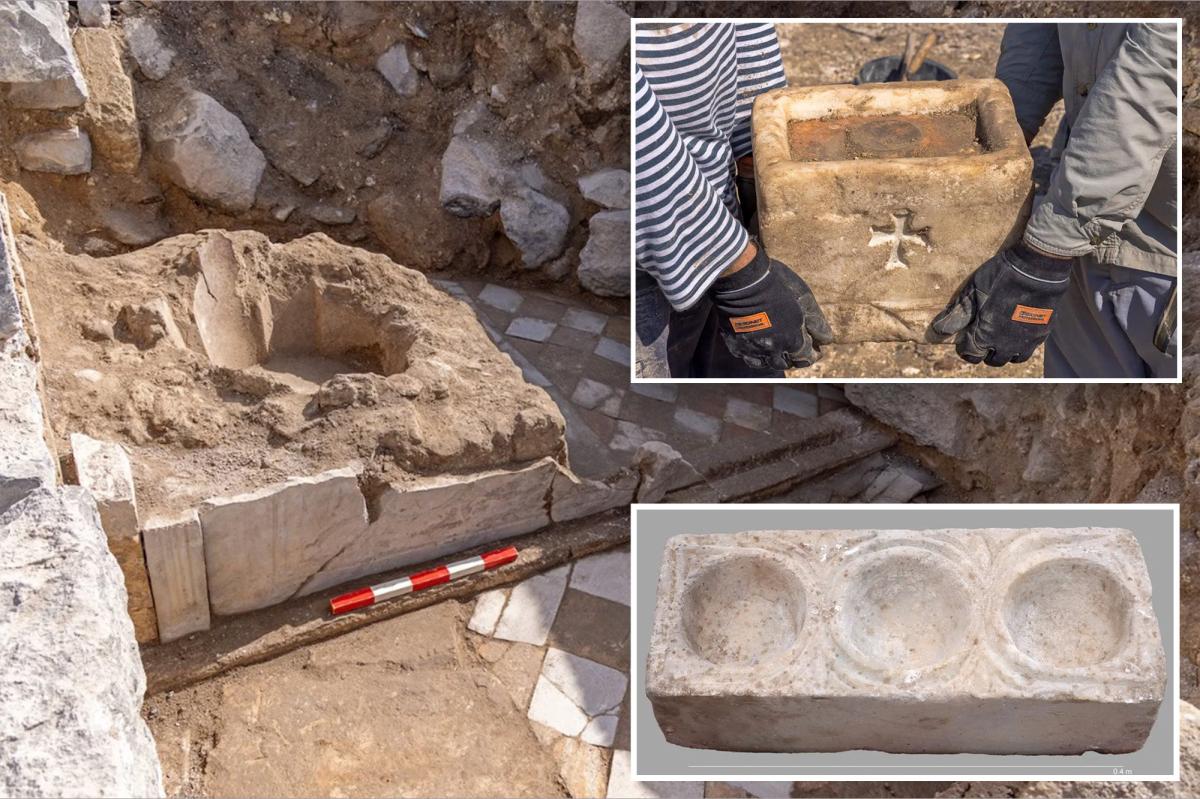
The artifact, a marble block, was discovered in a baptismal hall known as a photisterion. Officials believe it could illuminate aspects of early Christian baptismal rites that have remained undocumented until now.
The cathedral at Hippos featured two baptismal halls: one designated for adults and another for infants and children, the latter being the site of the recent find.
Constructed after 591 A.D., the smaller hall met its demise in an earthquake in 749 A.D., establishing the artifact’s age at approximately 1,400 years.
Officials described the artifact as “a rectangular block bearing three hemispheric cavities, found beside a baptismal font in a newly revealed ceremonial hall.”
Researchers believe the block may have held three different oils used during a threefold baptismal immersion ceremony.
Pictures of the object show the weathered marble block with three bowl-shaped basins, suggesting it was designed to hold liquids side by side.
Early Christian baptisms more commonly involved two anointings before and after the rite — which makes the three-part design particularly unusual.
“The collapse buried the marble and bronze artifacts beneath the rubble, preserving them until their recent discovery,” the release noted.
Officials added, “After extensive examination and comparison, the scholars concluded that no known parallels to the artifact exist.”
Michael Eisenberg, a University of Haifa archaeologist who recently published the results in the journal PEQ, along withcolleague Arleta Kowalewska, said the object was found among a variety of “remarkable liturgical objects,” including a bronze candelabrum used to hold candles.
“Only after careful research did we realize how unique they are for understanding Christian ritual practices in the cradle of Christianity by the Sea of Galilee,” he said.
The object was “nothing special at first glance,” to the excavations, Eisenberg told Fox News Digital.
“But here is exactly where the archaeological and liturgical studies came into play.”
“Realizing that it is a one-of-a-kind artifact that may fill unknown regional and perhaps wider lacunae in one of the most ancient and sacred Christian ceremonies was a complete surprise.”
Eisenberg said the findings may “open a portal” to the development of baptism rituals in the early Christian world.
“In different regions, distinct liturgical traditions developed, many of which are not documented in written sources,” the archaeologist said.
“This find offers a rare glimpse into how the baptismal rite was shaped and practiced in the Byzantine Christian community of Hippos.”
The find joins a long list of significant archaeological discoveries found at Hippos in recent years.
Last year, excavators in Hippos found a 1,600-year-old Christian care facility for the elderly, which is possibly the world’s oldest nursing home.
Last July, metal detectorists found a trove of ancient jewelry and gold coins near ruins in Hippos.