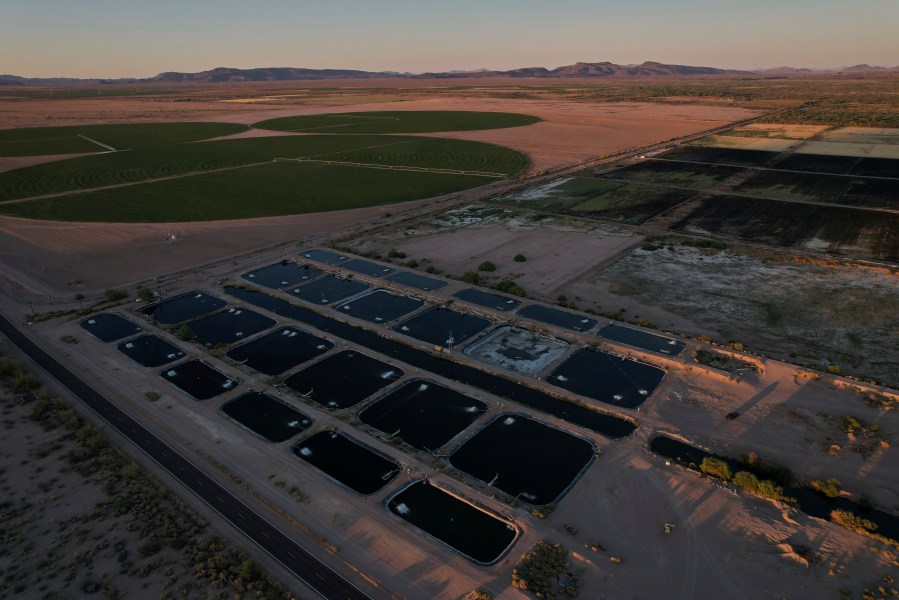


DATELAND, Ariz. (AP) — As Dan Mohring drives his pickup down the dusty path, a flurry of storks flees over the azure water. His trailer is loaded with minced beef, chicken, fish, and nutritious pellets, all set to be launched by a cannon into the ponds below.
It’s time to feed the fish.
Mohring activates the contraption, and a colorful arc of food cascades into the air. The water suddenly stirs to life. Countless barramundi surge to the surface, wriggling and swirling as they compete for a bite. In just a few months, these fish will be destined for dinner plates themselves.
Amid the Arizona desert, where scrutinizing water use has become crucial due to the Colorado River crisis, Mainstream Aquaculture operates its fish farm. Here, they cultivate barramundi, also known as Asian sea bass, to supply U.S. restaurants with this tropical delicacy.
Mainstream sees it as a sustainable alternative to ocean-caught seafood. They say chefs and conscious consumers like that the food has a shorter distance to travel, eliminating some of the pollution that comes from massive ships that move products around the world. And they and some aquaculture experts argue it’s efficient to use the water twice, since the nutrient-rich leftovers can irrigate crops like Bermuda grass sold for livestock feed.
“We’re in the business of water,” said Matt Mangan, head of Australia-based Mainstream’s American business. “We want to be here in 20 years’, 30 years’ time.”
But some experts question whether growing fish on a large scale in an arid region can work without high environmental costs.
That question comes down to what people collectively decide is a good use of water. In Arizona, some places manage water more aggressively than others. But the whole state is dealing with the impacts of climate change, which is making the region drier and water only more precious.
The farm uses groundwater, not Colorado River water. It’s a nonrenewable resource, and like mining, different people and industries have different philosophies about whether it should be extracted.
“As long as groundwater is treated as an open resource in these rural parts of Arizona, they’re susceptible to new industries coming in and using the groundwater for that industry,” said Sarah Porter, director of the Kyl Center for Water Policy at Arizona State University’s Morrison Institute.
Some scientists believe aquaculture can play a role in protecting wild ocean ecosystems from overfishing. And it might play at least a small role in smoothing any supply problems that result from the Trump administration’s tariffs on imports from dozens of countries, including those that send the U.S. about 80% of its seafood, per the United States Department of Agriculture.
A two-for-one deal?
In the greenhouses at University of Arizona professor Kevin Fitzsimmons’ lab in Tucson, tilapia circle idly in tanks that filter down into tubs full of mussels and floating patches of collard greens and lettuce. Fitzsimmons mentored the student who started the tilapia farm eventually bought by Mainstream about three years ago where they now raise barramundi.
“I don’t think desert agriculture is going away,” he said. “Obviously, we want to do it as water-efficient as possible.”
But not everyone agrees it’s possible.
“Artificial ponds in the desert are stupid,” said Jay Famiglietti, a professor at ASU and director of science for the Arizona Water Innovation Initiative. He worried about heavy water losses to evaporation.
Mangan says that evaporation hasn’t been an issue so much as the loss of heat in the wintertime. That has required pumping more water since its warmth when it arrives at the surface helps keep the barramundi cozy. But Mangan says they’ve been improving pond design to retain heat better and have found, after the last year of research and development, that they can cut their water requirement by about half as a result.
Plus, he argues, the water coming out of the fish ponds is “essentially liquid fertilizer,” and though it’s slightly salty, they use it for crops that can tolerate it, like Bermuda grass dairy cows can eat.
But that’s supporting the cattle industry, which contributes more than its share of planet-warming greenhouse gas emissions, Famiglietti said.
“Doing two suboptimal things doesn’t make it better,” he said.
Defining a ‘reasonable’ use of groundwater, a finite resource
Purple flowers sprout alongside paddle wheels. Fish bones crunch underfoot. The faint odor of brackish water and ammonia catches in the breeze.
Without groundwater, none of it would be possible.
Some farmers in Arizona rely on water from the Colorado River, but many others use well water to irrigate crops like alfalfa for the dairy industry or the lettuce, cucumbers and melons shipped nationwide year-round.
Arizona has seven areas around the state where groundwater is rigorously managed. Dateland doesn’t fall into one of those, so the only rule that really governs it is a law saying if you land own there, you can pump a “reasonable” amount of groundwater, said Rhett Larson, who teaches water law at ASU.
What might be considered “reasonable” depends from crop to crop, and there’s really no precedent for aquaculture, an industry that hasn’t yet spread commercially statewide.
Using numbers provided by Mainstream, Porter calculated that the fish farm would demand a “very large amount” of water, on par with a big ranch or potentially even more than some suburbs of Phoenix. And she noted that although the water use is being maximized by using it twice, it’s still depleting the aquifer.
When the company scoped out Arizona to expand, Mangan said they didn’t see nearly the same kinds of regulations as back in Australia.
As part of its growth strategy, Mainstream is also hoping to work with other farmers in the area so more can use nutrient-rich fish pond wastewater to produce hay. They say a few have expressed interest.
An alternative to wild-caught fish
The seafood industry needs to reduce its reliance on catching small wild fish to feed bigger farmed ones that humans eat, said Pallab Sarker, an assistant professor at the University of California, Santa Cruz, who studies sustainability in the aquaculture industry. He said seabirds and mammals rely on small species like anchovies and mackerel commonly used in fish meal.
“We should not rely on ocean fish to grow fish for aquaculture to meet the demand for humans,” Sarker said.
Mainstream gets its fish feed from two suppliers, Skretting and Star Milling, but Mangan and Mohring said they didn’t know for certain where those suppliers got their base ingredients from.
Fitzsimmons, of the University of Arizona, also pointed out that between pollution, overfishing and oceanfront development for recreation, the commercial fishing industry had already been facing problems. He doesn’t think that Trump’s moves this spring to open up marine protected areas for commercial fishing will improve that situation the way aquaculture could.
“We can’t keep hunting and gathering from the ocean,” Fitzsimmons said.
___
Follow Melina Walling on X @MelinaWalling and Bluesky @melinawalling.bsky.social. Follow Joshua A. Bickel on Instagram, Bluesky and X @joshuabickel. Follow Annika Hammerschlag on Instagram @ahammergram.
___
The Associated Press’ climate and environmental coverage receives financial support from multiple private foundations. AP is solely responsible for all content. Find AP’s standards for working with philanthropies, a list of supporters and funded coverage areas at AP.org.