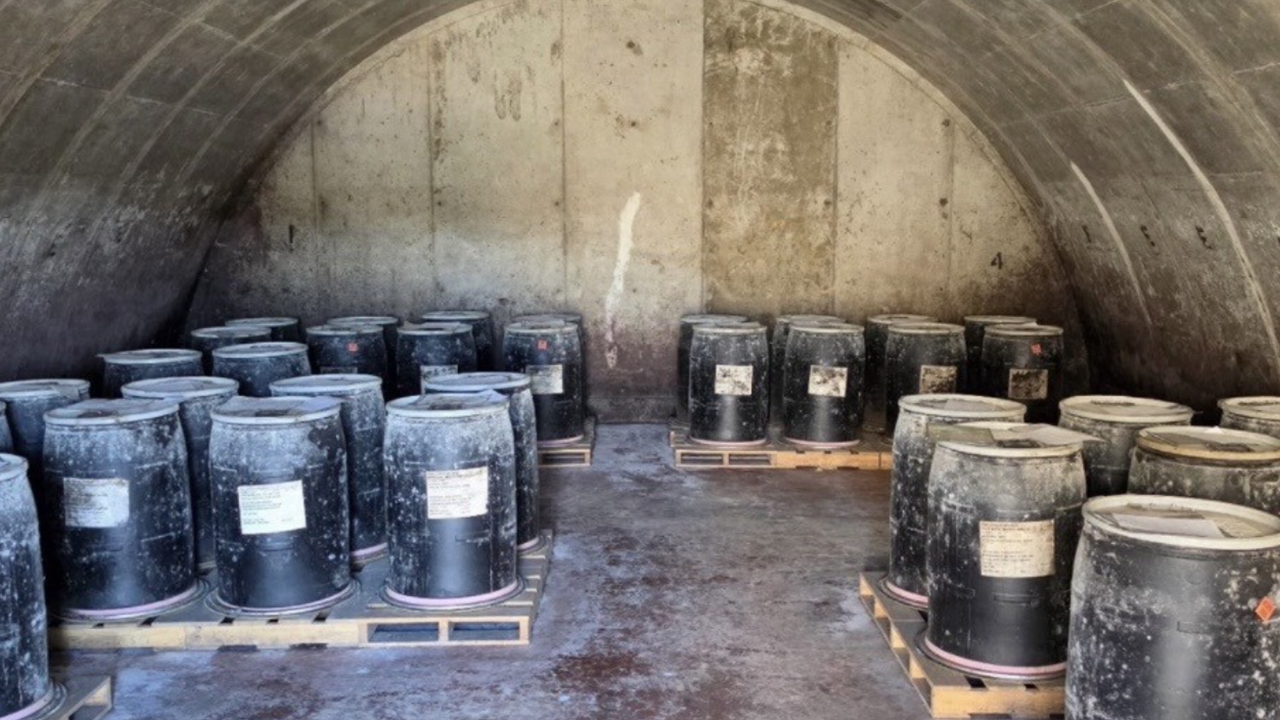


Barrels containing unstable lead azide were stored at the Iowa Army Ammunition Plant before Wednesday’s planned controlled detonation. (U.S. Army)
After several delays and intervention by a federal court, the U.S. Army detonated nearly 5 tons of degraded lead azide at its ammunition plant in Middletown, Iowa.
Two blasts were heard near the facility, according to a video feed.
A senior Trump administration official told Fox News that the planned detonation “exceeded all expectations” and achieved “maximum mitigation.” President Donald Trump later posted briefly on Truth Social, saying early reports indicated that the mitigation measures had worked.
Missouri Gov. Mike Kehoe said the detonation occurred about 15 minutes after residents heard the explosion. Updated Army maps showed the blast plume was expected to move southwest toward the northeastern corner of Missouri.
“Initial analysis shared with us by federal partners and Iowa Homeland Security and Emergency Management indicates that the mitigation measures appear to have been successful and the explosion was well-contained,” Kehoe wrote in a social media post.
DISCOVER MORE: Christian Filmmaker Finds Jewish Roots, Pursues Centuries-Old Secret

A sign marks the facility behind a fence at the Iowa Army Ammunition Plant on Nov. 19, 2026, in Middletown, Iowa. (Scott Olson/Getty Images)
Before the detonation, residents and environmental advocates cautioned that destroying the bomb-making materials could spread toxic lead dust across nearby communities. The Army built extensive barriers and applied specialized gels designed to capture and absorb debris.
Army officials and other federal agencies determined that a controlled detonation of the 68 barrels of lead azide — a highly volatile explosive — was safer and significantly preferable to allowing the material to explode on its own.
Officials said a spontaneous blast could have occurred at any time because the lead azide had crystallized. The crystals are extremely sensitive to heat, shock and friction. Authorities also warned that freezing temperatures, including those affecting Middletown on Wednesday, could further destabilize the material and set off an explosion.
This is a developing story. Please check back for updates.


