
Share this @internewscast.com
At Cape Canaveral, Florida, the excitement is palpable as NASA gears up for a monumental event. It’s been over fifty years since humanity’s remarkable journeys to the moon through the Apollo program, leaving an indelible mark on history. As NASA prepares for a new chapter with the Artemis program, comparisons to those iconic Apollo missions are inevitable.
In the coming days, a diverse crew of four astronauts will embark on humanity’s first lunar voyage in more than half a century. These astronauts represent a significant evolution from the early days of Apollo. Unlike the pioneering Apollo 8 mission, which made history as the first to orbit the moon, the Artemis II mission will take a more cautious approach. The crew will execute a slingshot maneuver around the moon before returning to Earth.
One of the most striking differences between the two programs is the representation within the Artemis crew. This mission includes a woman, a person of color, and a Canadian astronaut, showcasing a commitment to diversity that reflects modern society.
While Artemis is undeniably rooted in the legacy of Apollo, it also signifies a new era for NASA. Christina Koch, a NASA astronaut and member of the Artemis II crew, acknowledges this evolution. “There is no way we could be that same mission or ever hope to even be,” she remarked, emphasizing that Artemis, named after Apollo’s twin sister in Greek mythology, is forging its own path.
As NASA aims for an early April launch, excitement builds for this next step in lunar exploration. This mission will not only honor the pioneering spirit of Apollo but also pave the way for future endeavors, with a crew that embodies the diverse world we live in today.
Here’s the lowdown on Apollo vs. Artemis, the twin sister of Apollo in Greek mythology, as NASA targets the first six days of April for liftoff.
It took NASA just eight years to go from putting its first astronaut in space to putting Apollo 11’s Neil Armstrong and Buzz Aldrin on the moon in 1969, beating President John Kennedy’s end-of-decade deadline.
RELATED: ABC13 gets insight from NASA administrator on new test mission, city’s chances for retired shuttle
“The Apollo program still just absolutely blows me away,” said Artemis II astronaut Jeremy Hansen of the Canadian Space Agency,
Artemis has progressed much more slowly, after decades of indecision and flip-flopping between the moon and Mars as the next grand destination. NASA’s new moon rocket, the Space Launch System, or SLS, has soared only once in a test flight without anyone on board more than three years ago.
This plodding approach is why NASA’s new administrator, Jared Isaacman, overhauled the Artemis program in February. Keen to emulate Apollo, he added a mission between the upcoming Artemis II mission and the moon landing that’s now shifted to Artemis IV in 2028.
During next year’s revamped Artemis III, astronauts will stick closer to home, as Apollo 9 did in 1969. Instead of attempting a moon landing as originally envisioned, they will practice docking their Orion capsule in orbit around Earth with one or both lunar landers under development by Elon Musk’s SpaceX and Jeff Bezos’ Blue Origin. The rival companies are accelerating work on their landers to be first.
The Soviets were America’s fierce rivals during Apollo, but their moon rockets kept exploding at liftoff, and they eventually gave up. Now the Chinese are the competition.
China already has landed robotic spacecraft on the moon’s far side – the only nation to achieve that – and is scrambling to land astronauts near the lunar south pole by 2030.
NASA is aiming for the same polar region, where shadowed craters are thought to hold vast amounts of ice that could provide drinking water and rocket fuel. Like his predecessor Bill Nelson, Isaacman is determined to beat China to the finish line and win this second space race.
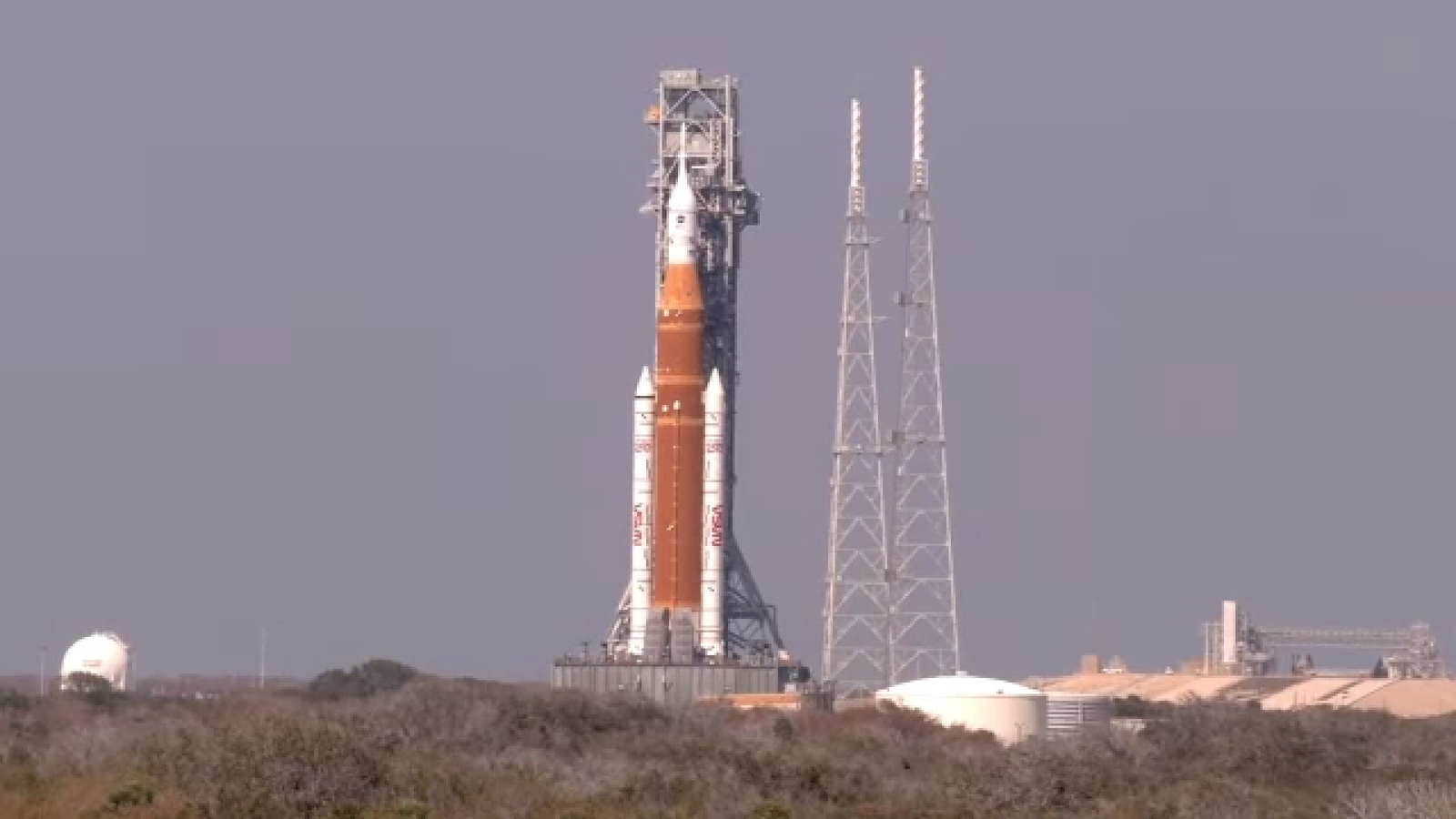
Apollo’s Saturn V rockets stood 363 feet (110 meters), with five first-stage engines. The Artemis SLS rocket comes in at 322 feet (98 meters) but packs more liftoff thrust with its four main engines and two strap-on boosters.
All but one Saturn V rocket soared from Kennedy Space Center’s Launch Complex 39-A, now leased by SpaceX. NASA will use the neighboring pad, 39-B, for all SLS flights.
While the Saturn V launched twice before carrying astronauts, the SLS has flown only once. Hydrogen fuel leaks delayed the SLS debut in 2022 and struck again during a countdown test in February, stalling the Artemis II mission. Then, helium trouble reappeared, causing further delay. NASA is now targeting an April liftoff.
Launch Control remains at the same place. There was one woman in the packed firing room for the liftoff of Apollo 11. Now a woman leads it: Artemis launch director Charlie Blackwell-Thompson.
Apollo 8 still ranks as the gutsiest space mission of all time. Frank Borman, Jim Lovell and Bill Anders became the first humans to launch to the moon in 1968. Borman, the commander, insisted on as few lunar orbits as possible given the risks. He and his bosses settled on 10 orbits as a warm-up for Armstrong and Aldrin’s 1969 moonwalk.
NASA decided long ago against orbiting the moon on Artemis’ crew debut, judging it too dangerous. The main goal is to test the Orion capsule’s life-support equipment, flying for the first time.
One big similarity between Apollo 8 and Artemis II is the troubled times surrounding them. “If we can contribute a little bit to hope for humanity,” said Artemis II pilot Victor Glover of NASA, “that is a huge thing.”
The Artemis astronauts will orbit Earth for a day to make certain everything is working properly before igniting the main engine and heading for the moon. It will take three to four days for the capsule to reach the moon and continue some 5,000 miles (8,000 kilometers) beyond, exceeding the distance record set by the 1970s ill-fated Apollo 13.
Like Apollo 13, Artemis II will take advantage of the moon and Earth’s gravity, making a figure eight after whipping around the moon to head home, using a free-return trajectory that requires little or no fuel. It got Apollo 13’s three astronauts safely back although they had to abandon their moon landing.
Artemis astronauts will parachute into the Pacific after their mission, as the Apollo crews did.
For Apollo, the white, bulky spacesuits did double duty. What the astronauts wore for launch and return was the same for moonwalks since there wasn’t enough storage space for different outfits.
The Orion capsules for Artemis are bigger, designed to hold four astronauts instead of three plus two sets of spacesuits. NASA created brand new spacesuits for use inside the capsule, while turning to private companies for the moonwalking attire.
Commander Reid Wiseman and his crew will wear the orange custom-fitted suits for launch and reentry. They’ll also use them in case of a depressurization or some other emergency. They can survive up to six days in the suits, inserting a straw into the helmet to sip water or protein shakes, and relying on undergarment bags and bladders as built-in toilets.
Houston-based Axiom Space is designing the white moonwalking suits that will accompany future Artemis crews.
Apollo was all about beating the Russians to the moon and planting the U.S. flag. Astronauts landed six times from 1969 through 1972, with the longest surface stay lasting 75 hours. Five of the 24 Apollo astronauts who flew to the moon are still alive.
For the first Artemis moon landing, a pair of astronauts could spend nearly a week there. It’s a more complicated plan than Apollo.
Artemis moonwalkers will launch to the moon aboard Orion and, once in lunar orbit, transfer to SpaceX’s Starship or Blue Origin’s Blue Moon, whichever is ready first. They’ll descend to the surface, and, after a few days, blast back into orbit to rendezvous with their Orion capsule. Orion will be the astronauts’ ride home.
NASA is striving for sustained lunar living, with Mars to follow, although “day one of the moon base is not going to look like this glass-enclosed, domed city,” Isaacman said. Last week, he unveiled a blueprint for the moon base showing habitats, rovers, drones, power stations and more. NASA plans to invest $20 billion over the next seven years.
Copyright © 2026 ABC News Internet Ventures.