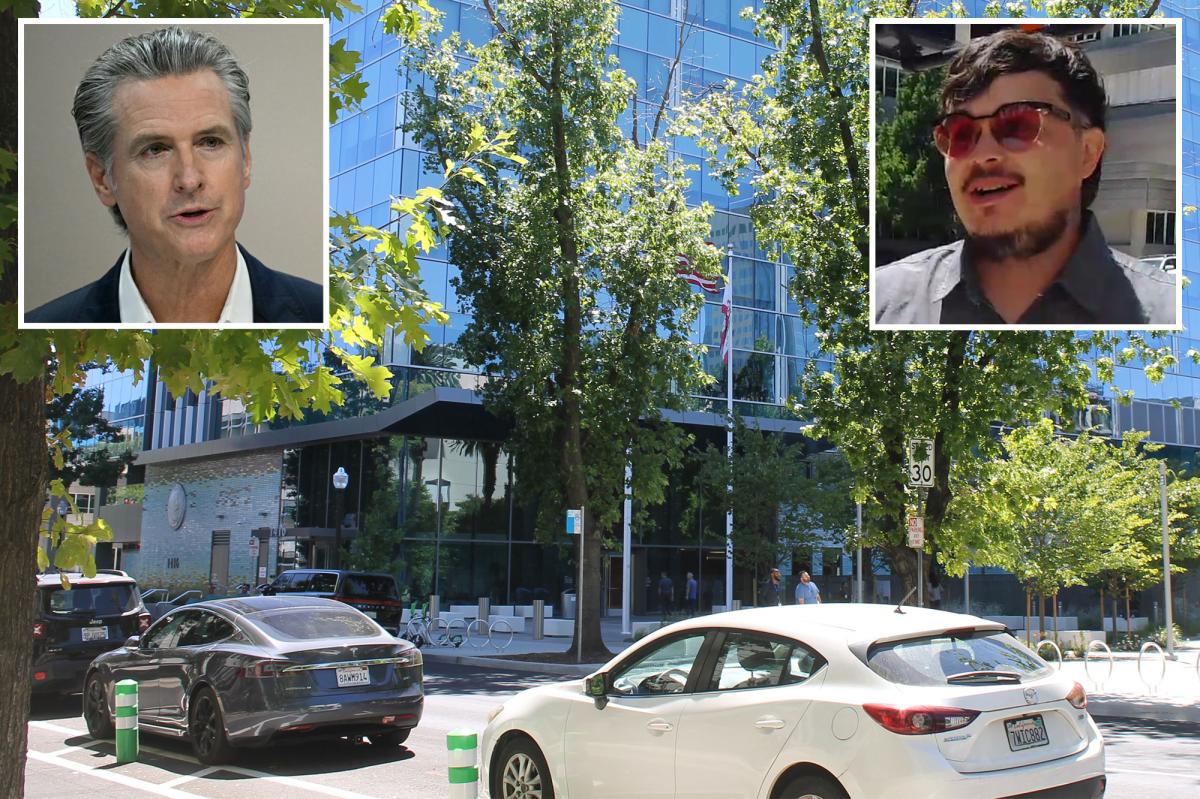

State employees have returned to downtown Sacramento for their first full workweek since Gov. Gavin Newsom directed most remote-working state staff to resume in-person work beginning July 1 — and many say the transition has been anything but welcome.
The California Post visited several state office areas Tuesday and spoke with public employees and others who said the corridors near the Capitol are noticeably more crowded. But they also described a return marked by higher food and parking expenses, difficult commutes and sagging workplace morale.
Juan Murillo, a resource strategies analyst based at the California Energy Commission building, sharply criticized the governor’s decision, saying employees were ordered back without meaningful bargaining.
“The feeling around the office is a little bit off, right? People are a little bit — not necessarily just working remote. It’s the fact that the governor’s office is able to make demands and make decisions on behalf of all of state of California employees,” he said.
“What if he’s able to tell us you have to work Saturdays and Sundays? What if what if he’s able to tell us your new schedule is 7:30 a.m. to whatever, right?” he added. “Just can’t have the governor’s office and any one person really making decisions across the state like that.”
Newsom’s directive affects about 108,000 state workers and represents a significant change for employees who had been operating under broader telework policies adopted during the COVID-19 pandemic. Under the new requirements, most must report to the office at least four days a week, although individual agencies may grant exceptions based on operational needs.
Newsom has argued that bringing workers back on-site is necessary to strengthen collaboration and improve public service. Unions representing state employees, however, have pushed back and protested the mandate.
Murillo pointed to several concerns labor organizations have already raised, saying they are now playing out in real time for him and his colleagues. Child care, he said, was far easier to manage while working remotely, but juggling it with office attendance has become especially challenging now that schools are out for summer.
He added that while there’s “more movement” downtown, folks are trying to save money to offset expenses for traveling to work, such as bringing their own lunch.
“Just because we’re here doesn’t mean we’re going to spend the money here,” Murillo said.
Parking costs have been a major thorn, workers said, and The Post observed many spaces filled to the brim. State employees have long complained about the state not covering parking in most cases.
The return-to-office mandate seems to have made finding parking a lot harder, even for non-government laborers. Juan Mahecha, a construction worker, told The Post that he didn’t understand why in the last few weeks, the lot he parked his truck at has suddenly consistently filled up.
Carey Wells, a state Department of Justice contract procurement analyst who also lives downtown, said parking at his own residence has become more of a hassle.
“If I’m leaving between the hours of 7 and 5, I likely will spend 20 to 30 minutes finding parking if I go on a lunch break anywhere or anything like that,” Wells told The Post while taking a break near Franklin D. Roosevelt Park.
Wells said his department isn’t under the governor’s authority so he doesn’t have to go into the office as often. But when he does have to, the costs of parking and eating out add up, he said. He criticized the bargaining process for many of his state government colleagues.
“You can’t have it both ways. We don’t have the money for raises but we have the money to send you back into office. Doesn’t make sense,” Wells said.
LaTonya Slade, an analyst with the state’s Employment Training Panel, said she wasn’t happy when she first heard of the return-to-office mandate. She said she still feels downtown feels more dead than expected, though she acknowledged it’s only the first full week back.
“It’s kind of very mixed right now,” she said on the general state of feeling from her and coworkers.
The transition period with returning to office is still in progress, she said. She hasn’t been asked to formally log which days she checks into the office and out, Slade said, though there may be further directions soon.
Murillo said the state needs to step up more. While he said he’s lucky he’s able to walk 20 minutes one way to his office, it speaks volumes that he rather walk than make the drive.
“‘l’ll tell you right now in this building, I’ve actually driven to the office, and it’s worse to drive to the office. Because there is no parking,” he said. “The state doesn’t want to provide us parking spaces. They don’t want to provide us anything. They’re not bargaining in good faith.”
Download The California Post App, follow us on social, and subscribe to our newsletters