
Share this @internewscast.com

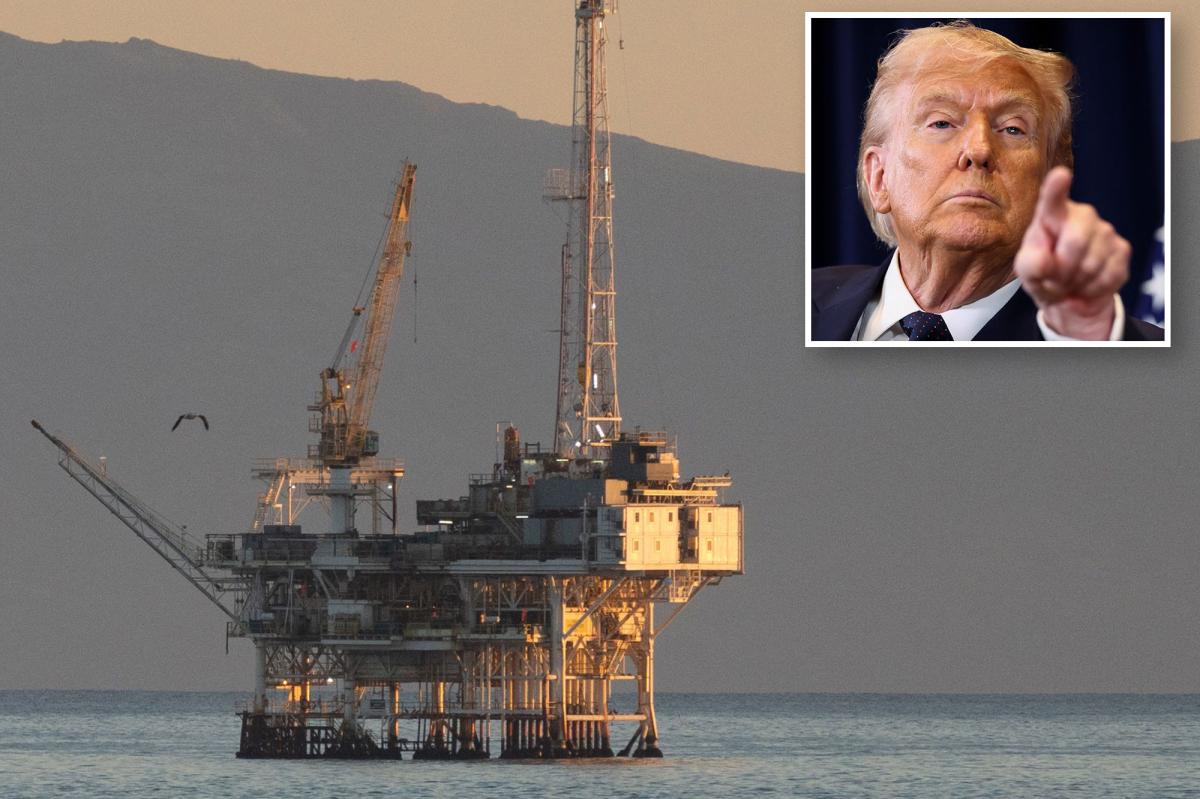
President Donald Trump took steps on Friday to reactivate offshore drilling in California through an executive order, but motorists shouldn’t anticipate a decrease in gas prices anytime soon.
In a bold move, the Trump Administration utilized the Defense Production Act’s emergency powers to authorize the reopening of the Santa Ynez offshore platforms and pipeline near Santa Barbara, operated by Sable Offshore Corp.
Sable Offshore Corp. has already informed local fire officials that they plan to “resume pumping operations within 24 hours.” However, Steve Borenstein, director of energy at UC Berkeley’s Haas School of Business, expressed skepticism to CBS News, stating, “It’s not going to have any effect on oil.”
“Not in the near future, because these things are going to be held up in court,” Borenstein explained. “There are going to be lots of lawsuits.”
The pipeline in question was involved in a significant oil spill in 2015, one of the worst in California’s history, which has kept Sable from resuming operations until now.
In response, California Governor Gavin Newsom has pledged to challenge the administration’s decision in court.
Borenstein said resuming offshore drilling won’t bring down oil prices, but it would create some jobs.
“What it does do, it increases the profit of oil companies and increases employment in the oil sector, so this would create jobs,” Borenstein told the outlet.
The Trump administration also announced it plans on tapping into the strategic oil reserves, releasing 172 million barrels starting next week.
However, Peter Leidel, founder of Yorktown Partners LLC, which manages private equity partnerships, told the California Post the decision likely won’t result in much relief at the pumps.
“Oil is a global commodity, you know 100 million barrels a day might have a very minor impact for a few weeks, but I don’t think that’s truly going to be that consequential,” he said, adding that it takes time for that oil to get through the system.
“You can’t just turn it on tomorrow. It takes a while to get it out and then it has to be refined,” Leidel said. “It probably takes two weeks to get it through the system.”
Oil prices have been hovering around $100 a barrel in the futures markets since Trump announced an attack on Kharg Island, a critical Iranian oil hub, where some 90% of its crude exports flow past.
“To get it back down, that we could stay at $3.50, you got to get lower than $83 oil prices,” Leidel told The Post.
California’s strict regulatory policies are also contributing to rising prices, according to Leidel, who said the state is in a particularly worse position than the rest of the country due to how dependent it is on foreign oil.
Patrick McDonald, CEO of Carbon Energy Corporation, which operates some of the oldest oil wells in the state, said easing the permitting restrictions on new wells would significantly help revamp the state’s oil and gas industry.
“We currently have 100 additional well locations that are off limits due to Senate Bill 1137, which is the setback from a sensitive receptor,” he told The Post.
The bill creates a 3,200ft Health Protection Zone around sensitive areas like homes, schools and hospitals — but McDonald said it is effectively being used to “put a halt to all activity.”
Download The California Post App, follow us on social, and subscribe to our newsletters
California Post News: Facebook, Instagram, TikTok, X, YouTube, WhatsApp, LinkedIn
California Post Sports Facebook, Instagram, TikTok, YouTube, X
California Post Opinion
California Post Newsletters: Sign up here!
California Post App: Download here!
Home delivery: Sign up here!
Page Six Hollywood: Sign up here!
If those restrictions were relaxed, McDonald said he could double his oil and gas production — a move that has already been piloted in Kern County through Senate Bill 237.
“The state is now allowing Kern County to issue their own permits for drilling, so that has dramatically changed the relatively restrictive policies that were in place at the state level and transferred that authority directly to Kern County, which is far more amenable and understands how the industry needs to work,” McDonald said, adding that he is hopeful the same change could come to Ventura County.
While McDonald is hopeful the move in Kern County signals broader change throughout the state, there is no quick fix overnight that could provide drivers some relief.
In the meantime, filling the tank will cost more for at least a few more weeks.