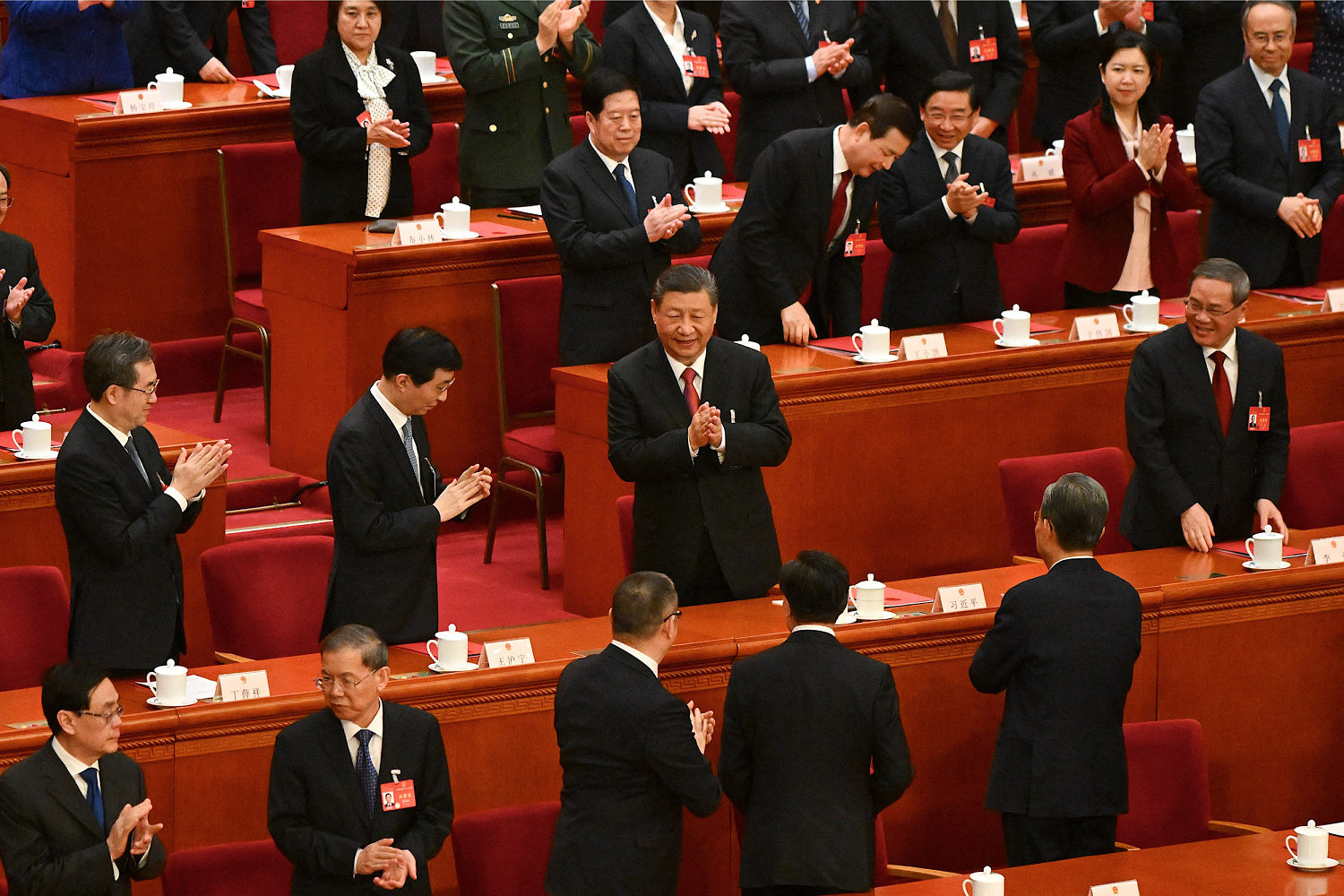
BEIJING — China’s national congress was concluding its annual session Monday with the usual show of near-unanimous support for plans designed to carry out ruling Communist Party leader Xi Jinping’s vision for the nation.
The weeklong event, replete with meetings carefully scripted to allow no surprises, has highlighted how China’s politics have become ever more calibrated to elevate Xi.
Monday’s agenda lacked the usual closing news conference by the premier, who in the past was responsible for economic affairs as the party’s No. 2 leader. It was the one time each year when journalists could directly question a top Chinese leader.
The news conference has been held most years since 1988, and the decision to scrap the event emphasizes Premier Li Qiang’s relatively weak status. Past premiers have played a much larger role in leading key economic policies such as modernizing state companies, coping with economic crises, and leading housing reforms that transformed China into a nation of homeowners.
The nearly 3,000-member congress approved revisions to the Organic Law of the State Council that direct China’s version of a cabinet to follow Xi’s vision. The vote was 2,883 to eight, with nine abstentions. Other measures passed by similarly wide margins. The most nays were recorded for the annual report of the supreme court, which was passed by a vote of 2,834 to 44.
“The Communist Party always called the shots but the party leaders who ran the State Council used to have a much freer hand in setting economic policy,” Neil Thomas, a Chinese politics fellow at the Asia Society Policy Institute, said in an emailed comment.
“Xi has been astonishingly successful in consolidating his personal hold over the party, which has allowed him to become the key decisionmaker in all policy domains,” he said.
In foreign policy, China appears to be sticking with Wang Yi as foreign minister. Wang stepped back into the post last summer after his successor, Qin Gang, was abruptly dismissed without explanation after a half-year on the job.
Analysts thought the Communist Party might use the annual congress to appoint a new foreign minister and close the book on an unusual spate of political mishaps last year that also saw the firing of a new defense minister after a few months on the job.
The Organic Law of the State Council is being revised for the first time since it was adopted in 1982. The revision calls for the State Council to “uphold the leadership of the Communist Party of China.” It also adds the governor of China’s central bank to the body.
Echoing words seen in just about every proposal, law or speech made in China these days, it spells out that China’s highest governing officials must adhere to the party’s guiding ideology, which refers back to Marxism-Leninism and Mao Zedong Thought and culminates in Xi’s philosophy on “Socialism with Chinese Characteristics for a New Era.”
Alfred Wu, an expert on Chinese governance at the National University of Singapore, said the revision institutionalizes previously made changes, making it harder to reverse them. He described the congress as a “one-man show” that shows Xi’s determination to create a system in which the party leads on policy, diminishing the role of the State Council and the legislature.
“His determination is very clear,” Wu said. “He is willing to change everything.”