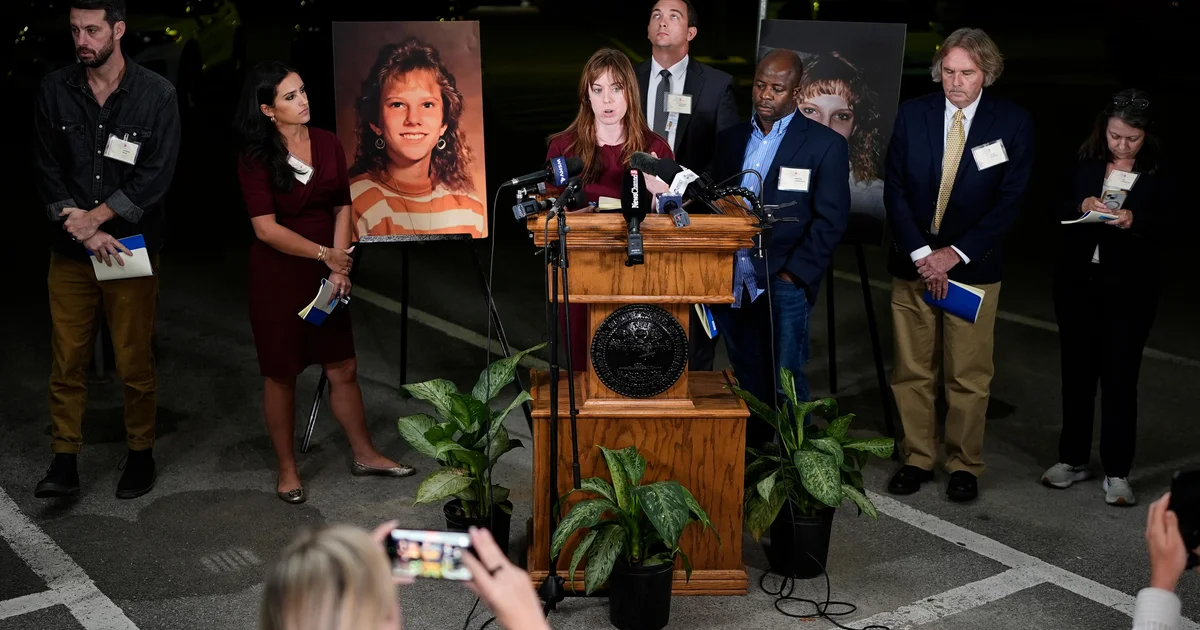

Attorneys for Tennessee death row inmate Christa Pike are urging the governor to commute her sentence after she survived the state’s attempt to execute her by lethal injection Wednesday night. They described the failed procedure as a “cruel,” “torturous” and “predictable” botched execution.
“The state of Tennessee has shown us again that they are not capable of carrying out an execution consistent with basic human dignity,” attorney Randy Spivey said at a news conference Thursday. “Last night was not just inefficient, it was cruel, and it was torturous. It was also predictable.”
Spivey and fellow attorney Steve Ferrell said they had warned state officials months earlier that Pike could face an agonizing death because of a blood condition and previous medical difficulties locating her veins.
“Christa has endured punishment greater than any other person in the history of the American death penalty,” Spivey said. “The governor must commute Christa’s sentence now.”
Pike remained in critical condition and was receiving lifesaving medical treatment Thursday afternoon. Additional details about her health were not immediately available.
“We don’t have a sense of her prognosis or much update on her health at the moment,” Spivey said.

AP
Pike’s execution is now on hold after Tennessee Gov. Bill Lee canceled the state’s remaining scheduled executions for the year and ordered “a comprehensive, third-party review to determine exactly what occurred.”
Pike had been set to become the first woman executed in Tennessee in 200 years after the Supreme Court ruled earlier Wednesday that the execution could proceed. She was sentenced to death for the 1995 killing of her former classmate, Colleen Slemmer.
Court records state that Pike and Slemmer were students at the Job Corps Center in Knoxville when Pike, then 18, tortured and killed Slemmer, 19. Prosecutors said the attack stemmed from remarks Slemmer had made about Pike’s relationship. Pike is now 50.
Spivey said the execution team spent an hour trying to establish an intravenous line Wednesday night. He said he personally counted at least seven needles being used, including one that appeared bent when it was removed from Pike’s arm after an unsuccessful attempt.
“It took an hour, despite the fact that Ms. Pike was not just cooperative, but was trying to help instruct the people placing the IV lines of where they could find them,” Spivey said. He recalled Pike repeatedly directing the team to try higher on her shoulder and other locations, then thanking them whenever they believed they had successfully established a line.
“Ms. Pike was kind, and she was cooperative, and she was at peace the whole time,” he added.
MORE STORY: The Lavish Lifestyle of a Chanel-Wearing ‘Karen’ Unveiled
The attorneys said Pike’s earlier court filings did not seek to stop or postpone her execution. Instead, they said, she wanted it carried out humanely, quickly and with as little pain as possible.
“I don’t think we could ever know what it was like to go through that time, but I do know that that really was her biggest fear,” Ferrell said. “It was not a fear of dying, it was a fear of a prolonged, painful, traumatic death.”
Spivey said Pike’s spiritual adviser was removed from the execution chamber twice even though Pike was visibly still alive. He also said officials lowered the curtain separating the chamber from the viewing room.
“What the protocol calls for is a five-minute waiting period, where they check the vital signs,” Spivey said. “And so, between 8:25 and essentially 8:50, when we were finally told that the ambulance was on its way, I have no idea what happened in that room.”
The attorneys further condemned the state’s handling of communications during the failed execution, saying officials were unable to quickly convey information about the emergency.
Spivey said it took about seven minutes—and passage through six locked doors—to reach a telephone where he could notify Pike’s legal team. He said that happened roughly 40 minutes after Pike received the first dose of chemicals.
Ferrell said the Tennessee Supreme Court had previously expressed concern about limited telephone access during an earlier botched execution but “did absolutely nothing to remedy the problem.”
When the attorneys finally reached a phone, Ferrell said they contacted the governor’s office but received no response. They then called the state Supreme Court through a special emergency number and reached voicemail. According to Ferrell, they gained access to the court only after filing an emergency motion electronically and receiving a cellphone number by email.
Neither attorney could say with certainty what would happen next for Pike. Both expressed hope that she could recover and be part of any litigation moving forward. They noted the state has no requirement to apply for a new execution date and that the electric chair is another option available to the state. But they reiterated their hope that Pike’s sentence would be commuted after what she has gone through.
“She is in a class by herself as to what she has gone through,” Spivey said. “She endured more than 20 years of solitary confinement, and a full attempt, a full lethal injection attempt. That is unprecedented. That is cruel. This should not happen again.”
Emily Mae Czachor
contributed to this report.