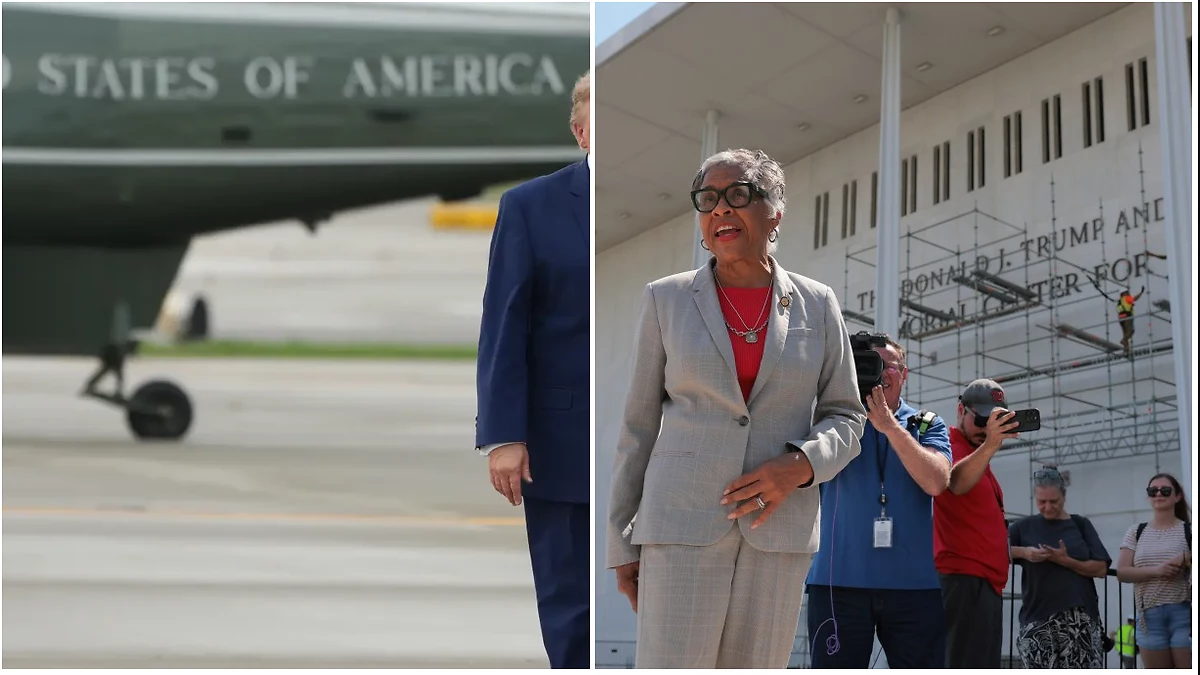

WASHINGTON — A new legal battle over the Kennedy Center for the Performing Arts erupted Thursday night, when a Democratic congresswoman asked a federal court to urgently stop President Trump’s name from being restored to the famed Washington, DC, cultural landmark.
Rep. Joyce Beatty (D-Ohio), who serves as an ex officio member of the Kennedy Center’s board of trustees, filed the emergency motion after board members voted last week to rename the area surrounding the venue as “President Donald J. Trump Plaza” and to place Trump’s name back on the building’s exterior — despite a federal judge previously ordering it removed in May.
Under the board’s proposal, Trump’s name would be displayed near the main entrance only if the renovation fund secures $100 million in donations. If that threshold is met, the venue would carry the formal title: “The John F. Kennedy Center for the Performing Arts Restored and Renovated By President Donald J. Trump.”
The performing arts center had been referred to as the “Donald J. Trump and John F. Kennedy Center for the Performing Arts” shortly after Trump’s January 2025 inauguration, following his push to remove the institution’s leadership and install a new board of trustees that subsequently named him chairman.
Trump’s name was taken down from the facade in June after DC US District Judge Christopher Cooper issued an order requiring its removal. The same ruling also halted a proposed two-year shutdown of the Kennedy Center for renovations.
In a status report submitted earlier this week, the board disclosed that it intended to move forward with restoring Trump’s name to the Kennedy Center complex as soon as Sept. 8.
That disclosure triggered Beatty’s Thursday night court filing, which asks Judge Cooper to temporarily freeze the renaming effort while he reviews whether the board’s latest moves run afoul of his May order.
Beatty’s motion contends that Cooper’s directive keeping Trump’s name off the Kennedy Center cannot be sidestepped simply by reframing how the president is honored, arguing that only an act of Congress could authorize such a change.

In 1964, Congress passed legislation renaming a planned National Cultural Center on the banks of the Potomac River after Kennedy, who had been assassinated the year before. The center opened in 1971.
That law explicitly prohibits the board from making the center into a memorial to anyone else or putting another person’s name on the building’s exterior.