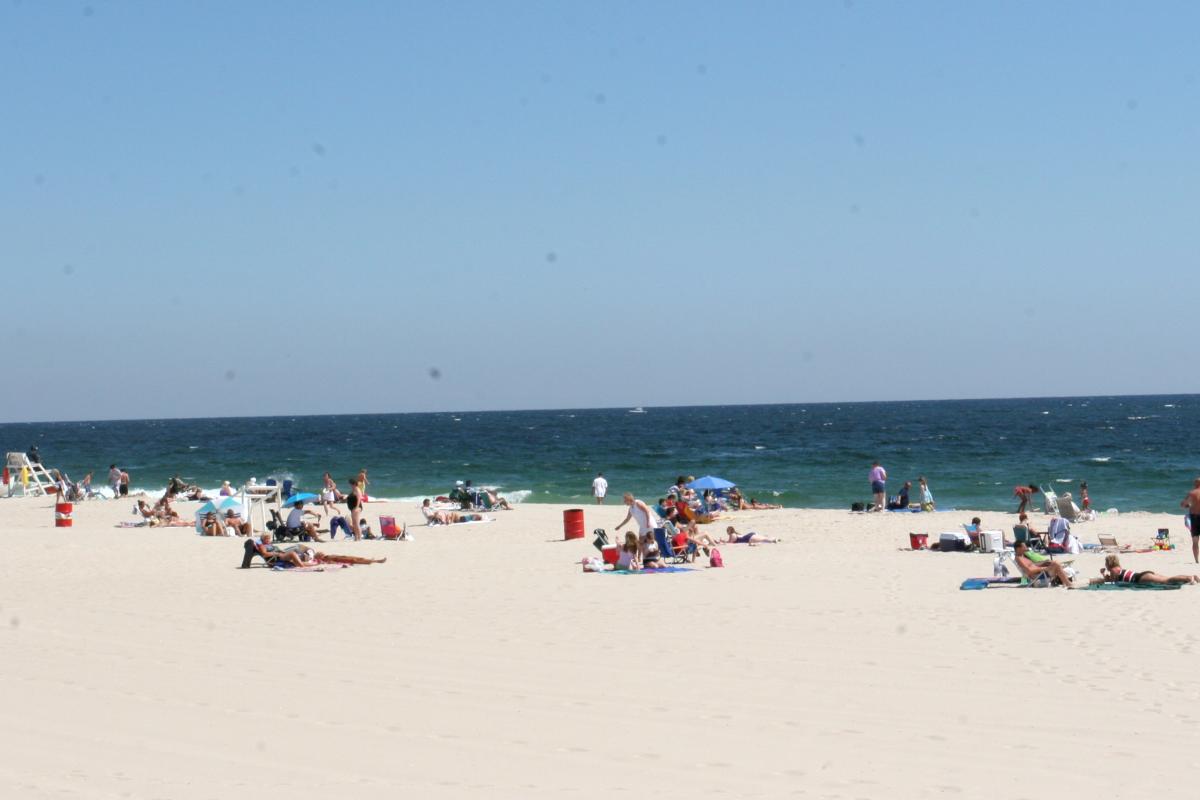


If you’re dreaming of tropical waters, you might not need to venture too far from home. The Mid-Atlantic coast is currently experiencing a remarkable change, with the ocean displaying a brilliant turquoise hue.
NASA’s satellite images have captured this transformation, highlighting the unusual brightness of the waters in areas like the Jersey Shore. These striking patches are the result of a combination of spring sunlight, nutrient-rich waters, and seasonal ocean upwelling, as explained by NASA.
Since early April, satellites have been observing an intriguing patch of brownish, blue-green water off the shores of New Jersey, Delaware, Maryland, and Virginia. This phenomenon is most pronounced in the shallow coastal zones where the waters of Raritan Bay, Delaware Bay, and Chesapeake Bay merge with the Atlantic Ocean, a region known as the Mid-Atlantic Bight.
The Mid-Atlantic Bight stretches from Cape Hatteras in North Carolina up to Martha’s Vineyard in Massachusetts. Here, coastal phytoplankton blooms are a common occurrence during winter and summer, although the timing and scale of these blooms can vary annually.
The colors and patterns appear to be most intense in the shallow coastal zone where the waters of Raritan Bay, Delaware Bay and Chesapeake Bay merged with the Atlantic Ocean — an area known as the Mid-Atlantic Bight.
The Mid-Atlantic Bight falls between Cape Hatteras, North Carolina, and Martha’s Vineyard, Massachusetts. In this area, coastal phytoplankton blooms initiate in the winter and summer, although the timing and size of blooms varies from year to year.
The area is not typically known for its Caribbean-like water. In fact, scientists consider the Mid-Atlantic to be “noisy” or “dirty” because rivers often discolor coastal waters with plumes of suspended sediment, water stained with colored dissolved organic matter and an array of microscopic and aquatic plant life, according to NASA.
When this matter mixes with phytoplankton blooms, it becomes more difficult for scientists to distinguish and categorize blooms in shallow coastal zones compared to deeper, darker, more uniform waters of the open ocean, NASA said.
Why the water looks tropical
Scientists say the blue waters come from phytoplankton, which are microscopic plant-like organisms that float near the ocean’s surface.
When sunlight hits chlorophyll inside dense concentrations of the organisms, the water reflects bright blue and turquoise tones visible from aircraft and orbiting satellites.
The ocean off New Jersey typically appears darker green or gray because of sediment, algae and changing light conditions. This bloom changes that appearance dramatically.
But if you’re on a boat in the middle of the ocean, the water might not look all that different to you.
As phytoplankton multiply rapidly in nutrient-rich water, chlorophyll absorbs portions of sunlight while reflecting blue-green wavelengths, producing the glowing turquoise effect which is now visible in the Mid-Atlantic, according to NASA.
As a result, locals and visitors are comparing the coastline to tropical destinations, like the Caribbean and the Bahamas.
NASA’s Earth Observatory and Goddard Space Flight Center have been closely tracking the bloom as it expands across the Mid-Atlantic coast.
These blooms happen every year, but the scale and vivid coloring of this year’s bloom have drawn attention. NASA said the combination of weather, nutrient levels and ocean currents this spring produced one of the region’s most visually striking displays in recent memory.
Last year’s bloom turned water in the Atlantic and Cape May counties a bright blue for several weeks before disappearing, according to NASA.
“The colors are caused by light interacting with high concentrations of phytoplankton near the surface,” scientists explained in NASA observations of the event.
But is it safe?
Luckily, the bloom poses little danger to those on the water, including swimmers, surfers and beachgoers, officials said.
Phytoplankton form the foundation of the marine food chain and are essential to ocean ecosystems. Similar blooms happen every spring as temperatures rise and sunlight increases.
However, scientists say extremely large blooms can sometimes create temporary stress on marine life if massive amounts of phytoplankton die off at once.
When algae dies and sinks to the ocean floor, it is consumed by bacteria. This process consumes oxygen in the water and if the levels drop too low, it can stress and potentially kill fish and shellfish, according to researchers. These impacts tend to be very limited and short-lived.
Oceanographers with Rutgers University said the bloom will likely fade once available nutrients in surface waters are depleted.
Unless storms, river runoff or additional upwelling replenish those nutrients, the tropical appearance will dissipate within weeks as ocean conditions return to normal.