
Share this @internewscast.com

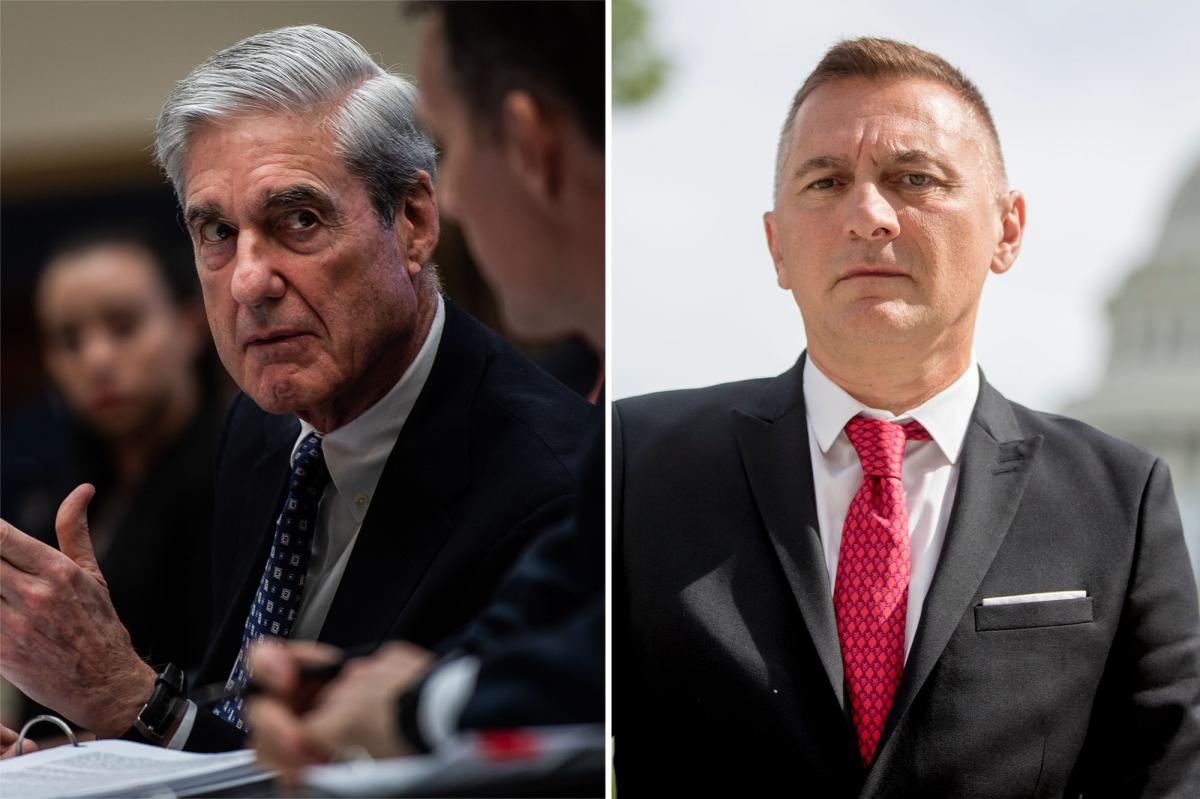
The Justice Department has discreetly amended a significant detail in former special counsel Robert Mueller’s report concerning the investigation into President Trump and Russia. This adjustment follows an extensive legal battle and acknowledges an essential mistake in the report’s notorious “golden showers” footnote.
Within the footnote of Mueller’s 2019 report, a connection was suggested between Georgian-American businessman Giorgi Rtskhiladze and alleged recordings of Donald Trump in Moscow. This insinuation sparked fervent speculation across cable networks, suggesting that Russia might possess compromising material, or “kompromat,” on Trump.
This allegation was among the most sensational claims from the “Steele dossier,” which was put together by former British intelligence officer Christopher Steele during the lead-up to the 2016 presidential election. However, the footnote contained a critical inaccuracy, which Rtskhiladze argues has had significant repercussions for him.
“This was a massive falsehood. Now, with the correction, it’s clear I was misrepresented. They knew from the start that I was Georgian-American, not Russian,” Rtskhiladze expressed to The Post.
The erroneous identification in the report further fueled the controversial and unverified claims about Trump’s alleged activities with sex workers in a Moscow hotel during the 2013 Miss Universe event. It also highlighted Rtskhiladze’s interactions with Michael Cohen, Trump’s former attorney, as potentially incriminating.
This correction marks the sole official amendment to the 448-page document, which was a focal point of political contention during Trump’s initial presidency. Despite its significance, the Department of Justice did not publicly announce the adjustment, which now resides quietly on the agency’s archival page dedicated to Mueller’s work.
Rtskhiladze sued Mueller and the US government for defamation in 2020. DOJ issued its dry correction to footnote 112 in December, The Post has learned.
DOJ “notes that the Report on the Investigation into Russian Interference in the 2016 Presidential Election (2019) incorrectly identified” Rtskhiladze as a “Russian businessman … when in fact he is Georgian-American,” it states, in its entirety.
The correction mentions nothing else about its unsubstantiated allegations about Trump. But the correction punctures a key part of the narrative, which Rtskhiladze says destroyed his reputation by portraying him as an agent for Moscow and ultimately its president, Vladimir Putin.
He was born in a former Soviet republic that is experiencing severe strains with Moscow. He has become a US citizen, and says his texts with Cohen were mere banter and passing along rumors he had heard in Moscow.
In one fateful text included in the footnote, Rtskhiladze wrote Cohen that he “Stopped flow of some tapes from Russia.” The Mueller report omitted the word “some,” which Rtskhiladze also says distorted the tone of his message.
The businessman, who once partnered with Trump on a tower project in the Republic of Georgia, brought his defamation case all the way to the US Court of Appeals for the DC Circuit. He didn’t win any money, but is in the process of trying to get the feds to pay legal fees in the thousands of dollars. The court did rule he had standing to bring his claim, reversing a lower court ruling.
“Everybody knew this was a lie. Mueller knew it was a lie. They knew it was a lie because I spent 25, 30 hours with them (being interviewed by his prosecutors). And they were fishing the whole time, trying to find angles in every way possible,” he said.
“They were offering me all kinds of different things — I could not discuss until this case was done and closed.”
What they wanted, Rtskhiladze claims, was dirt on Trump.
“They were implying in every way possible if I ever detected Trump being interested in meeting Mr. Putin, if I was ever asked by Mr. Trump to set up a meeting with Mr. Putin. And when we were in Georgia, did Trump ever acquire any, you know, women — [or engage in] bad behavior. All those questions were coming to me in a way [that] if you give us that, we’ll kind of take it easy on you. If not, you’re going to have seven prosecutors coming at you like dogs hunting your throat.”
The Justice Department did not respond to a request for comment. Former Mueller assistant prosecutor Jeannie Rhee, a private lawyer who interviewed Rtskhiladze in 2018 as a top prosecutor on Mueller’s team, did not respond to a request for comment.
Cohen praised the DOJ’s correction.
“I’m glad he got his ounce of flesh from them in terms of having to have a correction put in,” said Cohen, who said he was “happy with the outcome but disappointed on how long it’s taken in order to get to this truth.” He recalled his 2019 House testimony “about the infamous pee-tape” and said there was no such thing. “They asked me how do you know? And I said because I tried to find it. And it doesn’t exist,” he said.
Former Trump campaign aide George Papadopoulos, who pleaded guilty to lying to the FBI in 2017 about meetings with Russian intermediaries, said he understood Rtskhiladze’s battle against the Justice Department.
“In terms of the power that a special counsel — these type of prosecutors — have, they could destroy your life if they want to, and they try to do that to many people,” said Papadapoulos, who got a pardon from Trump — and whose case helped trigger the Russia probe.
“My experience was basically being somebody caught between a rock and a very hard place, and that was the tool that the government wanted to utilize,” Papadapoulos said.
In addition to fighting in court to try to clear his name, Rtskhiladze worked behind the scenes to persuade key Trump administration figures, buttonholing AG Pam Bondi and Vice President JD Vance during events at the now-renamed Trump-Kennedy Center.
“This addresses a mischaracterization that distorted the 2016 election narrative and fueled the Russia hoax,” said Rskhiladze’s spokesperson Melanie Bonvicino, who said the footnote error caused “irreparable harm to him and his family.”
Rskhiladze ended his development deal with the Trump Organization after Trump won the 2016 election. The project in Batumi, Georgia, had been Trump’s first building project within Moscow’s historic sphere of influence.
“They have dismantled very good people, American citizens with enormous networks in that part of the world fighting Russian influence,” he said.