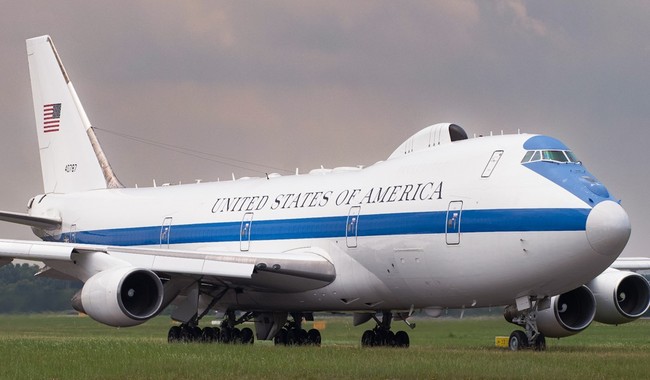

The striking aircraft spotted at Tulsa International Airport this week was not Air Force One, although its appearance made that assumption understandable. The E-4B Nightwatch is a heavily modified Boeing 747, and only four are operated by the U.S. Air Force. Its mission is serious: preserving America’s national command capabilities if a disaster or attack disables facilities on the ground.
That responsibility gives the aircraft a sobering purpose. It also illustrates that national defense relies on more than policy statements. It requires advance planning, specialized technology, rigorous training and personnel prepared to respond to events most people hope will never happen.
Known officially as the National Airborne Operations Center, the E-4B can serve as a secure command post for the president, secretary of defense and Joint Chiefs of Staff during a national emergency. From the air, senior officials can communicate securely, issue orders to U.S. forces and coordinate with civilian agencies. The aircraft can refuel while airborne, carries sophisticated communications systems and is supported by a readiness program designed to keep at least one plane available at all times.
— ꧁ C a r o l i n a ꧂ (@CarolinaOuest) September 28, 2026
The aircraft’s purpose is practical rather than glamorous. The nickname “doomsday plane” attracts attention, but it can distract from the central mission of the E-4B: ensuring continuity of government and military command under the most extreme conditions.
A government acting responsibly does not wait for communications networks to collapse, computer systems to fail and key buildings to become unreachable before deciding how the country will be led. It creates backup plans in advance. Preparing for a worst-case scenario helps prevent fear, disorder and opportunism from shaping the national response when a crisis strikes.
The E-4B “Nightwatch” appeared Monday morning at Tulsa International Airport as part of a training exercise. Often called the “Doomsday Plane,” the aircraft serves as the president’s National Airborne Operations Center during a national emergency. Courtesy: Tulsa International Airport https://t.co/AJmj4mOKyz
— KOKH FOX 25 (@OKCFOX) September 28, 2026
The logic is familiar. Families purchase insurance without expecting their homes to burn, and cities fund emergency services without anticipating disaster every day. The federal government has the same obligation on a national scale, especially when it is responsible for protecting more than 300 million Americans.
The Nightwatch fleet is notable not only for its mission but also for its limited size. The Air Force has just four E-4Bs, all based at Offutt Air Force Base in Nebraska. One aircraft remains on alert around the clock, supported by a worldwide watch team ready to activate the system. The fleet represents a narrow, highly specialized safeguard—not unnecessary duplication—designed to ensure that command and communications remain available when they are needed most.
The Navy’s “Doomsday Plane” fleet could nearly double with the arrival of new E-130J aircraft. The larger number of smaller turboprops is expected to replace the current fleet of larger E-6B jets, although the Navy has also recognized potential challenges. https://t.co/ooPfpJF4NH
— TWZ (@thewarzonewire) August 10, 2026
The E-4B is an aging platform, and the Air Force is working toward a replacement called the Survivable Airborne Operations Center. Updating the capability is necessary, but doing so will require stable funding and consistent acquisition planning rather than budget delays and political maneuvering. A credible defense posture depends on reliable equipment that is maintained and modernized on time—not simply on promises or speeches.
The Nightwatch’s appearance in Tulsa was not evidence that an emergency was unfolding. Instead, it offered a visible reminder that preparedness is a continuous mission. The country is more secure when its leaders can continue governing during a crisis, military commanders can receive lawful instructions and potential adversaries know that a single strike cannot render the United States leaderless or unable to respond.
That is not fearmongering. It is a fundamental responsibility of national security.
Editor’s Note: Socialism has deeply influenced the Democratic Party, and that influence is expanding rapidly. Although Democrats say there is no cause for concern, we believe the reality is more serious.