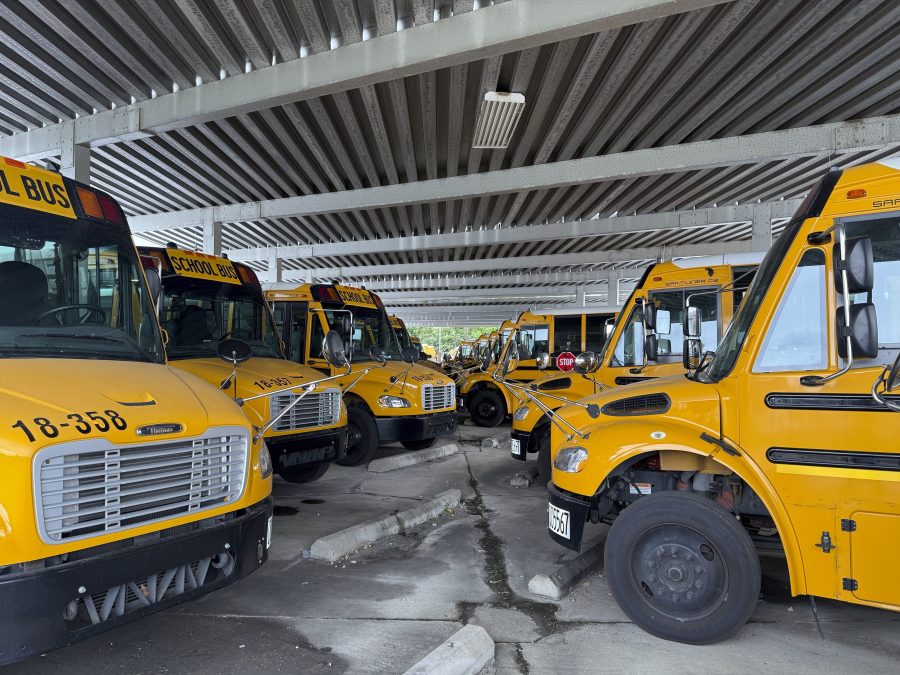


COLUMBUS, Ohio (AP) — A scramble is underway for some Ohio families over a staple of the back-to-school season: rides on the big, yellow school bus.
Public school districts have once again canceled bus transportation for thousands of high schoolers this year. Interestingly, they continue to bus students to private and charter schools to avoid hefty fines under state mandates. In Dayton, an interim measure involving public transit passes for students instead of school bus rides was temporarily reinstated by a judge last week. This decision followed the district’s lawsuit claiming the state had unlawfully limited the program.
The shortage of rides arises from a bus driver scarcity worsened by Ohio’s school transportation rules and the introduction of a universal voucher program. This program aids in funding private school education. Districts have long been required to transport EdChoice voucher students, but conflicts have grown as the program expanded by nearly 90,000 students in the last four years.
Public dollars for busing private students
Advocates for public education argue Ohio’s transportation mandates are inflexible, vague and expensive.
This policy holds public school districts accountable for transporting K-8 students to their respective private or charter schools, even on district holidays or if buses malfunction. It also necessitates that districts provide the same transport services to high school students attending private or charter schools in the region as they do for those in public schools.
In response, some large districts have eliminated high school bus services entirely, offering city transit passes where feasible or leaving public school students to find their own transport. These districts might still be required to bus private school students if adequate notification is not given within a specified period.
“It’s unfair that public funds are redirected to other entities,” said Ronnee Tingle, a Dayton mother whose 7th-grade child rides the school bus, while her teenagers in public school have to rely on city buses.
Her daughter, Suelonnee Tingle, a senior, begins her day by checking an app to see when a public bus will reach her stop. Although using the buses is “not bad,” the senior admits that learning the routes, transferring, and ensuring punctuality can be difficult due to the fluctuating arrival times.
Dayton Superintendent David Lawrence calls it “madness” that the Republican-led Legislature diverted roughly $2.5 billion in state education funding to the voucher program over the next two years — and still is still is requiring public districts to foot transportation costs for those students. His district runs 54 bus routes for its students and 74 for non-public students, according to data compiled by the Ohio 8 Coalition, representing the eight largest districts.
The Dayton district could easily provide bus rides for all of its public school students if the state ended some of the requirements about transporting voucher students, Lawrence said.
“If we didn’t have to transport charter school and parochial students, we could transfer all of our students almost door to door from K through 12,” he said. That would also help eliminate ancillary issues that arose with public high schoolers making their own ways to school, including disruptions on city buses and threats to their physical safety, he said.
Footing the bill
Republican state Sen. Andrew Brenner, a school choice advocate who chairs the Senate Education Committee, said he doesn’t believe that financial hardship, logistical nightmares and driver recruitment challenges are creating a school transportation crisis in Ohio, as public education advocates contend.
“That’s a completely inaccurate description,” he said. “What they have done is they’re excluding all the kids with school choice in many districts and they’re doing everything they can to avoid transporting them.”
Brenner said lawmakers provided districts with $1,500 per student to cover the costs of transporting voucher students, and he accused districts of abusing a provision that lets them deem busing the voucher students “impractical” and make “payment in lieu” of transportation to those families. The amount ranges from roughly $600 to $1,200 per student this year to offset the families’ costs.
Public school districts argue that transporting both public and private students costs way more than the state provides for it, contributing to budget woes. For Ohio’s largest districts, the gap can total millions of dollars.
Transportation burdens for parents
Cleveland paid families for 2,739 students it deemed impractical to transport to private schools this fiscal year, according to state data. Columbus was second on the list, paying for about 2,500. The state has sued Columbus schools, accusing the district of shirking mandates about transporting voucher students.
“Parents are being forced to quit their jobs, rearrange their lives and scramble for transportation, while the school board fails to meet its legal duties,” Republican Attorney General Dave Yost said last year. The case is still pending.
Columbus defended the decision, arguing that folding those non-public school students into its operation — a sophisticated, software-driven enterprise whose buses transport more than 16,000 public and 3,400 non-public students along some 450 routes — was unworkable. Spokesperson Mike Brown said the district has $75 million budgeted this school year for transportation, and another $15 million budgeted for transportation-related fines.
Lawrence said Ohio’s setup requires public districts to cover overhead for transportation systems. In Dayton, that includes buses that can cost more than $150,000 each, a stable of $66,000-a-year mechanics, a $1.1 million maintenance division, and drivers who make about $22 an hour with benefits on average. Those wages aim to offset the “Amazon effect” of drivers choosing package delivery over ferrying children for reasons including comfort, schedule flexibility and pay.
Brenner said he’d like to see more public schools explore the benefits of combining operations within counties to share resources.
The state’s largest urban and suburban districts — the Ohio 8 — argue lawmakers could help solve the issue by updating “antiquated” laws and regulations to align with current realities.
A study group was created in the last budget but tasked with studying just one issue: how to get non-public students to school on days when public districts are closed. Its recommendations are due in June 2026.
___
Associated Press videojournalist Patrick Aftoora-Orsagos contributed to this report.