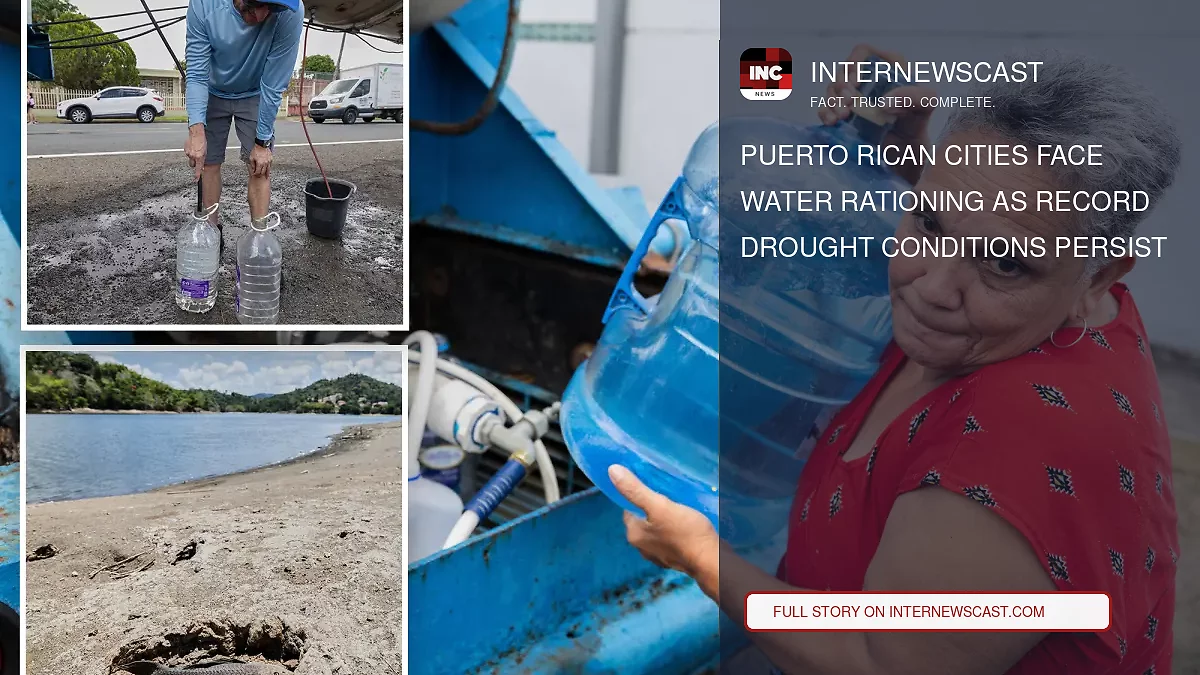

SAN JUAN, Puerto Rico — Puerto Rico is preparing to impose water rationing in San Juan and several other major cities as a stubborn drought tightens its grip on the U.S. territory, with forecasters warning that significant relief is not expected soon.
Beginning Friday, more than 180,000 customers will lose running water for 48 hours at a time under an alternating service schedule. The restrictions come as officials race to manage a worsening water crisis while extreme heat warnings remain in effect across parts of the island.
“This situation is out of our hands,” Gov. Jenniffer González said late Tuesday, pointing to persistent weather conditions as the driving force behind the emergency. “Nothing prevents this from worsening.”
San Juan endured its driest July in more than 120 years of recordkeeping, and the month also ranked as the capital’s second hottest on record.
Nearly a quarter of Puerto Rico is now in severe drought, while another 36% is classified as being in moderate drought, according to the U.S. Drought Monitor.
María Novoa García, a meteorologist with the National Weather Service in San Juan, said experts have forecast a milder 2026 hurricane season, with dry conditions likely to continue at least through September.
Rainfall over the next two to three weeks is expected to run at least 50% below normal, she said, deepening concerns over Puerto Rico’s strained water supplies.
“We are seeing that El Niño continues to get stronger,” Novoa García said, referring to the natural warming cycle that can influence weather patterns across the region.
In addition to affecting parts of San Juan, the rationing will extend to certain neighborhoods in the cities of Carolina, Juncos, Gurabo, Trujillo Alto, Canovanas and Loiza.
The governor said she doesn’t know how long the rationing measures will remain in place.
Luis González Delgado, president of Puerto Rico’s water and sewer system, said large trucks would distribute potable water, with priority given to hospitals and residences for older people.
Tania Conde Sterling, president of Puerto Rico’s Association of Health Services Administrators, called for calm on Wednesday, saying that hospitals and other health centers are prepared for the rationing.
“We do not improvise at hospitals,” she said. “We have manuals of rules and procedures, as well as protocols for every type of scenario.”
The drought is worsening, but thousands of Puerto Ricans were already experiencing water shortages up to a year before for unknown reasons.
Among them is 61-year-old community leader Marcia Soler París. She said Wednesday that the rationing measures don’t really mean much because her neighborhood already was experiencing severe water shortages for months.
“It’s chaos,” she said, questioning how Puerto Ricans are supposed to prepare for rationing when they don’t have water now. “It’s truly pitiful.”
She worries most about bedridden and older people who are unable to haul heavy water buckets to their homes and apartments.
The lack of water unrelated to the drought prompted San Juan Mayor Miguel Romero to sue the island’s Water and Sewer Authority in late May, with the governor acknowledging the agency’s infrastructure has lacked investment and maintenance for decades.
Puerto Rico Rep. Domingo J. Torres García warned on Wednesday that he would go to court if he doesn’t receive a response from the water and sewer authority about what’s causing the chronic water problems.
“The people have the right to know what is happening, what the plans are and what concrete actions are being taken to address this crisis,” he said.
Puerto Rico previously implemented rationing measures in 2020 and in 2015, when some 400,000 utility customers received water only every third day.


