
Share this @internewscast.com

In the town of Salla, Finland, a long-standing tradition continues to captivate audiences as the Salla Reindeer Cup drew a crowd of enthusiastic spectators this past weekend. Despite the biting cold and the town’s remote position near the Russian border, approximately 1,000 fans gathered to witness this unique event, located about 264 kilometers (164 miles) northeast of Oulu.
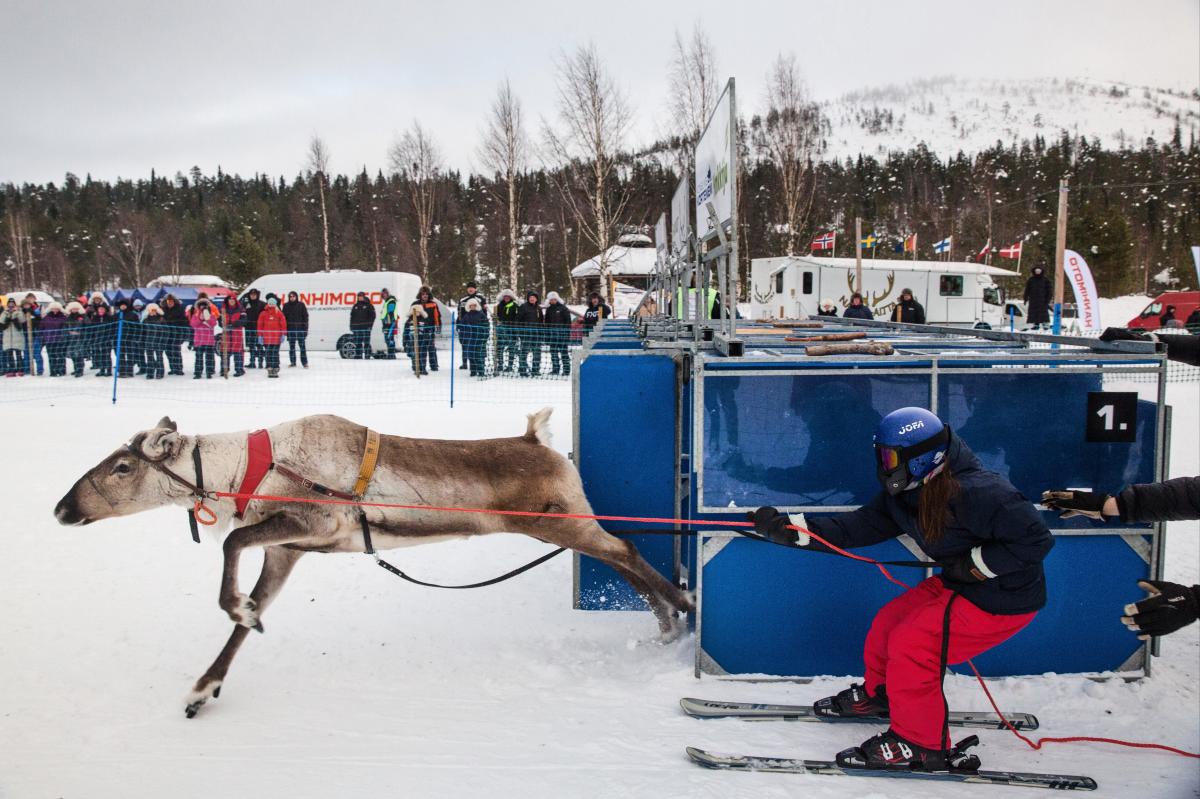
The chilly air was filled with excitement as reindeer thundered across the snow-laden track, each one towing a handler who expertly skied behind them. The thrill of the race lies in the speed—whoever crosses the finish line first claims victory.
This beloved spectacle attracted visitors from far and wide, with attendees hailing not only from various parts of Finland but also from countries like Italy, Norway, Germany, and France, underscoring its international appeal.
Reindeer racing is more than just a sport; it is a cultural cornerstone deeply embedded in Scandinavian heritage. Particularly for the Sami Indigenous people of northern Finland, reindeer husbandry remains a vital tradition, embodying a way of life that has persisted for generations.
Spectators came not only from Finland but also from Italy, Norway, Germany, and France, among other countries.
Reindeer husbandry has been an important part of Scandinavian culture for many decades, especially for the Sami Indigenous people in the far north of the country.
“Salla has a long history in reindeer racing — it’s been going on here since the 1950s,” said Lasse Aatsinki, the head of Salla Reindeer Cup. “Back then, men spent winters in the forest, there were no snowmobiles. In late winter, the reindeer were in great shape, so they started racing them.”
These days, reindeer racing is an organized and regulated competition with trained male reindeer.
The premiere event was the so-called hot series, in which reindeer qualify if they race the kilometer-long (just over a half-mile) track in 1 minute, 19 seconds, or less. Only the fastest reindeer get to compete in this race.
“It’s a science. A lot depends on the reindeer’s character — it has to tolerate a lot: the audience, other reindeer, noise, movement,” Aatsinki said. “Everyone has their tricks — and they’re usually kept under the fur hat. Every owner has their own way.”
During the race, crowds cheered their favorites on with calls of “hyvä, hyvä” and “mene, mene” — which is Finnish for “good, good” and “go, go” — as the reindeer sprinted down the final stretch.
In between races, people kept warm with reindeer soup and kampanisu, a traditional local pastry specialty from Salla.
The competition culminated on Sunday with the final rounds, and it was a reindeer named Pompom that won the final race.
“Pompom is exceptionally fast and smart, and you rarely find one like that,” said Hannu Krupula, the winning animal’s owner.
“If there’s any weakness, it’s that it’s not very good-looking — which can be misleading,” he added.
“When you look at that reindeer, you might quickly think it’s poorly fed or something. But it eats well. It’s a rare individual.”
And thus after the race, Pompom and all the other reindeer got their own reward — lichen, a symbiotic, colorful organism that grows on trees or rocks, and is the animals’ favorite treat.