
Share this @internewscast.com

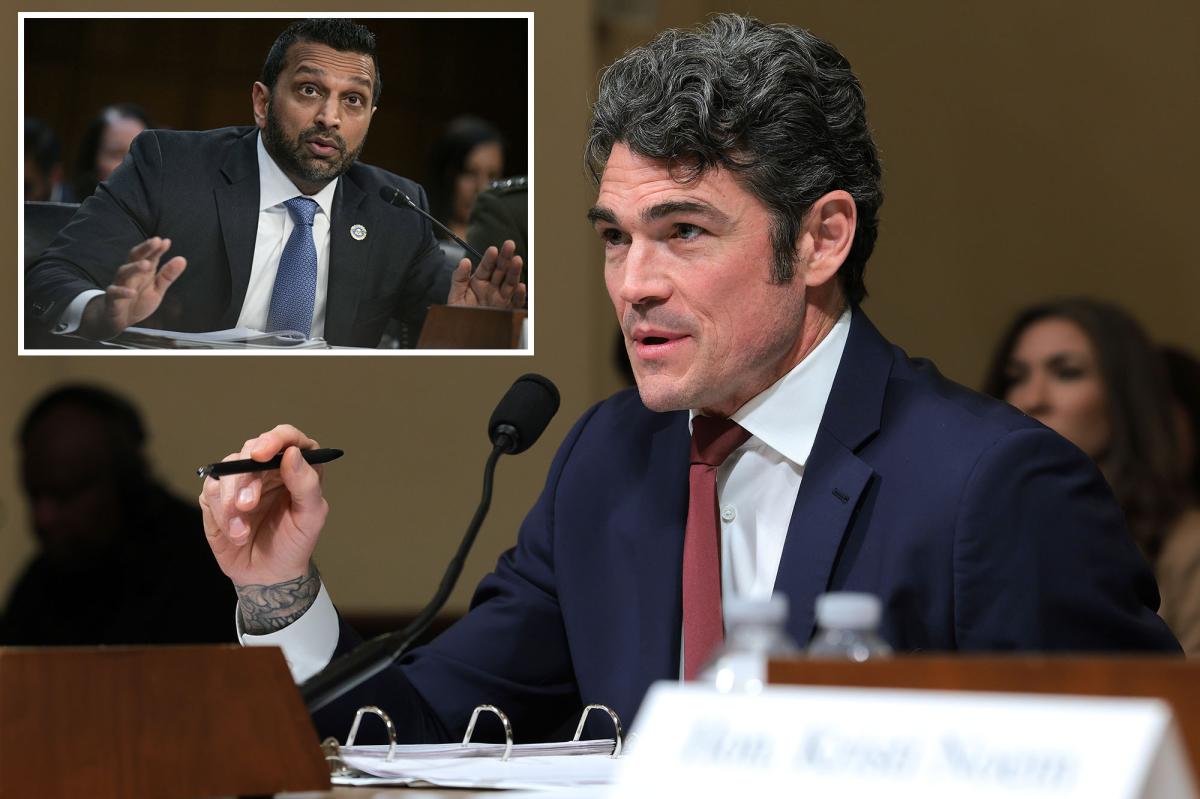
Joe Kent, once the National Counterterrorism Center’s director, stepped down on Tuesday in protest against the conflict with Iran. Now, he finds himself under FBI scrutiny for allegedly leaking classified information, according to a source familiar with the situation.
The investigation, initially reported by Semafor on Wednesday, began before Kent’s sudden exit from the Trump administration.
Further information on the investigation remains scarce at this time.
This revelation comes just a day after Taylor Budowich, a former deputy chief of staff at the White House, took to social media platform X on Tuesday, calling Kent “a crazed egomaniac” frequently involved in national security leaks, yet rarely, if ever, contributing meaningful work.
Budowich criticized Kent’s resignation, stating, “This isn’t some principled resignation. He just wanted to make a splash before getting canned. What a loser.”
In his resignation letter, Kent argued that Iran “posed no imminent threat to our nation” and claimed that President Trump initiated Operation Epic Fury “due to pressure from Israel and its influential American lobby.”
Kent, a two-time Republican congressional candidate, expanded on those claims in an interview with podcaster Tucker Carlson released Wednesday night, accusing conservative media personalities — “your Mark Levins, Sean Hannitys, etc.” — of repeating Israeli talking points about Iran enriching uranium to the point of developing nuclear weapons.
“Yet, if you looked in classified intelligence, we didn’t see any of that,” he insisted. “The circle that was around [President Trump] was very, very tight and very small and I think they were on the same sheet of music, and I think a lot of them were getting their information from the ecosystem that I described.”
Kent added that while there was “robust debate and robust discussions” leading up to Trump hitting three Iranian nuclear sites in June 2025, deliberation ahead of Operation Epic Fury was “conducted by just a handful of advisers around the president.”
Trump himself responded to Kent’s departure Tuesday, with the president telling reporters in the Oval Office: “I always thought he was a nice guy, but I always thought he was weak on security, very weak on security.”
“When I read the statement, I realized that it’s a good thing that he’s out, because he said that Iran was not a threat,” the president added. “Iran was a threat. Every country realized what a threat Iran was.”
The president added: “When somebody is working with us that says they didn’t think Iran was a threat, we don’t want those people … They’re not smart people, or they’re not savvy people. Iran was a tremendous threat.”
White House press secretary Karoline Leavitt also accused Kent of peddling “false claims” in his resignation letter, noting that Trump had deployed “his top negotiators” in an effort to avoid war, but “had strong and compelling evidence that Iran was going to attack the United States first.”
She also blasted “the absurd allegation that President Trump made this decision based on the influence of others, even foreign countries,” calling it “both insulting and laughable.”
The investigation of Kent is not the first time the Trump administration has scrutinized one of its former employees for improper handling of national security information.
This past October, a federal grand jury indicted former national security adviser John Bolton on 18 counts of illegally hoarding or sending sensitive information — alleging that the longtime Iran hawk transmitted classified national security documents through a personal AOL email account and knowingly sent secret materials to outside contacts while serving in the first Trump administration.
Prosecutors allege that Bolton, now 77, used email and messaging apps to send documents classified as high as “top secret” that revealed intelligence about future US attacks, foreign adversaries and international relations.
The former US ambassador to the United Nations also kept diary-like notes of his daily activities and assessments, more than 1,000 pages of which he shared with two relatives — believed to be his wife and daughter — who did not have security clearances and were not authorized to see the information Bolton shared.
The case against Bolton is pending in Greenbelt, Md. federal court.
Additional reporting by Caitlin Doornbos