
Two Florida business owners are facing third-degree felony charges after authorities said they scattered roughly 1,500 “toxic” mothballs across a St. Pete Beach shoreline in an apparent attempt to stop an imperiled bird species from nesting there.
If found guilty, each defendant could be sentenced to as much as five years behind bars, fined up to $5,000 and placed on probation for up to five years.
The case began in late April, when visitors walking along the white, powdery sand of St. Pete Beach in St. Petersburg, Florida, reported seeing mothballs scattered across the area.
Officers from the Florida Fish and Wildlife Conservation Commission, along with bird conservation volunteers from the Audubon Society, responded to the scene. Together, they removed about 1,000 small white balls from the sand behind the Plaza Beach Hotel.

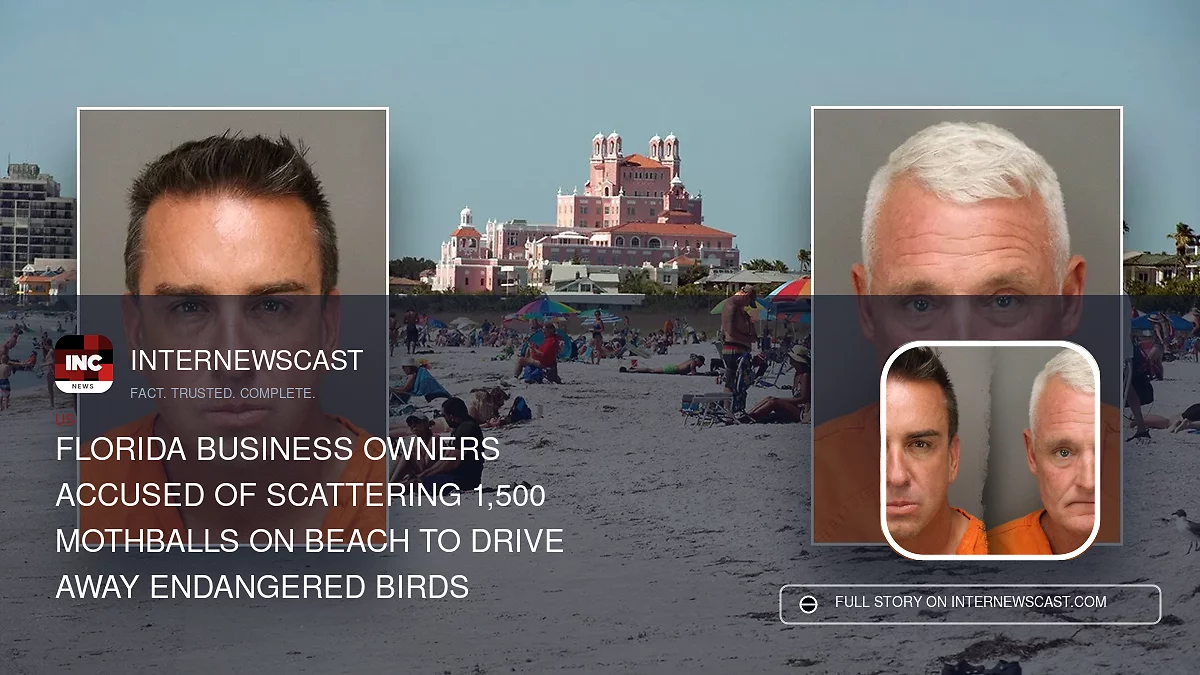
Robert Czyszczon (L) and Christopher Monroe (R) were both charged with third-degree felonies after authorities said mothballs were spread on the beach behind their St. Petersburg, Florida, businesses. (Pinellas County Sheriff’s Office)
By the next morning, investigators said, another 500 had appeared.
FWC officials said during a news conference that the pesticide-filled mothballs had been placed in an area where black skimmers, an endangered shorebird species, were “attempting to establish a nesting colony.” The agency also warned that the chemicals were left where other wildlife, as well as children, could easily touch or ingest them.
As the mothballs continued to show up, officials said it became increasingly apparent that the birds may have been deliberately targeted.
So FWC investigators flew into action.
Crying fowl
Meanwhile, the discovery of the mothballs ruffled feathers in the community.
There was “a lot of public outcry” expressing concern for the birds, while investigators tried to locate the source of the mothballs, FWC officials said.
Law enforcement served search warrants, combed through “terabytes” of data and eventually seized cellphones to try to locate the individuals behind the caper.
That work led them to Christopher Monroe, owner and manager of Chris’s Beachside Bar, and Robert Czyszczon, owner of the Plaza Beach Hotel, FWC officials said.
Out of fear of lost revenue, the two allegedly hatched a plan to use mothballs to deter birds from congregating on the beach behind their businesses, authorities said.
HIKERS FACE $25,000 FINE AFTER OFF-LEASH DOG BARKED AT GRIZZLY BEAR ON BANFF NATIONAL PARK TRAIL
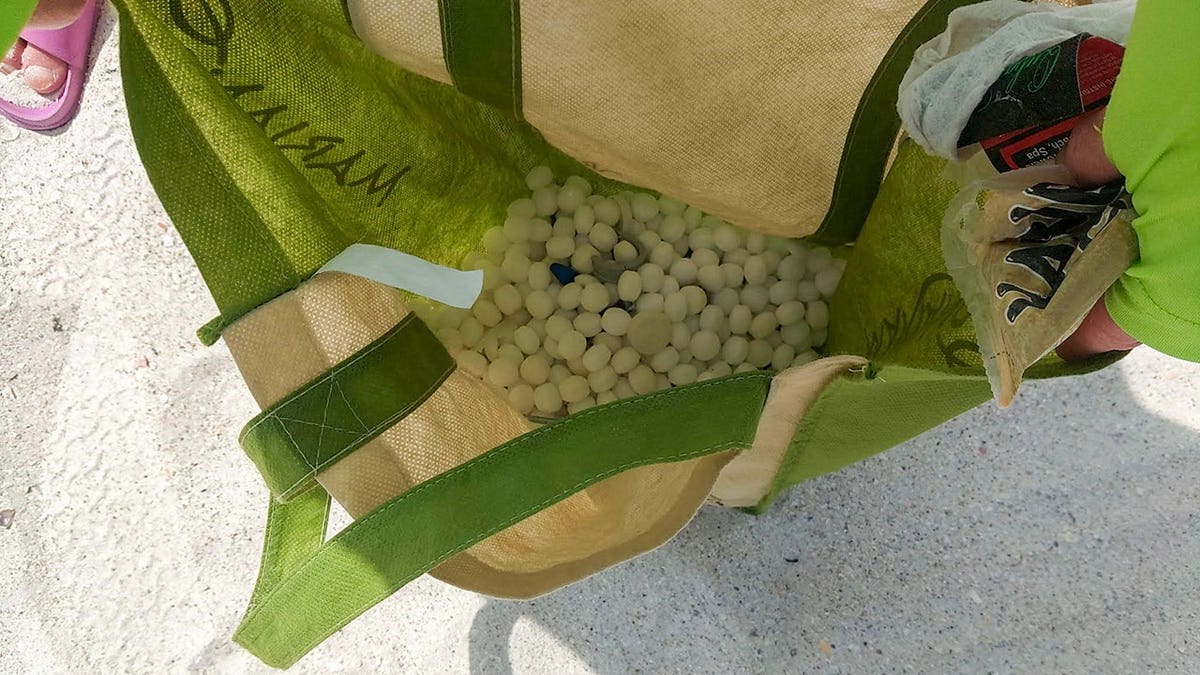
Officers with FWC worked with Audubon Society volunteers to remove mothballs from St. Pete Beach when they appeared in April. (FWC)
Through video surveillance and receipt records, investigators found that Czyszczon spent about $60 buying “a large quantity” of mothballs at a Walmart the day before they first appeared on the beach, FWC officials said.
Upon examining his phone, investigators found “incriminating” text messages between him and fellow business owner, Monroe, discussing their objections to the native fowl.
Text conversations revealed plans for placement of the mothballs on the beach, officials said. That’s what led investigators to Monroe as a suspect.
The men discussed how they “were going to do something” to prevent the birds from nesting on the beach, FWC officials said.
Black skimmers don’t nest in trees. They kick beach sand backwards to make depressions on the ground. Then they lay their eggs and raise their young near the surf.
“They’re the worst birds,” one of the men allegedly wrote in anticipation of nesting season.
“The bird people will put up fence around the area, and then the beach people will not be able to get to and from because they will fence around that space.”
Cellphone tower data showed Monroe’s phone was at the same location as Czyszczon’s phone on both nights when the mothballs appeared on the beach, FWC officials said.
The men feared that nests on the beach would lead to fewer customers and less money being spent there, authorities said.
“Why didn’t you tell me we lose $25,000 to $50,000?” one allegedly wrote in a text.
Monroe and Czyszczon were charged with illegal dumping, a third-degree felony, according to Pinellas County court records. They also were charged with the “attempted take of a state-listed imperiled species by harassment,” a misdemeanor, according to FWC officials.
Both are out of jail on bond.
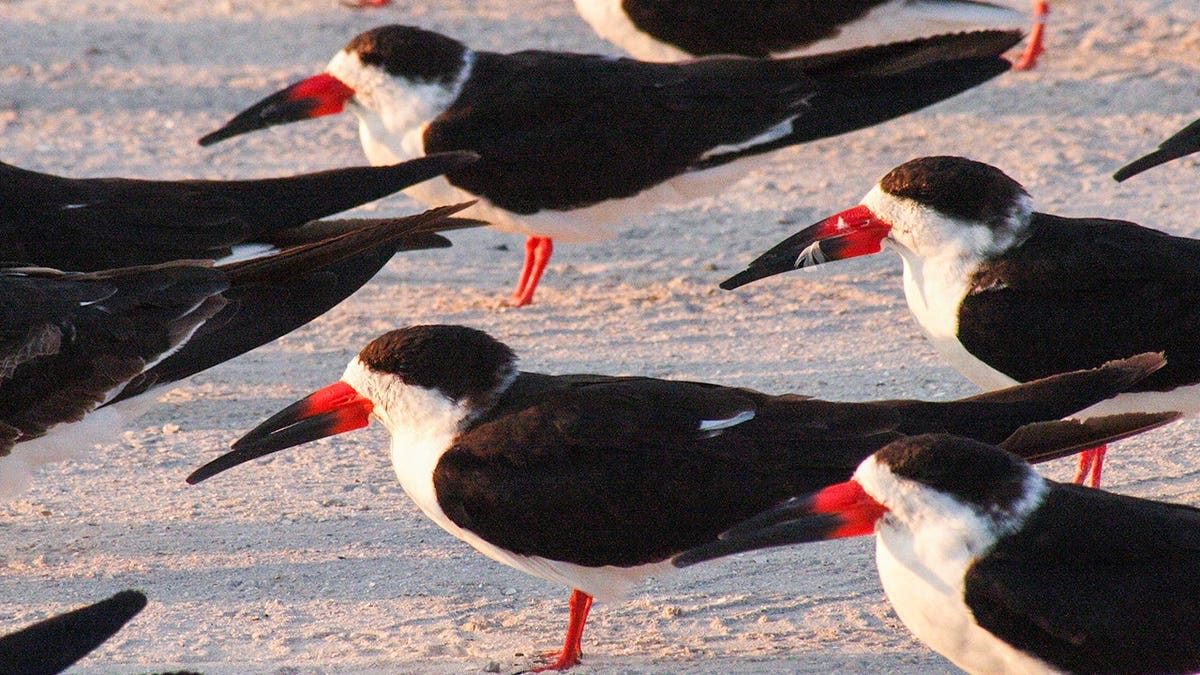
Black skimmers lay eggs in depressions they make in beach sand. (FWC)
About 6,800 black skimmers live in Florida. FWC officials estimate that several hundred live on the beaches of Pinellas County.
The pesticide in mothballs can harm people and wildlife that come into contact with their vapors, according to an educational publication by the University of Florida Institute of Food and Agricultural Sciences (IFAS).
“With any pesticide, the label is the law,” Brett W. Bultemeier, director of the UF/IFAS Pesticide Information Office, wrote in a 2021 educational publication about mothballs. “The label language is not simply a set of directions. Rather, they are requirements that are legally enforceable.”
The birds probably weren’t hurt by the “harassment,” FWC officials said.
But it did delay their nesting, they said. That pushes the date that their young can fledge from the nest further back in the season. And that could put them in danger.
A big storm at the end of hurricane season, which ends on Nov. 30, “can wipe out a colony if those young birds haven’t fledged yet,” an FWC official said.
An attorney for Czyszczon did not respond to a request for comment from News Outlet. Court records indicate that Monroe doesn’t have an attorney. He couldn’t be reached for comment.