

Share this @internewscast.com
According to the CDC’s announcement on Friday, the hospitalization rate for children and teens due to the flu has surged to its second-highest level in 15 years at this stage of the season.
WASHINGTON — If you found yourself battling the flu over the holiday season, you’re in good company. This flu season has already seen over 15 million cases, as reported by the CDC, with the expectation of more cases to arise as winter progresses.
Data released by the Centers for Disease Control and Prevention on Friday underscores the severity of the current flu season, which has led to over 180,000 hospitalizations and claimed 7,400 lives in the 2025-26 period.
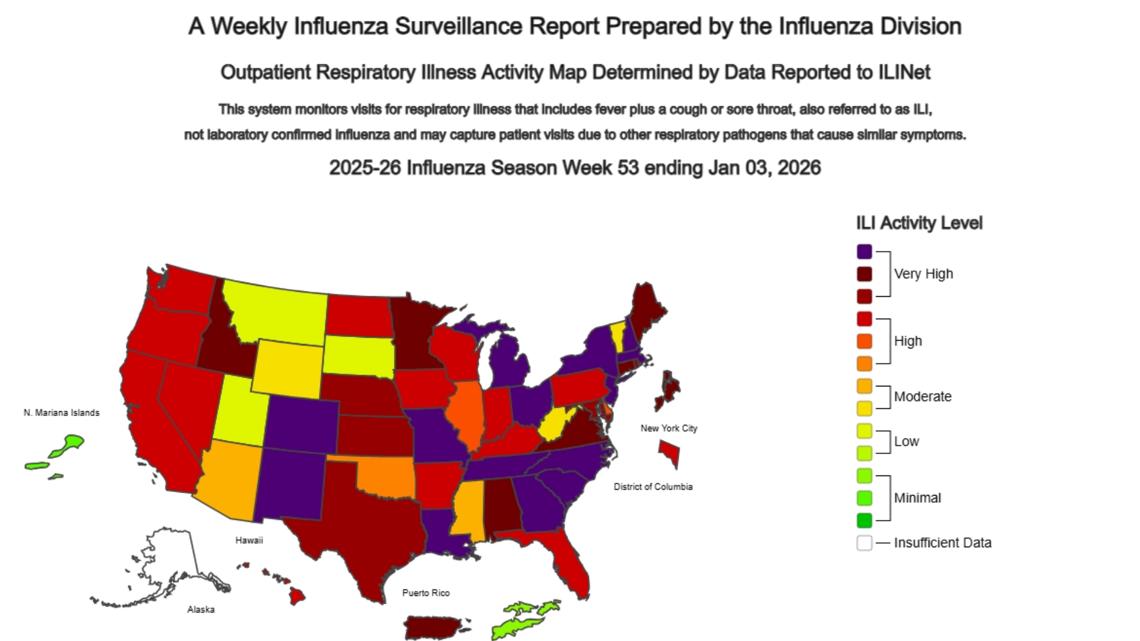
Flu activity remains elevated in 44 states, with cases categorized as high or very high, according to the latest figures.
In several respects, the current season is on track to surpass last winter’s flu epidemic, which was noted as one of the most severe in recent memory.
The CDC’s latest data highlights that the hospitalization rate for young people nationwide is the second highest it has been at this point in any season over the past 15 years.
One of the major spreaders of the disease this year is a new variant, which some have dubbed the “super flu.” The A(H3N2) strain, sometimes referred to as subclade K, emerged late last year and spiked the number of flu cases recorded in Japan and the United Kingdom. In the U.S., it has quickly become a concern for cities across the country, including in New York.
The variant is especially problematic because it’s one that has been spreading faster and with stronger symptoms, according to Dr. Parissa Rabbinafard of Peachtree Dunwoody Medical Associates in Atlanta.

“A (H3N2) viruses are the main drivers of the increase in flu cases this year.,” she said in a statement on Northside Hospital’s website. “While influenza B is also circulating, it is doing so at lower levels and influenza A spreads faster and with stronger symptoms than influenza B.”
Vaccine recommendations cut as infant deaths rise
This year’s flu shot does protect against the subclade K variant, but the Trump administration said it will no longer recommend flu shots and some other types of vaccines for all children.
On Jan. 5, the CDC announced at the recommendation of Health and Human Services Secretary Robert F. Kennedy Jr. that flu vaccines would no longer be universally recommended for children. Instead, the CDC encouraged parents to make the decision about flu vaccinations themselves after discussing with a healthcare provider.
Kennedy, a longtime vaccine skeptic, has used his role as the nation’s top doctor to weaken the U.S. stance on vaccines.
But doctors and health researchers continue to stress that vaccines, especially those given to children and infants, are important and necessary to stop the spread of dangerous diseases.
Already in the 2025-26 flu season, 17 pediatric deaths have been reported. Eight of those deaths were in the first week of 2026.
Cold weather brings out the worst of flu season
Cold weather, like the temperatures seen throughout the country during the post-New Year’s cold snap, creates ideal conditions for the flu to spread.
In colder, drier air, the virus’s outer coating hardens, helping it survive longer and travel farther in the tiny droplets we breathe out.
At the same time, your body’s defenses take a hit: cold air dries out nasal passages and constricts blood vessels in the nose, reducing the germ-fighting cells that normally trap and kill viruses.
Add in more time spent indoors—where people are in close contact and ventilation is limited—and winter becomes peak season for flu transmission.
Cautious optimism in the latest CDC data
Experts warn that the actual number of cases may be higher than the CDC estimate, and the number of deaths will continue to climb throughout the winter.
There is some good news in the CDC’s latest data, however. For the week ending Jan. 3, there had been a 24.7% decrease over that week in patients who tested positive for influenza.
There was also a 7.2% decrease in healthcare visits for respiratory illness in general, the CDC reported.
Despite the positive signs, CDC researchers cautioned that the numbers released Friday may be overly optimistic.
“Although some indicators have decreased or remained stable this week compared to last, this could be due to changes in healthcare seeking or reporting during the holidays rather than an indication that influenza activity has peaked,” the CDC wrote in its weekly report.
Flu season runs from late fall to spring, typically from October through May. Cases tend to peak early in the new year, with cold temperatures keeping people indoors and close together.