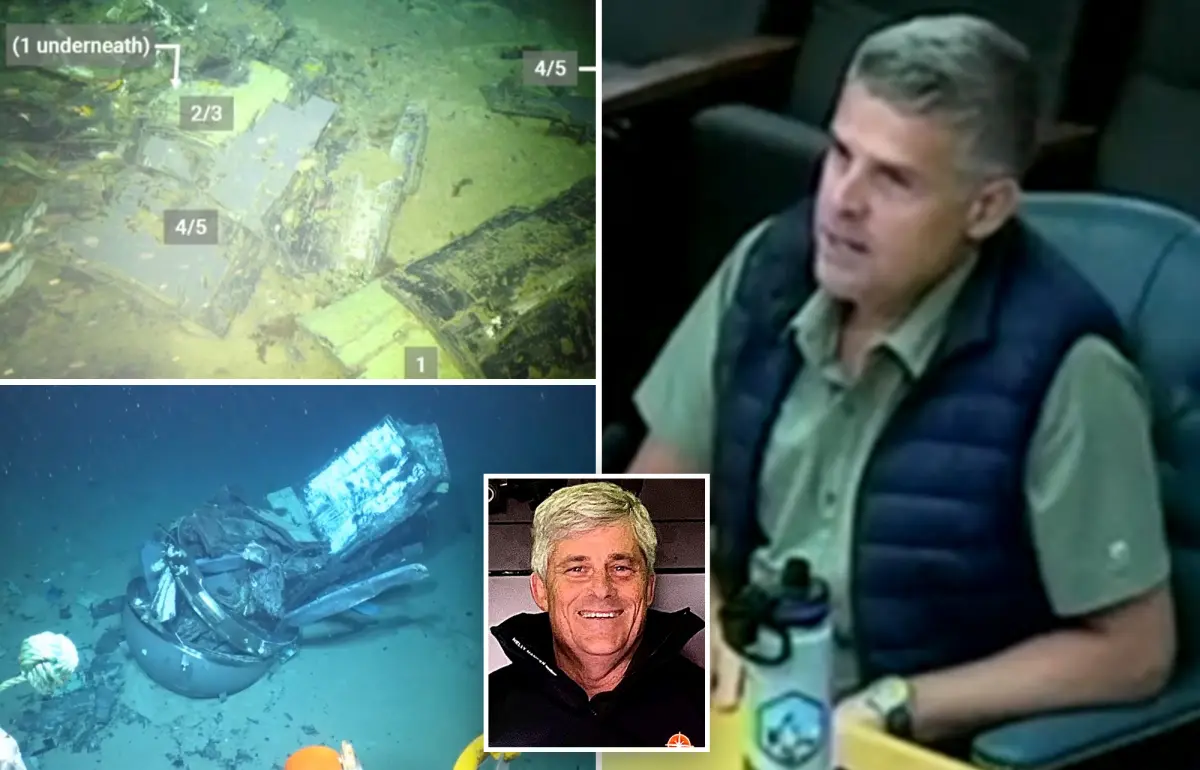

OceanGate CEO Stockton Rush always intended to die at the Titanic wreck, a close friend has alleged, accusing him of killing the wealthy passengers who paid as much as $250,000 to board what he called a “mousetrap for billionaires.”
According to Karl Stanley, a fellow commercial-submersible expert and longtime friend, the multimillionaire engineer wanted to become part of “Titanic mythology.” Stanley claims Rush designed the makeshift submersible to implode during its descent to the wreck, roughly 12,500 feet beneath the ocean’s surface.
“He was in fact a good engineer, and that machine did exactly what he designed it to do … He set a new standard for going out with a bang,” Stanley told author Matthew Gavin Frank for his book, “Submersed: Wonder, Obsession and Murder in the World of Amateur Submarines.”
“Rush’s ego was so big he was willing to die and kill to be the pivotal character of this story. He wanted to go [die] at the wreck [of Titanic],” Stanley told Frank just days after the Titan implosion.
“The more high-profile, the better. He didn’t just murder four wealthy people and get paid a cool mill to do it — they are allll part of the Titanic mythology now.”
The disastrous 2023 dive killed Rush and five passengers who had paid him up to $250,000 for the expedition.
Those who died included French underwater explorer Paul-Henri Nargeolet, widely known as “Mr. Titanic,” British adventurer Hamish Harding, and Pakistani father and son Shahzada Dawood and Suleman Dawood.
YOU MIGHT ALSO LIKE: Kylie Jenner Sparks Backstage Drama at Victoria’s Secret Show
Stanley alleged that Rush, who was fascinated by the Titanic, understood the voyage could be a one-way trip—and believed the disaster would secure his place in history.
“I know this is what happened,” Stanley insisted. He testified during the U.S. Coast Guard’s investigation into the catastrophe that Rush had always intended to die and characterized him as a “criminal.”
“Rush needed to compel more than just his own death, and he needed to knowingly fabricate a ‘futile’ vessel, costumed in a titanic name, as his murder weapon,” Frank wrote in the book.
Rush named the Titan submersible after the fictional British ocean liner in Morgan Robertson’s 1898 novel “Futility.” In the story, the enormous ship sinks after striking an iceberg—a scenario that eerily anticipated the Titanic disaster in 1912.
Stanley said OceanGate employees were “sh–ting their pants” after the implosion. “But, [Rush] being a madman who manipulated them is the best narrative for them,” he said.
Stanley had known Rush for more than a decade and accompanied him on a Titan test dive in 2019. During that expedition, Stanley recalled hearing loud cracking sounds, but said Rush dismissed his concerns.
Despite those concerns, Stanley told Frank that he does not regret joining Rush on the 2019 dive to the Titanic wreck.