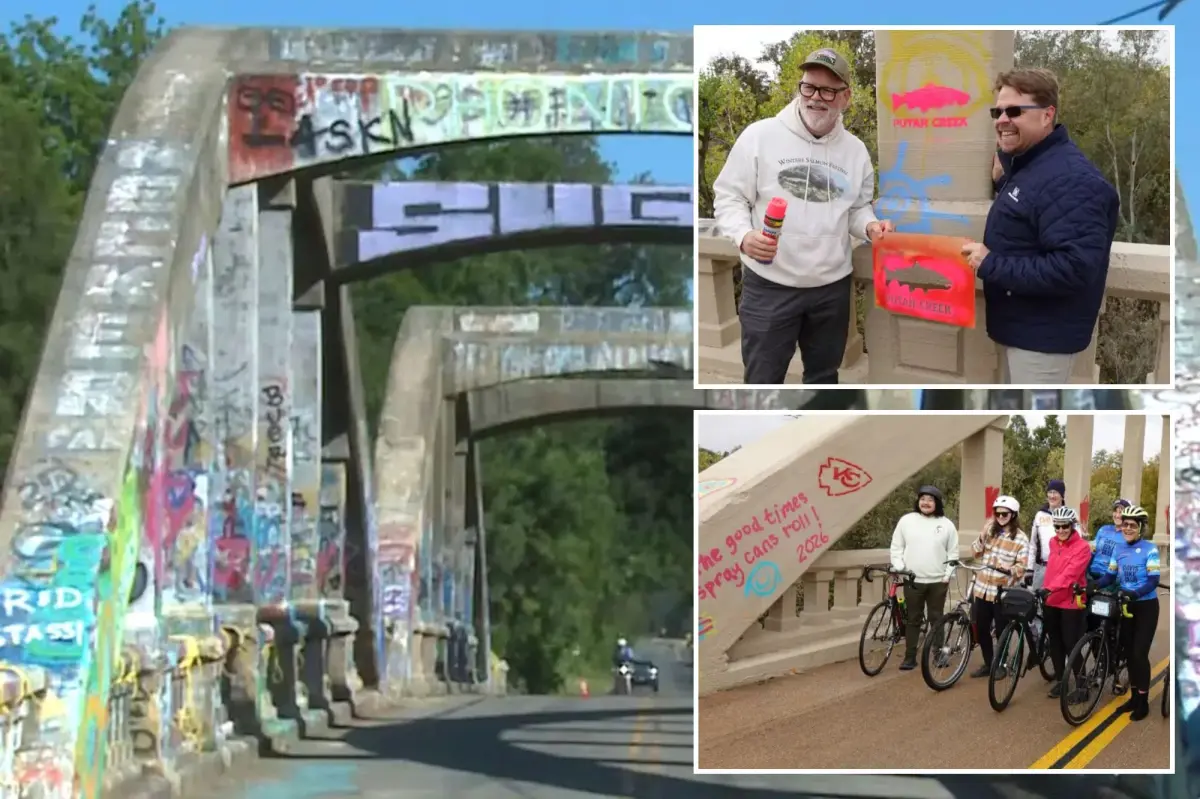

California taxpayers have spent $8.3 million restoring a graffiti-covered landmark, but the newly painted surface is already showing signs of wear.
Stevenson Bridge, the famously spray-painted crossing over Putah Creek, reopened after months of construction. Yet fresh graffiti has begun appearing on its restored arches and columns almost immediately.
Officials from Yolo and Solano counties marked the bridge’s reopening Friday, but the celebration included an eyebrow-raising moment. Photos released by Yolo County show officials spray-painting a “Putah Creek” stencil onto one of the bridge’s pillars.
Additional messages and drawings have since appeared on the newly painted structure, prompting questions about whether the bridge’s decades-old graffiti tradition is being welcomed back.
“Is graffiti now legal? Can we do it anywhere?” one person commented.
It remains unclear whether officials intend to allow the artwork to return. Before the rehabilitation, however, they had declined to say whether the graffiti that once covered nearly every surface would be permitted after the work was completed.
MORE STORY: Asra Q. Nomani: Hard-Left Youth Strike Seeks Socialist Revolution
The bridge closed in May for the $8.3 million project, which included seismic retrofitting, foundation repairs, scour protection and concrete restoration.
Instead of replacing the aging landmark, officials opted to preserve its distinctive arches and historic character.
Built in 1923, the 298-foot Stevenson Bridge crosses Putah Creek and connects Yolo and Solano counties west of Davis.
Officials describe it as California’s oldest surviving reinforced concrete through-tied-arch bridge and possibly the oldest bridge of its type in the country.
Before construction began, virtually every inch of the span was covered in graffiti, turning its paint-splattered appearance into a local trademark over generations.


