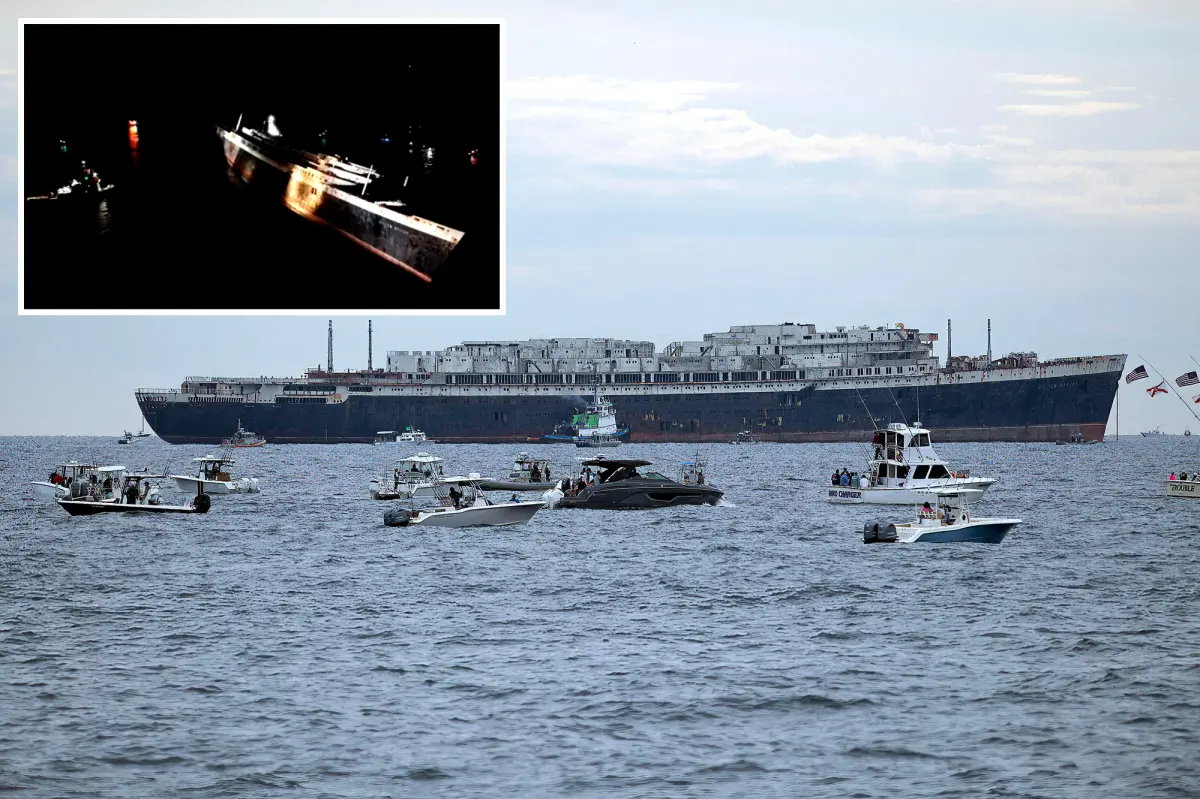

The historic SS United States, once the fastest passenger ship in the world, completed its final voyage Wednesday—beneath the sea.
The celebrated ocean liner—longer than the Titanic and a veteran of more than 800 Atlantic crossings—was intentionally sunk in the Gulf of Mexico. There, the former luxury flagship will begin a new life as the world’s largest artificial reef.
It was a lengthy farewell.
Even several hours after the operation began beneath overcast skies, much of the massive vessel remained visible in the dark waters off Florida’s Panhandle as night fell.
Organizers had expected the sinking to take as little as an hour.
At about 9 p.m., the ship finally tilted onto its side before rapidly disappearing below the surface.
“She is an amazing lady who will not lay down without a fight,” Coleen O’Malley, president of Coleen Marine, the company overseeing the operation, said before the ship vanished. “Much like the amazing nation she was named after.”
The controlled sinking was part of a long-planned, $13.5 million project designed to draw divers and anglers while creating habitat for tuna, marlin, swordfish and other marine life.
The descent took longer than expected in part because crews were pumping water into 128 fuel and lubricant tanks to ensure the ship settled evenly on the seafloor, said Nick Tomecek, a spokesperson for Okaloosa County, which helped organize the project. “It took longer than we thought,” he said.
“She’s a big ship,” Tomecek added.
A massive vessel with a long history
The reef project ensures that a ship once hailed as a technological masterpiece will not end its story as scrap metal.
Its famous passengers included Hollywood icons Grace Kelly and Elizabeth Taylor.
Presidents Harry Truman, Dwight Eisenhower and John F. Kennedy also traveled aboard, as did Britain’s former King Edward VIII. In 1968, a young Bill Clinton took the ship while traveling to Oxford University, decades before becoming president.
Passengers were served lavish meals, including caviar, roast duckling, smoked ox tongue and Calf’s Head en Tortue.
Before the sinking, organizers removed the ship’s 65-foot smokestacks. The funnels are expected to become anchors for a new museum dedicated to the vessel.
Explosives were not allowed to be used
Federal environmental and explosives regulations barred Okaloosa County and its contractor from using explosives to scuttle the ship, Tomecek said.
EXPLORE MORE: Attorney Michael Sanft: Age, Wikipedia, Role in Keffe D Trial
Officials moved the operation forward by one day because of concerns about worsening weather.
The SS United States originally used pipes to draw seawater into tanks that cooled its boilers. Those tanks were removed, allowing water to flood the hull once the valves were opened, Tomecek said.
Crews also cut 10-foot-by-10-foot openings into the decks and removed more than 400 portholes.
The ship was expected to rest in roughly 180 feet of water, with its top deck about 60 feet beneath the surface—shallow enough to accommodate less experienced divers.
The vessel will lie approximately 25 miles southwest of Destin, between Panama City and Pensacola.
Larger than the Titanic, the ship set a speed record on its first voyage
More than 3,000 workers built the SS United States in Virginia during 1950 and 1951. Among the 1,700 passengers on its maiden voyage were an Associated Press reporter and Margaret Truman, the president’s daughter.
The ship averaged nearly 41 mph during that crossing, surpassing the speed record set by Britain’s RMS Queen Mary in 1938 by 4.5 mph, according to an AP report.
It achieved the record despite encountering a full gale, with winds reaching 69 mph—powerful enough, the AP reported, to blow a pingpong table from the deck.
Measuring 990 feet, the SS United States is 108 feet longer than the ill-fated Titanic, which struck an iceberg and sank during its maiden Atlantic crossing.
“She really embodies and expresses this country’s best,” said Susan Gibbs, granddaughter of the ship’s designer. “She represents pride and resilience and strength and beauty.”
The ship’s resting place has many artificial reefs
More than 500 artificial reefs already sit in the waters surrounding the SS United States’ new home.
The previous record-holder was the USS Oriskany, an aircraft carrier sunk in the Gulf off Pensacola in 2006. It is close enough to the SS United States site that an experienced diver could visit both in a single day, Tomecek said. Launched in 1950, the Oriskany measures 911 feet long.
“We’re trying to be the best diving destination in the world,” Tomecek said.
The SS United States was decommissioned in 1969. Plans involving a hotel magnate and Norwegian Cruise Lines never materialized, and the ship remained docked in Philadelphia from 1996 until recently.
Mullane described the enormous funnels—the smokestacks removed to help anchor the new museum—as “works of art.”
“I’m just so happy that we are able to save parts of her,” Gibbs said.