Share this @internewscast.com
The United States has declared war on Iran, prompting the FBI to issue new alerts regarding potential retaliatory attacks from Iran on American soil.
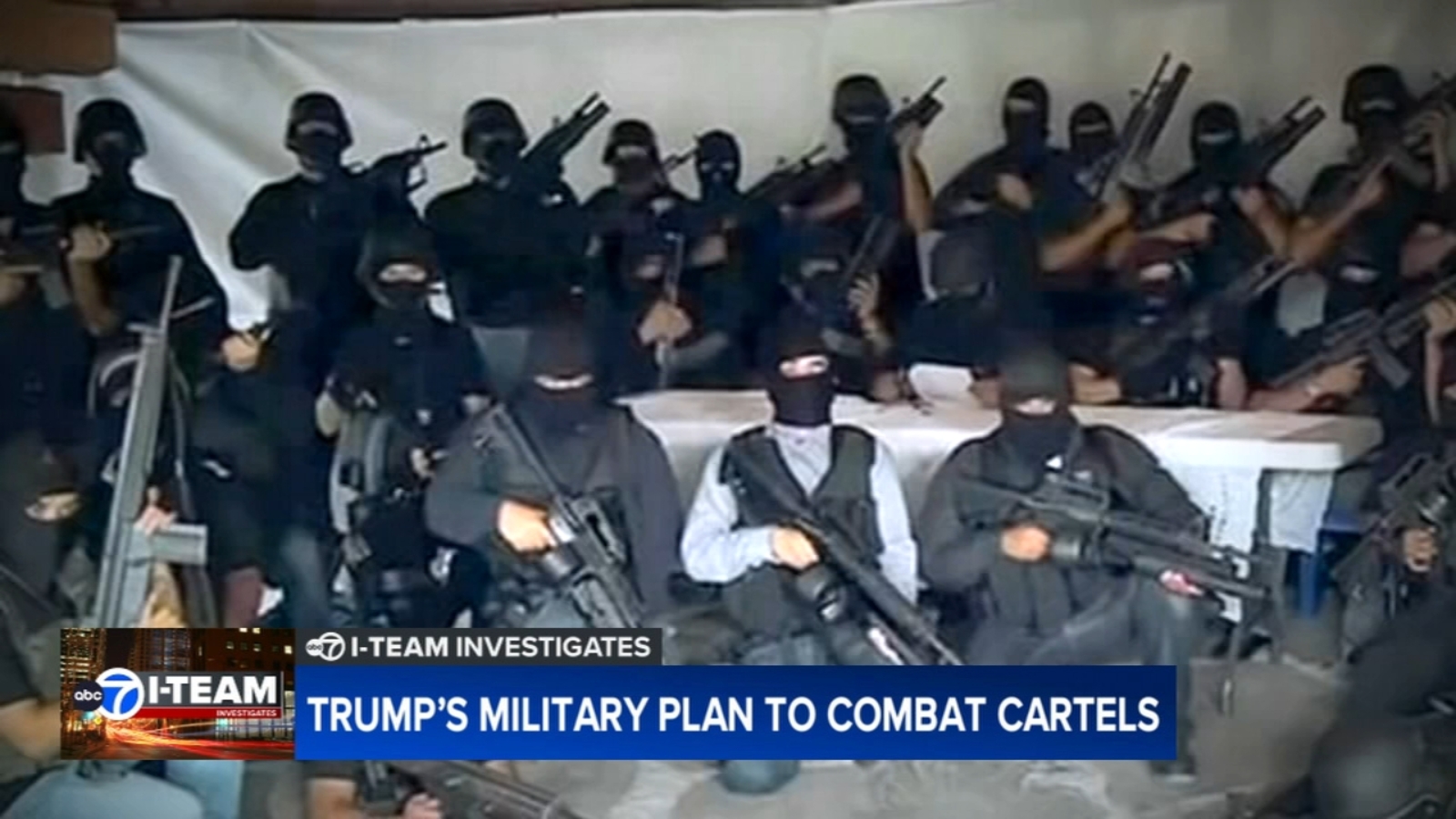
In a separate push, President Donald Trump is advocating for a more aggressive military approach against transnational drug cartels. Cartel experts caution that if the president cannot successfully employ “coercive diplomacy,” history suggests the situation could escalate into significant violence.
ABC7 Chicago is now streaming 24/7. Click here to watch
This initiative is being termed the Shield of the Americas.
“At the core of our agreement is a pledge to use lethal military force to eradicate the evil cartels and terrorist networks once and for all,” Trump stated.
The coalition, spearheaded by the U.S., involves over a dozen Latin American nations united in the battle against drug cartels throughout the western hemisphere.
Benjamin Lessing, a political science professor at the University of Chicago and a seasoned author on the subject, has dedicated years to analyzing the outcomes of military interventions in cartel conflicts.
“My sort of limited optimism around this flows from the fact that we need to move from a brute force approach to fighting the drug war to a more coercive approach that is, at present, sort of politically toxic and possibly unthinkable. But Trump is a specialist in making the politically unthinkable thinkable, and he’s also a specialist in the coercive use of force,” Lessing said.
Notably absent from the coalition is Mexican President Claudia Sheinbaum, who has consistently rejected any U.S. military intervention in her country despite ongoing threats from Trump.
“The Mexican cartels are fueling and orchestrating much of the bloodshed and chaos in this hemisphere, and the United States government will do whatever is necessary to defend our national security,” Trump said.
Lessing said he hopes this coalition will refrain from taking on all cartels with brute military force and a lack of strategy that could have disastrous consequences, telling the I-Team brute force “essentially creates a world where the way to succeed in the drug business is to accumulate military force, and so over the long run you get a drug trade that’s more militarized, more violent, more brazen.”
In the early 2000s, when Mexico mounted a concerted military attack on cartels, they fought back, splintered and only the most brutal, violent, and well-armed survived, spawning what he calls the most powerful current cartel: CJNG, Lessing told the I-Team. It was led, until his recent death, by “El Mencho,” who was killed by Mexican special forces.
What Lessing suggests is the more prudent course: coercive diplomacy and focused deterrence.
“The coercive strategy that most immediately strikes me as one that would appeal to Trump, would benefit the American people, and could potentially work, is one that deliberately punishes cartels for trafficking fentanyl and but does not apply that additional punishment when they’re only trafficking marijuana and cocaine,” he said.
He said that would give cartels a binary choice: Play by new rules and police themselves or face obliteration.
“That will intend to push them towards a more peaceful and less violent and less damaging approach,” he said.
Lessing tells the I-Team having the U.S. as a central decision maker on how and when to take action against cartels may be beneficial to some of the smaller countries who have signed on to this coalition that have less of a military apparatus to apply pressure on bad actors.
Copyright © 2026 WLS-TV. All Rights Reserved.