
Share this @internewscast.com

Authorities are currently investigating whether an air traffic controller momentarily left their station to respond to an emergency call just before a tragic collision occurred at New York’s LaGuardia Airport last month.
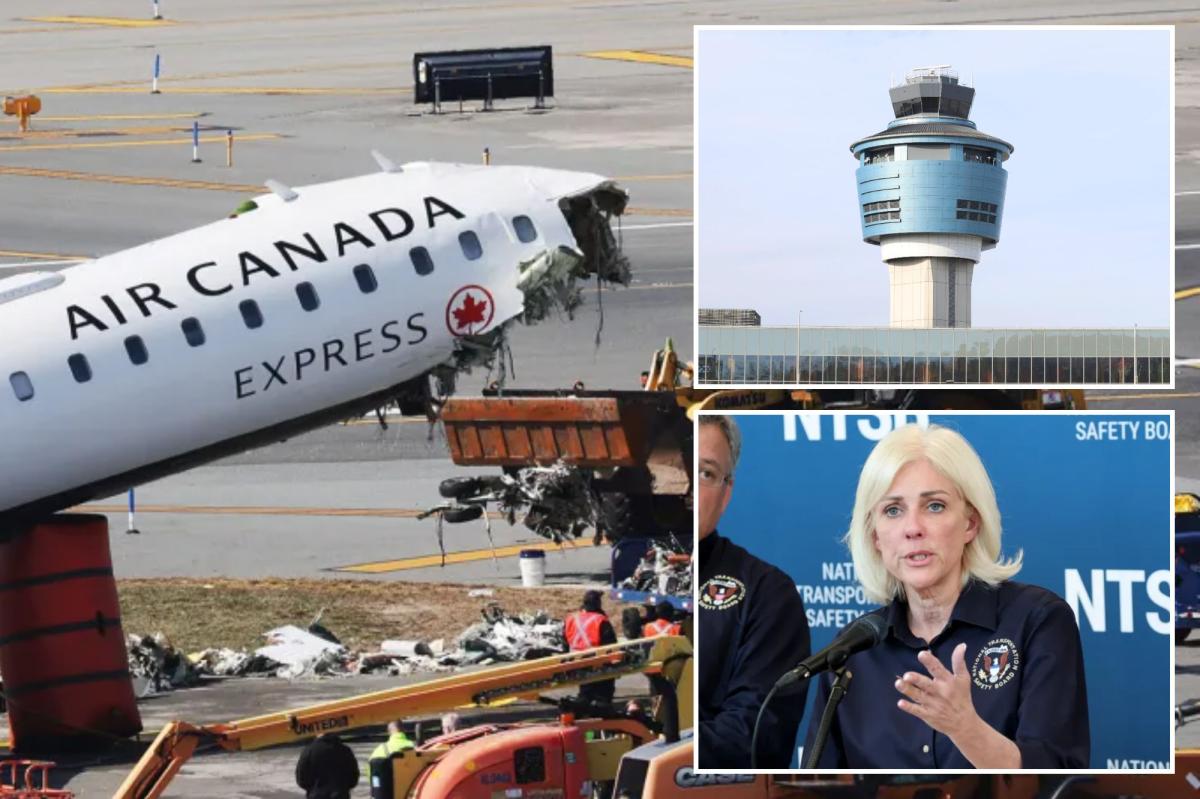
The fatal crash, which claimed the lives of both pilots on board an Air Canada flight on March 22, is under thorough examination. Sources revealed to The New York Times that investigators are particularly interested in determining if a controller vacated their post to attend to a “crash phone,” a specialized emergency line located in the control tower.
The National Transportation Safety Board is diligently reconstructing the events leading up to the jet’s collision with a fire truck shortly before midnight. This incident marks the first fatal accident at the airport in over three decades.
One area of focus for investigators is the arrangement of the control tower at LaGuardia. They are assessing whether the positioning of emergency phones, which are not always conveniently located near active workstations, might have contributed to the situation.
The configuration of these emergency phones could require a controller to leave their console during a critical moment to address a crisis.
As of now, no definitive conclusions have been drawn, and the investigation continues to unfold.
Beyond the tower, the NTSB is retracing the movements of a convoy of six fire trucks, the outlet reported.
The Air Canada jet struck the lead truck as it headed to an emergency on another part of the airfield.
Officials are trying to figure out whether the lead truck blew past a required stop line before entering the runway — and whether its crew missed instructions from air traffic control.
Weather conditions and visibility at the time are also being looked at, the outlet added.
NTSB Chair Jennifer Homendy confirmed that two controllers were on duty in the tower at the time — the standard overnight staffing level at LaGuardia and across the US, she said. A third and fourth controller were reportedly elsewhere in the building at the time.
But staffing at the airport may have strayed from standard procedures, with it suggested that roles could have been combined before midnight.
Controllers say ongoing staffing shortages, including at the supervisor level, are forcing workers to juggle both air and ground traffic duties more often.
If that was the case the night of the crash, it would mark a break from LaGuardia’s usual operating rules.
Another key focus is the airport’s ground radar system, ASDE-X, which is designed to track aircraft and vehicles and warn of potential conflicts.
Homendy previously said the system did not flag the fire truck because it lacked a transponder — equipment that would have made it visible to controllers.
The crash killed pilots Antoine Forest and Mackenzie Gunther. No passengers or firefighters were killed.
The incident has also raised fresh questions about how busy LaGuardia was that night, with some aviation insiders suggesting more staff may have been needed in the tower.
It comes as Air Canada faces its own fallout. CEO Michael Rousseau recently announced plans to step down later this year following backlash over his response to the crash.
Rousseau, who became CEO in 2021, faced a heated reaction after making his video statement almost entirely in English — snubbing Montreal’s official language of French.
With Post wires.