
Share this @internewscast.com
CHICAGO — Monday was a whirlwind day for U.S. stock markets, which saw a dramatic shift from early losses to notable gains, as fears about a prolonged conflict with Iran gave way to optimism. Initially, oil prices spiked to almost $120 per barrel, marking their highest point since 2022, before retreating to around $90.
The S&P 500 initially plunged by 1.5% in the morning but later reversed course to close with a 0.8% gain. The Dow Jones Industrial Average recovered from an early drop of nearly 900 points to finish 239 points higher, or a 0.5% increase, while the Nasdaq composite surged by 1.4%.
These dramatic intraday swings reflect the market’s volatility amid uncertainty over oil prices, which are influenced by potential disruptions in the Middle East’s energy sector. The remarkable turnaround in the last hour of trading followed President Donald Trump’s remarks to CBS News, where he expressed confidence that “the war is very complete, pretty much.”
These comments eased anxieties that had escalated earlier when Brent crude, the global oil benchmark, briefly soared to $119.50 per barrel, a price not seen since the summer of 2022 following Russia’s invasion of Ukraine.
If oil prices remain elevated for an extended period, the financial strain on households already grappling with high inflation could intensify. Businesses, too, would face rising costs for fuel and inventory management, heightening the risk of “stagflation”—a scenario where economic growth stalls while inflation remains persistently high.
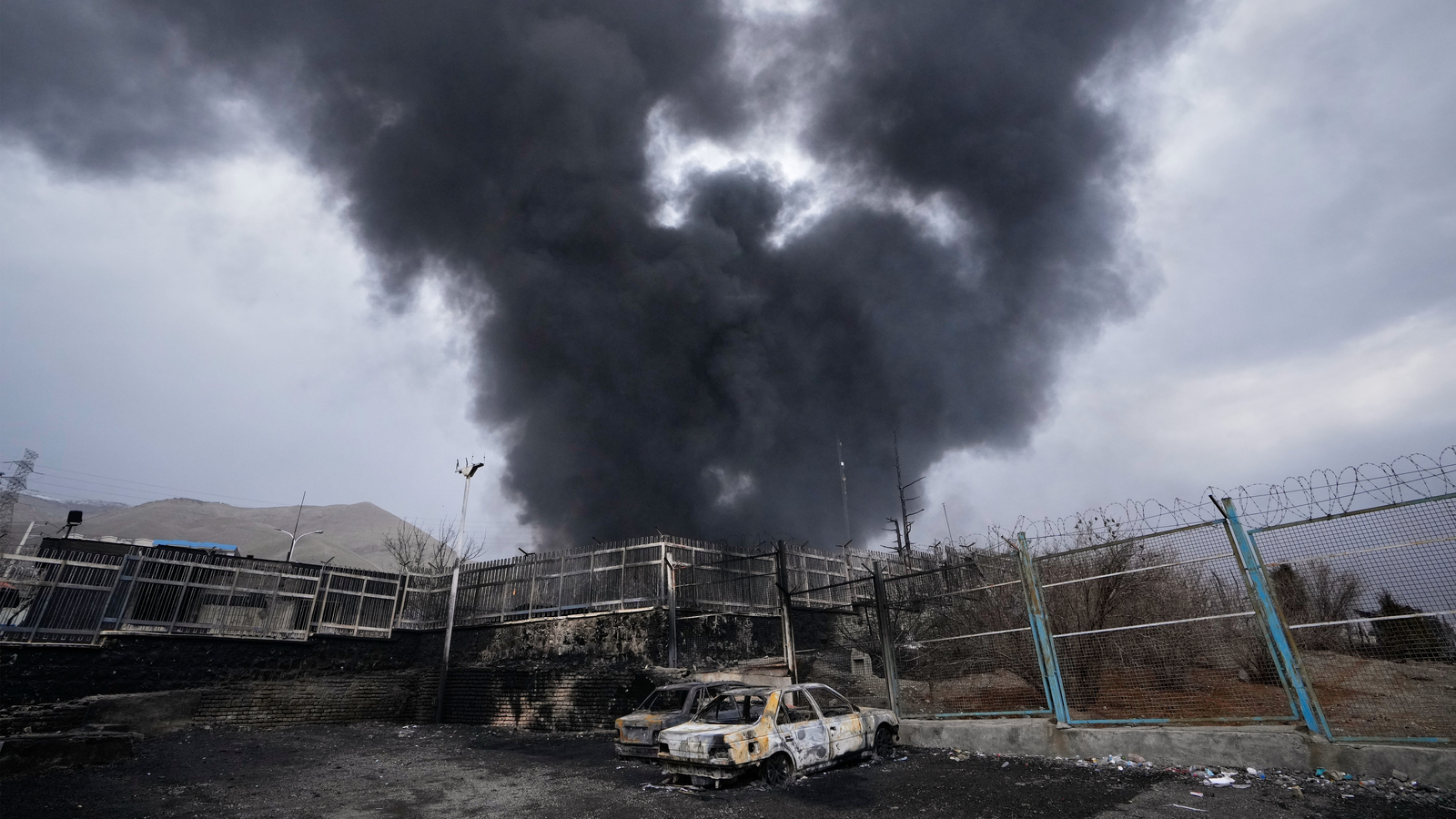
Tensions have particularly centered on the Strait of Hormuz, a critical chokepoint off Iran’s coast through which a fifth of the world’s oil supply passes daily. Earlier threats from Iran to target ships navigating this vital waterway added to the market’s anxiety.
If the strait remains closed for only a few weeks, the price of oil could push to $150 per barrel of higher, according to oil and gas strategists at Macquarie Research.
But oil prices pared their gains through the day, initially on talk that seven of the world’s largest economies could coordinate moves to push back on the spikes. They then slid sharply after CBS News said Trump said of Iran that “if you look, they have nothing left. There’s nothing left in a military sense.”
Trump also added that when it comes to the Strait of Hormuz, he’s “thinking about taking it over,” according to CBS.
A barrel of Brent crude pulled back to settle at $98.96 in the afternoon and then kept falling afterward below $90. A barrel of benchmark U.S. crude touched $119.48 during the morning, then pulled back to settle at $94.77 and then sank toward $85.
The U.S. stock market has a history of bouncing back relatively quickly from past military conflicts, as long as oil prices don’t stay too high for too long. Some professional investors continue to suggest that drops in prices for stocks could ultimately offer opportunities to buy them at cheaper levels before they rise again.
“We continue to believe that the current acute shortage of oil will be reversed in the coming months as new supply comes online and oil should drop significantly,” according to Sameer Samana, head of global equities and real assets at Wells Fargo Investment Institute.
Even with all the recent swings in the market, the S&P 500 index that sits at the heart of many 401(k) accounts is still within 3% of its record set in January.
All told, the S&P 500 rose 55.97 points to 6,795.99. The Dow Jones Industrial Average added 239.25 to 47,740.80, and the Nasdaq composite gained 308.27 to 22,695.95.
To be sure, prices could reverse again in the coming days given all the uncertainties about the war. That’s what happened through the huge swings that rocked Wall Street last week.
In stock markets abroad, where economies are more dependent on the import of oil and natural gas, stocks fell sharply before Trump’s comments were published. South Korea’s Kospi sank 6%, Japan’s Nikkei 225 tumbled 5.2% and France’s CAC 40 dropped 1%.
Trump’s comments came after he said late Sunday that high oil prices at the moment were worth the cost.
“Short term oil prices, which will drop rapidly when the destruction of the Iran nuclear threat is over, is a very small price to pay for U.S.A., and World, Safety and Peace,” he said in a posting on his social media network.
In the bond market, the yield on the 10-year Treasury fell to 4.10% from 4.15% late Friday.
Worries about high inflation and oil prices are pushing upward on Treasury yields, and the 10-year yield briefly rose above 4.20% early Monday.
But worries about a potentially slowing economy are pulling downward at the same time. On Friday, a discouragingly weak report on the U.S. job market showed that employers cut more jobs last month than they added.
Yields then slid late in the day when oil prices eased.
Copyright © 2026 by The Associated Press. All Rights Reserved.