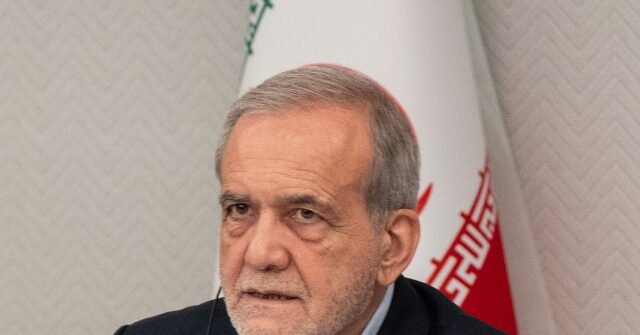

Iranian President Masoud Pezeshkian said Monday that Tehran will comply with the terms of its memorandum of understanding with the United States, provided Washington also meets its obligations, as both sides prepared for anticipated senior-level talks in Doha following a weekend confrontation in the Strait of Hormuz that briefly put the ceasefire under strain.
“Mutual understanding is a two-way street. If the American side adheres to the agreement, we will also fulfill our commitments,” Pezeshkian wrote on X, adding that Iran’s response to what he described as “unreasonable saber-rattling and baseless threats” would be guided by “rationality and human dignity in decision-making,” while remaining prepared to “defend decisively and fearlessly when it comes time to act.”
Pezeshkian’s comments came as U.S. and Iranian officials moved to reopen diplomatic channels after the weekend incident raised fresh concerns about the durability of the memorandum. President Donald Trump said Monday that Iran had asked for another meeting and that American officials were set to travel to Doha on Tuesday.
“Iran has requested a meeting. It will take place tomorrow in Doha!” Trump posted on Truth Social. He later told reporters in the Oval Office that the talks could prove “perhaps important, perhaps not,” adding, “We’re going to find out.”
Trump said the administration’s broader goal had not shifted, despite the recent escalation around the Strait of Hormuz.
“We are winning militarily. It’s almost won militarily, I would say,” Trump said. “It’s really very simple. It’s the denuclearization of Iran. We don’t want them to have a nuclear weapon, and they’re not going to have a nuclear weapon. And they’ve agreed to that, in all fairness.”
Soon after Trump’s announcement, White House Press Secretary Karoline Leavitt said Special Envoy Steve Witkoff and Jared Kushner would head to Doha for what she characterized as “high-level” meetings, with technical negotiations expected to run alongside them.
“Special Envoy Witkoff and Jared Kushner will be flying to Doha for high-level meetings this week, as we continue to discuss the memorandum of understanding,” Leavitt said during an appearance on Fox News. “On the sidelines of those high-level talks, there will be the technical talks.”
Leavitt said the White House believes it has honored its responsibilities under the ceasefire and memorandum, while emphasizing that the United States would continue to respond militarily to any additional attacks by Iran.
“As far as we’re concerned, we’re holding up our end of the ceasefire. Violence will be met with violence,” she said, adding that while the United States had responded to attacks on commercial shipping in the Strait of Hormuz, “the president obviously wants to see the peace process play out.”
EXCLUSIVE: Man Dies While Dumping Girlfriend’s Body in Woods After Strangling Her
Iran, for its part, continued to publicly maintain that no direct negotiations with U.S. officials are currently scheduled, despite Washington’s announcement.
Foreign Ministry spokesman Esmaeil Baghaei said an Iranian expert delegation would travel to Doha to discuss implementation of the memorandum’s provisions but insisted Tehran has “not yet entered the stage of negotiating a final agreement” and that “over the coming days, we will not have any negotiation meetings with the U.S. side at any level.”
Senior Iranian negotiator Kazem Gharibabadi likewise said reports that Iranian and American technical teams would meet in Doha were “not confirmed,” while noting that consultations with Qatar regarding implementation of the memorandum remain ongoing.
On Sunday, however, Trump administration officials said Washington and Tehran had agreed to stand down following the weekend exchange of strikes, with another U.S. official confirming plans for renewed discussions in Doha after both sides moved to contain the latest escalation.
The renewed diplomatic push came after a weekend exchange of strikes that briefly threatened the memorandum after Iran launched attacks against commercial shipping in the Strait of Hormuz, prompting two rounds of U.S. retaliatory strikes against Iranian military targets.
Trump later warned that continued Iranian violations of the ceasefire could ultimately force the United States to “militarily complete the job” it began, cautioning that the Islamic Republic “will no longer exist” if Washington is compelled to launch a broader military campaign.
Following the U.S. strikes, Iran launched missile and drone attacks targeting U.S.-linked sites in Bahrain and Kuwait while accusing Washington of violating the memorandum.
The memorandum, signed earlier this month, established a 60-day framework for reopening the Strait of Hormuz, restoring commercial shipping through the strategic waterway, and beginning broader negotiations over Iran’s nuclear program, sanctions relief, frozen assets, and other outstanding issues.
Tuesday’s discussions are expected to focus primarily on implementation of the agreement, even as Washington and Tehran continue to publicly characterize the scope of the talks differently.