Share this @internewscast.com

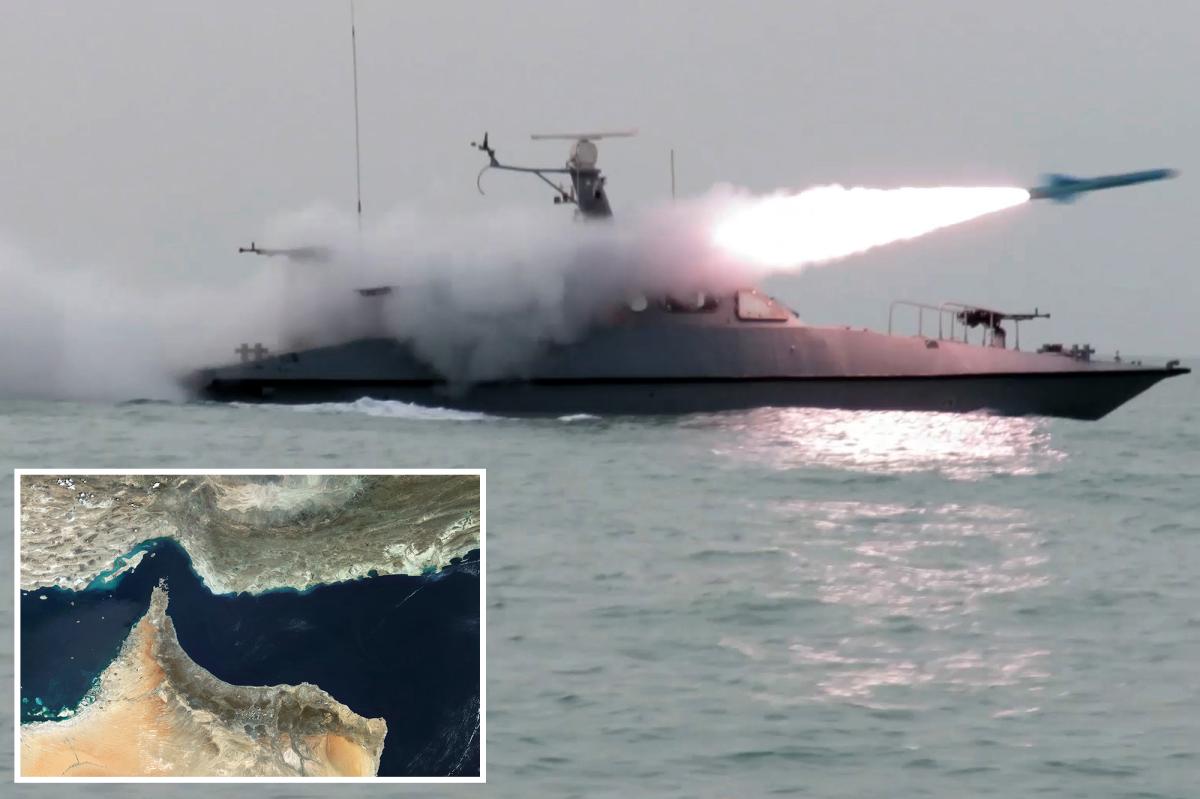
Despite six weeks of persistent US-Israeli airstrikes targeting Iran’s naval forces, over 60% of the Islamic Revolutionary Guard Corps’ (IRGC) fast attack ships remain operational. These vessels are crucial in their mission to patrol the strategic Strait of Hormuz, according to a recent report.
The Wall Street Journal has highlighted that while the United States’ efforts have significantly weakened Iran’s conventional navy, sinking more than 155 of its vessels, the IRGC’s fleet has largely been able to withstand these assaults. This resilience enables them to continue their control over the vital waterway that President Trump has pledged to keep open.
Chris Long, a former British naval officer with experience in the Persian Gulf, explains that the IRGC’s navy is uniquely constructed. It comprises a large number of small, fast attack ships that are adept at evading satellite detection. These vessels often find refuge in underground shelters along the rugged coastline of the 20-mile-wide strait, making them difficult targets for airstrikes.
“It will be a long time before the US can take all those out,” Long remarked to the Wall Street Journal, underscoring the challenge faced by US forces.
The origins of this fleet trace back to the Tanker War during the 1980s, when a decisive US strike obliterated much of Iran’s active naval force in one day. This event prompted the Islamic Republic to shift its strategy, focusing on an asymmetrical naval approach. The IRGC was then designated to secure the Strait of Hormuz, while Iran’s conventional navy took up the task of patrolling other vital waterways in the Gulf.
Since then, the Islamic Republic has pivoted to an asymmetrical navy, with the IRGC tasked with policing the Strait of Hormuz while Iran’s conventional navy patrols other waterways in the Gulf.
Iran previously showed off the speedy boats during live-fire military drills in February as a show of force against the US naval buildup in the Middle East prior to the start of the war.
The ships were shown to be armed with rocket launchers and able to lay mines in the strait, with the boats capable of moving at high speeds as they moved in and out of their underground pens.
The strategy appears to have paid off for Tehran, given the IRGC’s survival rate compared with that of the conventional navy, which US officials touted as completely destroyed in the first three weeks of the war.
The IRGC’s navy, meanwhile, has been able to effectively shut down the Strait of Hormuz with underwater mines and drone attacks, pausing a key trade route that oversees the transport of 20% of the world’s oil supply.
At least 50 attacks have been launched against shipping vessels in the Gulf and the Strait of Hormuz since the war began, according to the Armed Conflict Location and Event Data conflict tracker.
“Their asymmetrical strategy is working,” David Des Roches, a former director responsible for Persian Gulf policy at the Defense Department, told the WSJ.
Trump said Sunday that the US and it allies would be deploying minesweeping ships and destroyers to open up the Strait of Hormuz to the more than 2,000 ships stuck in the Gulf.