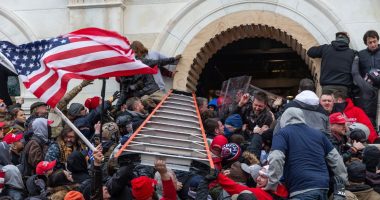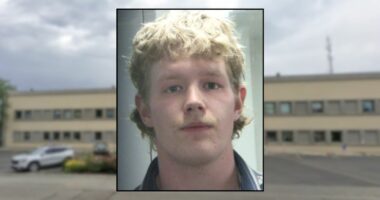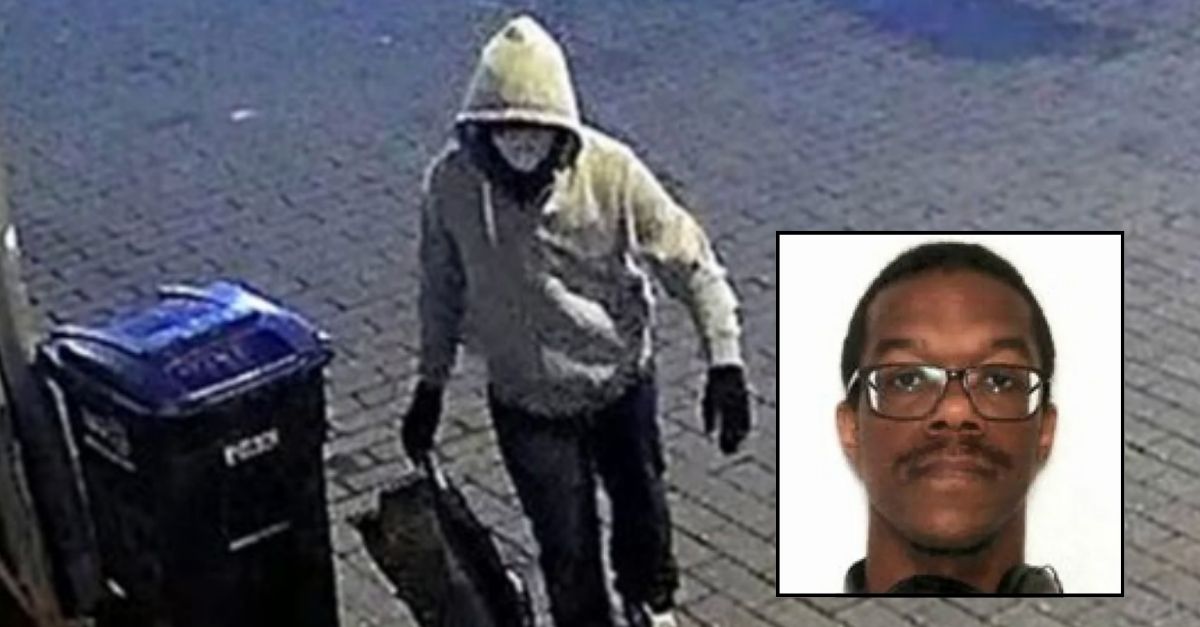

Inset: Brian Cole Jr. (Department of Justice). Background: Surveillance footage allegedly shows Brian Cole Jr. walking around Washington, D.C., while placing pipe bombs at the RNC and DNC headquarters (DOJ).
Recently unveiled court documents allege that a Virginia man admitted to placing pipe bombs near the headquarters of both the Republican and Democratic National Committees in Washington, D.C., just a day before the Capitol riot on January 6. According to federal prosecutors, the individual claimed he took this action to voice support for those denying the 2020 election results. His legal team now asserts that the case is being unjustly postponed by the prosecutors.
In a 15-page motion for discovery submitted on Monday, attorneys for Brian Cole Jr. stressed the urgency of obtaining all evidence against him, including any statements or confessions. They argue that transparency is essential immediately, not at a later date.
Cole’s defense claims the Justice Department is attempting to defer his preliminary hearing to January 7 or 8. However, they note that prosecutors have cited no substantial reasons, aside from typical scheduling issues and the potential for a pending indictment, as per court records.
In a motion filed late Sunday to affirm his preliminary hearing, Cole’s lawyers argue that the government’s request is untimely. They emphasize that the prosecution has not provided any exceptional circumstances to justify the delay.
They insist the court should mandate the government to present evidence supporting probable cause on Tuesday if the hearing proceeds. Cole has agreed to reschedule his hearing to Tuesday but refuses any additional postponements, according to the motion.
“December 30 is the appropriate and timely date for the preliminary hearing,” assert Cole’s legal team. They argue that the government’s wish to accommodate routine scheduling or the pace of a grand jury does not legally justify further delays, given the three weeks they have had to prepare.
Cole, 30, of Woodbridge, was arrested and charged in the District of Columbia earlier this month with transporting an explosive device in interstate commerce with the intent to kill, injure, or intimidate any individual or unlawfully to damage or destroy any building, vehicle, or other real or personal property. He was also charged with attempted malicious destruction by means of fire and explosive materials.
According to federal prosecutors, Cole drove his Nissan Sentra to Washington, D.C., by himself on Jan. 5, 2021, to plant at least two pipe bombs downtown “in the immediate vicinity” of the RNC and DNC headquarters. The improvised explosive devices had 60-minute timers, but failed to detonate. Cole allegedly said he planted them at night “because he did not want to kill people,” according to the DOJ.
Federal prosecutors say Cole learned how to make the bombs by playing video games. He allegedly admitted that he is a Trump supporter but does not like “either party” and wanted to go after the RNC and DNC because he was sick of election deniers being called “conspiracy theorists” and other “bad” things.
“The defendant felt that ‘the people up top,’ including ‘people on both sides, public figures,’ should not ‘ignore[e] people’s grievances’ or call them ‘conspiracy theorists,’ ‘bad people,’ ‘Nazis,’ or ‘fascists,” according to a DOJ memorandum that was filed Sunday in support of pretrial detention.
“Instead, ‘if people feel that their votes are like just being thrown away, then . . . at the very least someone should address it,’” Cole allegedly told federal investigators. “He explained that ‘something just snapped’ after ‘watching everything, just everything getting worse.’”
The DOJ says Cole’s pipe bombs were not discovered until approximately 1 p.m. on Jan. 6. “The FBI explosives examiner assessed that the pipe bombs were constructed using all the components necessary to explode and that they were viable explosive devices,” prosecutors say in the pretrial detention filing.
Cole initially claimed he traveled to D.C. to show his support for Trump in the Jan. 6 protests and riots before allegedly admitting he went to plant the bombs ahead of the demonstrations and Capitol attack. “I didn’t agree with what people were doing, like just telling half the country that they – that their [votes] – that they just need to ignore it,” Cole allegedly told federal investigators. “In the defendant’s view, if people ‘feel that, you know, something as important as voting in the federal election is being tampered with, is being, you know, being – you know, relegated null and void, then, like, someone needs to speak up, right? Someone up top.”
Cole explained that the idea to use pipe bombs came from his interest in history, specifically the “Troubles in Ireland,” according to prosecutors. He allegedly denied that his actions were aimed at Congress or related to Jan. 6.
“After planting the devices, the defendant returned to his car, left the city, picked up food from a restaurant in Virginia, and returned home,” the DOJ filing says. “After seeing himself on the news, the defendant stated that he discarded all the bomb-making materials he had at a nearby dump.”
Cole was arrested at his home in Woodbridge on Dec. 4 following a federal investigation.