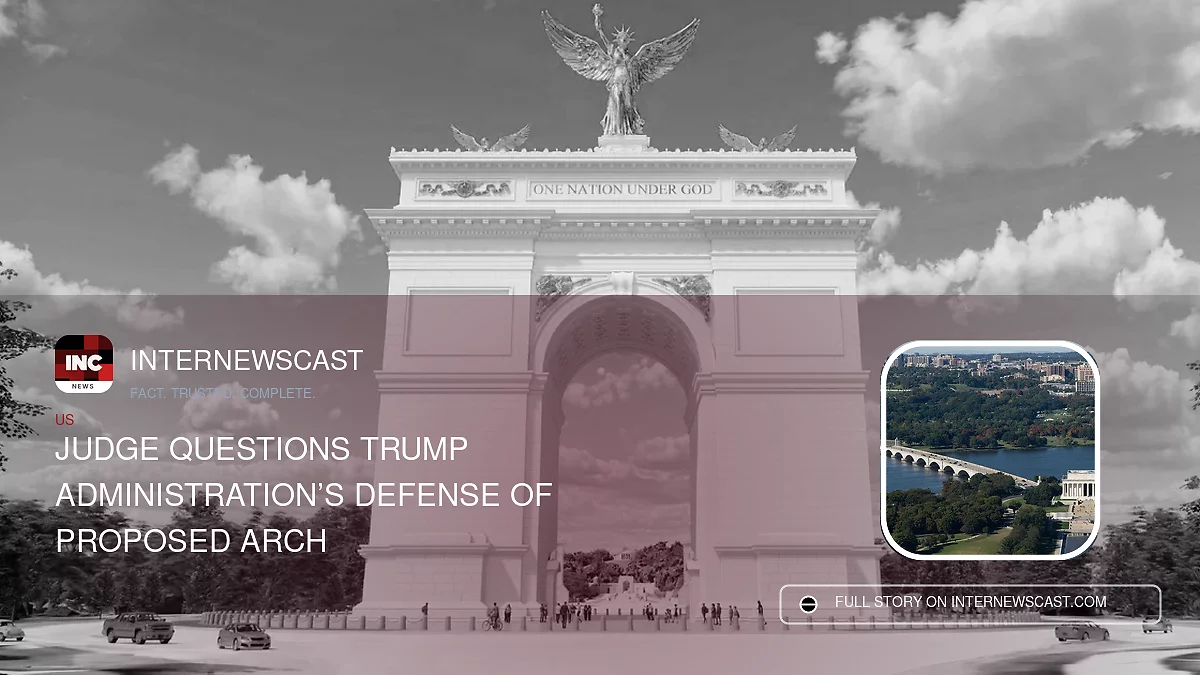

Washington — The Justice Department and a group of Vietnam War veterans clashed Friday in a Washington, D.C., courtroom over the future of a proposed 250-foot arch that President Trump wants to build between Arlington National Cemetery and the Lincoln Memorial.
U.S. District Judge Tanya Chutkan heard arguments on a preliminary injunction that would halt construction of the arch. Attorneys for three Vietnam veterans and a historian, who sued earlier this year to stop the project, argued that the construction process has been rushed and that the plan lacks proper congressional authorization. They also defended their legal standing to bring the case.
Chutkan said at the beginning of the hearing that standing was the central issue she needed to resolve. Earlier this year, the Supreme Court ruled that plaintiffs in a similar lawsuit challenging construction of a White House ballroom likely lacked the legal right to sue.
In court filings, the Justice Department described the plaintiffs’ arguments as “breathless” and urged Chutkan to follow the Supreme Court’s ruling in the White House ballroom case.
Two plaintiffs, Vietnam veterans Michael Lemmon and Shaun Byrnes, told Chutkan that the arch would alter their experience visiting graves at Arlington National Cemetery. They said they would be harmed by the structure’s size and intended purpose.
Lemmon, who appeared by Zoom, said the idea of placing a tourist attraction outside Arlington National Cemetery was “almost blasphemous.” He told the judge that he walks from the Vietnam Veterans Memorial to the Lincoln Memorial and then to Arlington Cemetery, where he visits the graves of people who served in the Vietnam War.
SAUL LOEB /AFP via Getty Images 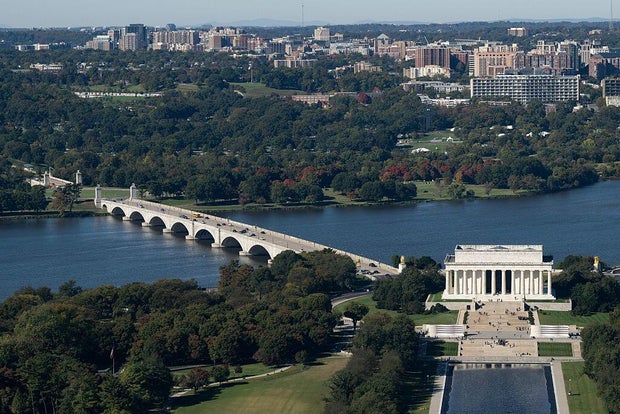
“It means an intense amount to me to be able to continue to do that,” he said, adding that the proposed structure rising over the gravesites would “change the entire experience in a profoundly negative way.”
Byrnes, who attended the hearing in person, said in a declaration submitted to Chutkan that he would reconsider being buried at Arlington if the arch is built.
The challengers also argued that recent renderings show the structure would disrupt the symbolic relationship between the Lincoln Memorial and the Robert E. Lee Memorial. That sightline was deliberately designed to represent national unity after the Civil War, they said.
According to court filings submitted by the Justice Department earlier this month, work on the arch could begin as soon as Nov. 5 if the National Capital Planning Commission grants final approval that day.
Justice Department attorney Robert Stander asked Chutkan to reject the request to halt construction and dismiss the lawsuit. He argued that this case was “easier than the ballroom case” to dismiss because the veterans’ objections stem from a “deep personal disagreement” with the concept of the arch.
Stander called the arch a “high-priority project” for the White House and suggested that the plaintiffs renew their request after construction starts.
NEXT UP: FBI Called In After Shooting at Fairfield Spirit Halloween Store
Chutkan questioned Stander about how the project would be financed, noting that its funding has so far remained unclear.
“I don’t even know who is paying for this thing,” Chutkan said. She later expressed skepticism about allowing construction to begin, asking what harm the government would suffer from a temporary delay “apart from the executive’s desire to bedazzle the city.”
Chutkan also challenged the Trump administration’s claim that the arch has national-security purposes, an argument the government raised for the first time in a filing Wednesday. She cited a declaration from Defense Secretary Pete Hegseth, who said the structure could include sensors, communications equipment and defense capabilities. The government also said the arch could draw between 2,000 and 22,000 visitors each day.
“We’re not talking about plans for a cafeteria,” the judge said.
Mr. Trump said in a Truth Social post in September that he had revised the arch plans to make the structure, in part, a “top grade Military Complex” equipped with snipers and drones.
The Trump administration also submitted sworn declarations from Homeland Security Secretary Markwayne Mullin and Hegseth. Both said the arch could be used by the military and Secret Service to protect the nation’s capital from unmanned drone attacks and other potential threats.
Hegseth wrote in his declaration that the proposed structure represents “a generational national defense opportunity” to prevent future threats.
Stander declined to offer additional details about how the arch would enhance national security, but noted that Mr. Trump has faced several assassination attempts since 2024.
“The arch is somehow intended to prevent assassination attempts against the president?” Chutkan asked. “It’s going to be completed three years from now.”
The Supreme Court allowed construction of the White House ballroom to proceed partly because the Trump administration cited national-security consequences that could result from a pause. But Chutkan said that, in this case, the high court’s reasoning “does not make the mention of national security to be talismanic.”
Critics have also warned that the project could interfere with aircraft flying to and from nearby Ronald Reagan International Airport. Arlington County, which borders the proposed site at a currently vacant traffic circle, filed suit in federal court in Virginia seeking to block the project.
The Federal Aviation Administration concluded that the arch would not endanger flights arriving at or departing from the nearby airport. Arlington County has argued, however, that the structure would require changes to flight paths serving Reagan International Airport and has asked a federal judge in Virginia to order an environmental review.