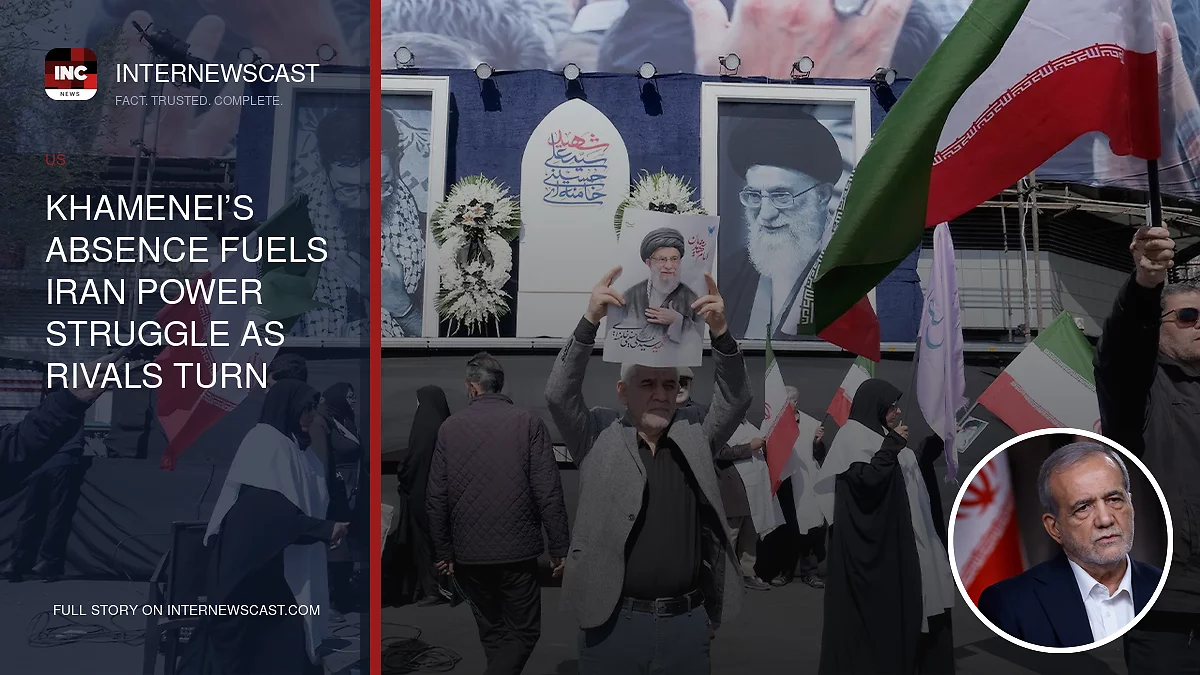

Iran’s competing political camps are increasingly using the name and perceived authority of Supreme Leader Mojtaba Khamenei as a weapon in their internal battles, an Iran analyst says, even as uncertainty remains over how directly he is steering the country’s affairs.
The power struggle came into sharper view through two Iran International reports examining the tense and murky relationship between Iranian President Masoud Pezeshkian and the new supreme leader.
One report cited senior cleric Mohammad-Bagher Kharrazi, who is connected to the Khamenei family through marriage, as claiming that Pezeshkian had threatened to step down more than once and was cautioned that any further resignation attempt would be accepted.
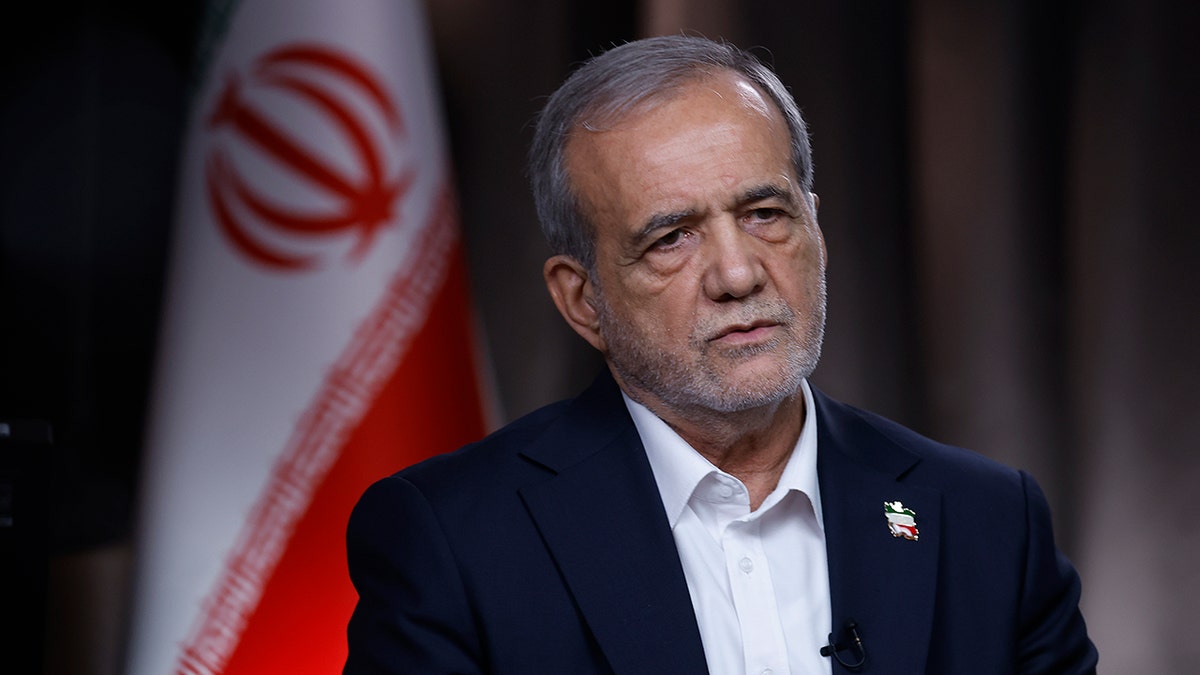
Iranian President Masoud Pezeshkian speaks with Fox News Channel’s Martha MacCallum during an interview on Sept. 25, 2025, in New York City. (John Lamparski/Getty Images)
Kharrazi alleged that Khamenei’s warning to the president was blunt: “If he resigns one more time, I will approve it.”
Pezeshkian’s team forcefully rejected the claim. Mehdi Tabatabaei, the president’s deputy for communications and information, dismissed it as “baseless and an outright lie,” while another adviser said Kharrazi had no access to the supreme leader and had a reputation for sharing “strange stories.”
Later the same day, Iran International released a second account, reporting that Pezeshkian had met Mojtaba Khamenei just one time — and only inside a vehicle with darkened windows at an unspecified location in Tehran.
Citing unnamed sources, the outlet said the brief meeting lasted only a few minutes, that the two men were unable to see one another and that Pezeshkian was not allowed to shake Khamenei’s hand. The report further claimed the president later wondered whether the voice he heard truly belonged to the supreme leader.
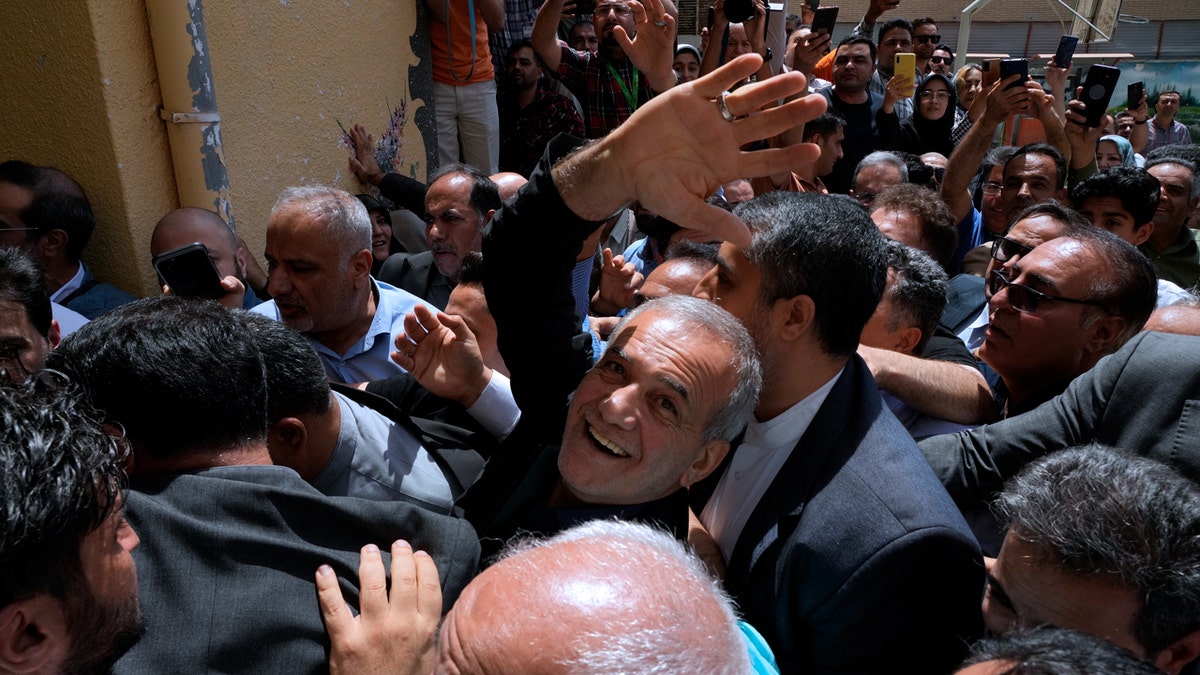
Masoud Pezeshkian, then a presidential candidate, waves as he arrives to vote at a polling station in Shahr-e-Qods near Tehran, Iran, on July 5, 2024. (AP Photo/Vahid Salemi)
The claims have not been independently verified. Pezeshkian previously described a substantially different encounter, saying publicly that he had spent approximately two and a half hours with Khamenei in a cordial atmosphere.
Kasra Aarabi, director of IRGC research at United Against Nuclear Iran, said the competing claims surrounding Pezeshkian and Mojtaba Khamenei reflected a deeper struggle inside what he described as an “Islamist oligarchic mafia system.”
Under Ali Khamenei, Aarabi said, the supreme leader functioned as the system’s “godfather,” arbitrating among rival Islamist factions and guaranteeing their access to power and money. His removal created a vacuum that Mojtaba Khamenei’s appointment was intended to fill, but the new supreme leader’s prolonged public absence has left rival factions uncertain about who is actually in charge.
“The very essence of this mafia system is built on a godfather,” Aarabi said. “If the godfather is absent, whether because he is severely incapacitated or nonexistent, that vacuum… re-emerges between the various Islamist oligarchic clans.”
Aarabi said those factions are not primarily divided by ideology.
“They’re not competing over ideology,” he said. “They’re competing over raw power and economic interests.”
In that environment, Aarabi said, Mojtaba Khamenei’s name has become a political instrument that competing factions can invoke to legitimize themselves, constrain their rivals or justify decisions whose true source remains unclear.
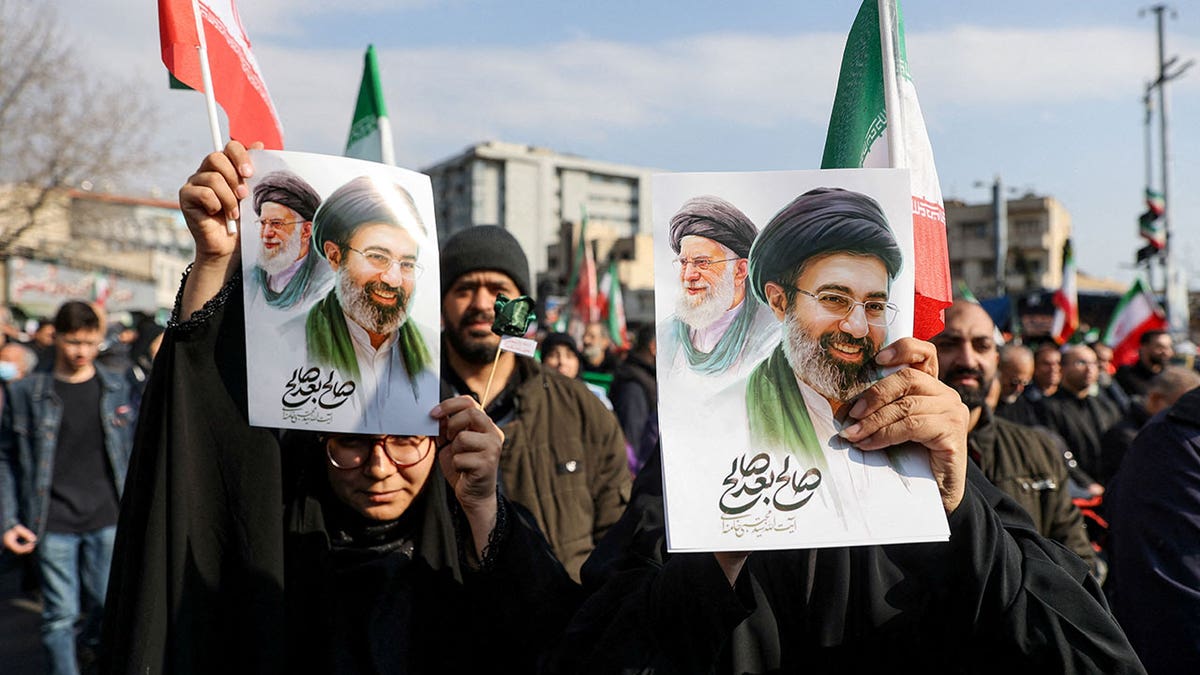
People hold placards with an image of Iran’s new supreme leader, Mojtaba Khamenei, and the late Ayatollah Ali Khamenei, during a rally in Tehran, Iran, March 9, 2026. (Majid Asgaripour/WANA (West Asia News Agency) Via Reuters)
“Mojtaba’s name is the glue that’s holding the system together right now,” Aarabi said. “Each of these clans invokes his name to justify its existence, legitimize its position, and consolidate its place within this fragile system.”
Exiled Iranian journalist Mehdi Ghadimi described the resignation claims as part of a recurring political strategy used by reformist administrations.
“This is a familiar cycle,” Ghadimi said. “Whenever they feel that their usefulness to the supreme leader has come to an end, they start circulating these resignation rumors in an effort to build public sympathy and improve their image before being pushed aside.”
Ghadimi said similar rumors surrounded former presidents Mohammad Khatami and Hassan Rouhani during the final years of their administrations. He argued that reformist-aligned media channels often continue circulating resignation claims even after a president’s office formally denies them, allowing officials later to portray themselves as having challenged the supreme leader.
On Mojtaba Khamenei’s status, Ghadimi went further than Aarabi, saying he did not believe there was “a functioning person by that name who is capable of thinking, making decisions or speaking.”
“Either he is dead, or he is being kept alive in an extremely unstable and severely deteriorated condition,” Ghadimi said.
Aarabi said the two reports illustrate that dynamic. A cleric opposed to or unaligned with Pezeshkian invoked Mojtaba Khamenei’s authority to weaken the president by claiming his next resignation would be accepted, while figures around Pezeshkian pushed back with an account portraying the president as having met directly with the supreme leader.
Mojtaba Khamenei has not appeared in any publicly released video or audio recording since succeeding his father, according to Iran International. Iranian officials have offered conflicting accounts about how often senior government figures have met him.
Aarabi cautioned that using Khamenei’s name as a source of authority will become increasingly difficult if his public absence continues.
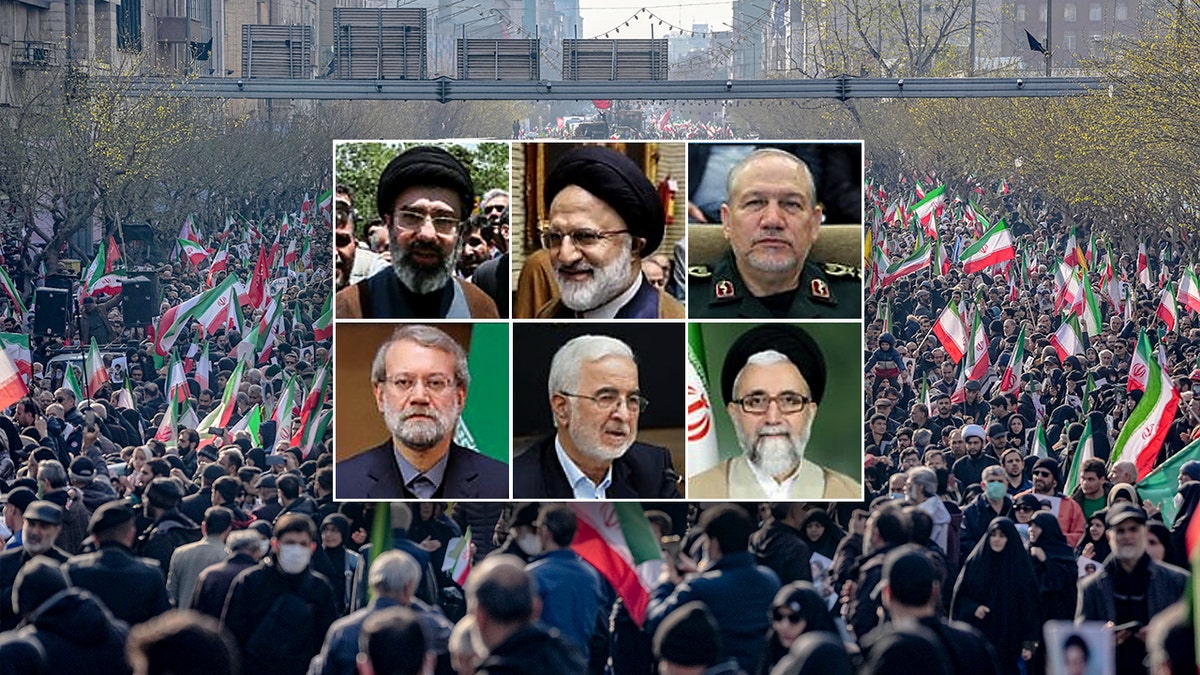
A composite image shows several Iranian leaders named in the State Department’s Rewards for Justice program offering up to $10 million for information on key figures tied to Iran’s Islamic Revolutionary Guard Corps (IRGC), including Mojtaba Khamenei, top left. (State Department/Rewards for Justice; Khoshiran/Middle East Images/AFP via Getty Images)
“There’s only so many times you can use someone’s name without any proof of life that they actually exist,” Aarabi said. “The longer Mojtaba is absent, the more questions develop over whether he is alive or able. And as soon as that doubt increases, you will see this infighting increase.”


